A pair of plays from the United Kingdom theater scene, Godot is a Woman and Strategic Love Play, journey from the Edinburgh Fringe Festival to downtown Charlottesville as part of Live Arts’ Fringe Favorites series.
Fringe theater, which originated as the across-the-pond equivalent of New York’s off-Broadway scene, often consists of experimental and relatively low-cost productions. That’s part of the reason these plays take place within set constraints.
Like the Samuel Beckett play it riffs on, Godot is a Woman is performed mostly on a single set while three people wait for something to happen. Strategic Love Play is a one-set play that takes place within the plot boundaries of a first date.
Godot is a Woman, directed by Mandy Shuker, puts an absurdist spin on the efforts of the estate of the late Beckett to prevent anyone but male thespians from acting in productions of Waiting for Godot.
Unlike the characters in Beckett’s original play—who are waiting through the entirety of the production for the arrival of a man named Godot—the characters in the fringe reimagining are members of a theater troupe waiting for a chance to speak with representatives of Beckett’s estate about loosening casting restrictions.
The wait in Godot is a Woman features dancing, costume changes, Madonna songs, and discussions about the history of gender identity. Shuker says her past experience producing and stage managing in the Edinburgh and New York fringes helped shape how she’s directing the three-person production in Charlottesville.
“One of my favorite things about working in spaces like both the fringe and … the Founders space at Live Arts, is finding ways to be really creative and to drive the action and the message using more actor-driven than set-driven mechanisms,” Shuker says. “I mean, who doesn’t love a chandelier crashing into the floor, or some other big effect? … But I find it really intriguing when someone can take me outside of my own brain and convince me to come into their world for a minute.”
Putting together an actor-driven play is an especially intimate challenge in Godot is a Woman, in which the characters go by the names of the real-life actors.
“This is a version of the three of them up there,” Shuker says. “They’ve created a theater troupe, and they’re doing this thing.”
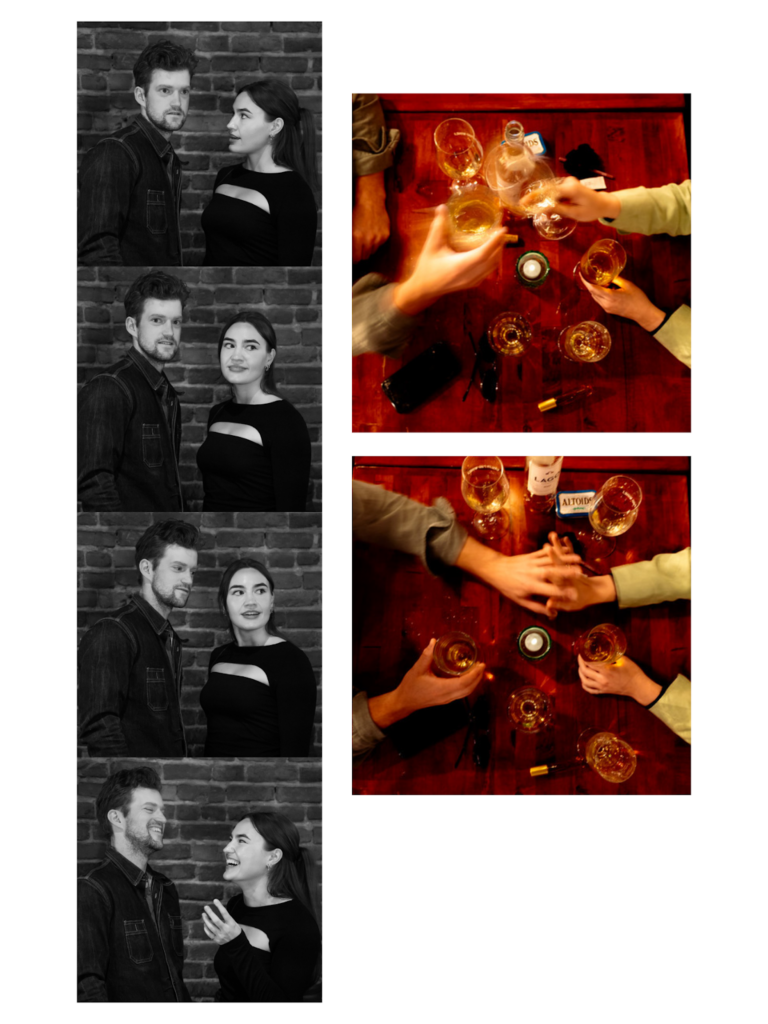
Laura May Brunk works with even less physical space directing Strategic Love Play, in which a man and a woman navigate the uncertainty of a first date after matching online.
Part of the challenge for Brunk is motivating the two actors to drive the story without set changes—armed only with beers and a bag of chips as props—and ignite one another in both positive and negative ways.
“There’s a lot of chemistry, but also argument,” Brunk says. “They’re rubbing up against each other. It’s like a chord that goes wrong. So I had fun playing with, how do you get people on two totally different planes when we’re also working together to make the same thing?”
For Brunk, a Charlottesville native and former Live Arts apprentice who studied theater in England and attended Edinburgh Fringe before returning to her hometown in 2024, building chemistry involved creating a shared playlist featuring everything from Mitski to Geese.
Building tension, on the other hand, meant dreaming up imaginative exercises in a range of stressful situations as far-fetched as being trapped together in a spaceship.
“Those types of things get their creative spirits flowing and push them to make choices that are not necessarily expected or totally within the bounds of what would happen between two people in a bar,” Brunk says. “And I think one of the real gifts of having such a small cast is that you get to really go in with a lot of creativity.”
Theatergoers can purchase a dual-ticket package to attend both plays, and Shuker says the stagings have more similarities than just their singular sets and Edinburgh fringe origins.
“The biggest theme for me that runs through these two plays is: What expectations are preset for us all—by society, based on our gender, the way that we present, [and] all of those factors that are really the outside? And not the meat of who we are,” Shuker says. “And then, how do we respond to them?”
“When you put yourself out there on a first date, what really is the perfect first date and the perfect relationship that you’re looking for? And when you are waiting to get the rights to do a play that you think is the play you’re just dying to do, are we really waiting for the right things?”