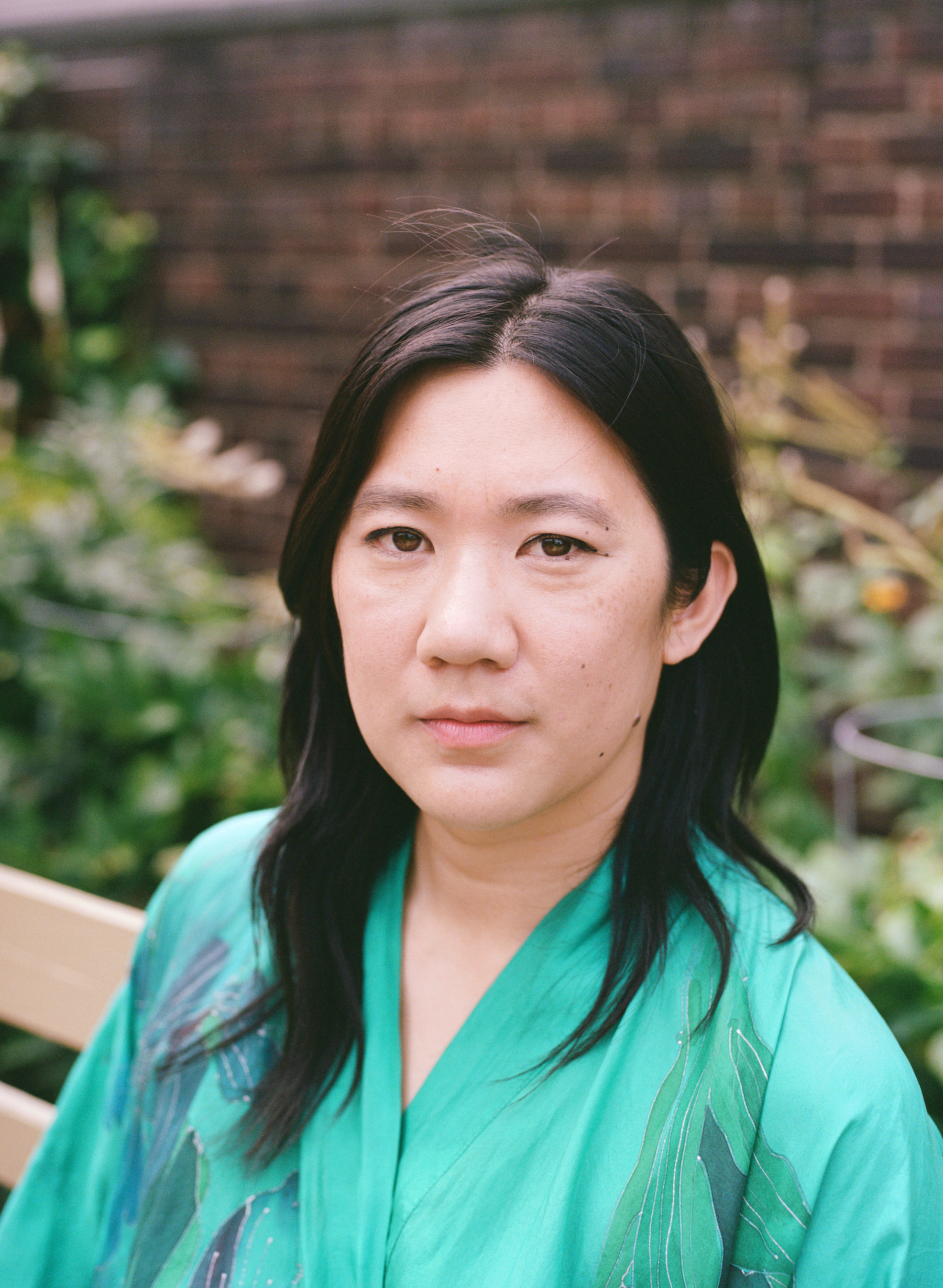
Poet and multimedia artist Diana Khoi Nguyen often explores themes of intergenerational and family trauma through her work, which includes two books of poetry: Ghost Of, which was a finalist for the National Book Award, and most recently, Root Fractures. In both books, photographs play a significant role, including family photos that Nguyen’s brother cut himself out of and which she, in turn, uses to provide textual form and explore questions of perspective and positionality.
Nguyen is a Kundiman fellow and recipient of a National Endowment for the Arts fellowship, and is currently the Rea Visiting Writer at the University of Virginia. She recently discussed her work with us, in advance of her upcoming reading.
C-VILLE: Throughout Root Fractures, and especially in the “Đi Mi” series of poems, you explore themes of war and diaspora. Has your relationship to these poems—and the relationship you hope readers will have with them—changed as the global sociopolitical landscape continues to embrace extreme aspects of fascism and xenophobia?
Nguyen: I’m thinking about the alarming and shifting global atmosphere—as trends are shifting in many places toward nationalism, fascism, and xenophobia. As someone not born in Vietnam, who has limited knowledge of Vietnam, and is that particular breed of tourist in Vietnam … a diasporic Vietnamese person in their parents’ homeland—someone who doesn’t but looks like they might belong. I am not able yet to decipher the complicated layers at work in the Vietnamese government.
What I am aware of is Vietnam’s extreme censorship—free speech is, in effect, strangled. It’s pervasive. Had I been born in Vietnam, I wouldn’t be able to fully express myself. In a way, this censorious culture was perpetuated in my immediate family; it makes sense that I turned to poetry first, instead of prose. As a way to distill, encode my emotional and lived experience.
My relationship with “Đi Mi” remains the same today as it did when I wrote them: They occupy this in-between space of languages, generations, and, in a way, of citizenship. I don’t fully feel at home in the U.S. at times, even though I think of myself as—and am—an American. And I’m not at home anywhere else, either, even if being in Vietnam can feel so deeply familiar.
In Root Fractures, you examine and play with the dynamics of past and anti-past, history and alternate histories. How does poetry feel uniquely capable of engaging with these ideas?
Yes, anti-past! Poetry is ultimately a space of tremendous possibility and potential. The rules of earth’s physics don’t necessarily apply, and besides, I don’t really understand/know physics anyway, despite trying to. In that sense, I can play with time in nearly a material way—to imagine it in impossible ways simply because I wish it, will it—because my grief for the dead is tremendous, my sorrow for the missed opportunities (ongoing) with some loved ones persists. Poetry is inherently speculative, if I want it to be, and I want it to be.
In Root Fractures, you also begin to incorporate Vietnamese language into your work, writing in one poem, “What will happen when I can tell my story in my mother tongue?” Has that shift changed how you conceptualize and create new work?
I think I’m still a little hesitant, nervous to fully lean into thinking and composing in Vietnamese. English comes so quickly to the front lines. But when I’m in Vietnamese communities—in the U.S. or abroad—my mind returns to its native tongue, and surprises me, startles me. Sometimes I have to translate myself to understand what I am thinking. Maybe I should just start there, actually—begin documenting when Vietnamese springs forth, feed it, fuel it, see where it goes.
But to respond to your question more directly, two pivotal moments in my relationship with the Vietnamese language are when I began taking Vietnamese language lessons and when I gave birth for the first time. The two things, taken together, shook me loose from a language amnesia. I became fluid (not necessarily fluent) in domestic Vietnamese and was conversing with my parents in ways I never had before; my vocabulary was limited, but I could feel the syntax and grammar springing forth without much thought. It was so bizarre. As if giving birth brought me back to a moment closer to when I was born, to my first language. This all influences my relationship to language in general. When I read and write in English, I often will trace a kind of ghost-Vietnamese language popping up. It’s so distracting sometimes that I have to stop reading what I’m reading and excavate the interrupting Vietnamese.
What are you working on, now or next?
I’ve been working on these Vietnamese excavations. I call them experimental translations, but those aren’t necessarily the right words. Sometimes I’m peeling back layers of text from a physical page—very literally. And also lifting Vietnamese syllables from a paper on archives—like panning for precious minerals or gems.
I’m also working on a baffling (to me) prose project that documents the ecology of the places where I grew up (in the U.S.) and [where] my parents [grew up] (in Vietnam), and the changes that occur in a family 10 years after suicide. It’s eco-autobiographical, but a ghost story, and also fictional. But also very, very real.