Bertolt Brecht’s The Caucasian Chalk Circle is a full-circle moment for Sara Holdren. “I grew up in the Greenwood/Crozet area outside of Charlottesville, and Live Arts was definitely a huge part of my artistic coming of age,” Holdren says.
She was part of the Live Arts Theater Training Ensemble—“the acronym was LATTE,” Holdren says—and recalls acting in Romeo and Juliet at the old Live Arts Lab Space on East Market Street. She helped christen the current theater on Water Street in 2003 when she appeared in the opening play Rosencrantz & Guildenstern are Dead. These productions were “really formative experiences,” which inspired her to major in theater with a focus on directing.
For Holdren, Live Arts was a family thing: Her mother, Tricia Emlet, is a costume designer for Live Arts and her father, John Holdren, has acted, directed, and done technical work on numerous Live Arts shows. (Both are working on Caucasian Chalk Circle: Emlet is creating the wardrobe, and John Holdren is playing the Grand Duke.)
After getting her bachelor’s degree in theater from Yale University, Holdren returned to Live Arts to perform in Gypsy and to stage her adaptation of Shakespeare’s Henry IV, Parts 1 and 2. “A lot of my peers went straight to New York after being in school, and I kind of had this suspicion that somehow that wasn’t the thing that I needed to do,” Holdren says. “I had this feeling that if I went to New York, I would kind of end up working in a restaurant and getting to do very small things. What I wanted to do was big, hard plays.”
Holdren has done much more than that in the past 10 or so years. After returning to Yale, where she now teaches directing classes, to get her MFA in directing, Holdren became the theater critic for New York magazine’s entertainment news site, Vulture.
“Her work in New York magazine is the only reason that I have a subscription,” says John Gibson, Live Arts’ first artistic director. “They do a fine job with a lot of things, but I tune in just so I can read what she’s thinking, because to step inside her mind is to join in the process of a passionate and rigorous view of the form by someone who is both a gifted practitioner and a deeply astute observer.”
Holdren was a 2025 Pulitzer Prize finalist for criticism. Her reviews don’t pull any punches. “In a moment when so much theater puts on kid gloves to handle its material and its audience, it can be bracing to have a play walk right up and slap you across the face,” she wrote about Becky Shaw earlier this year. “It’s a play of barbed wire and paper cuts, with salt ready for every nick and slice.”
After seeing the destined-to-flop musical The Queen of Versailles, Holdren dished out some salt of her own: “There is a two-hour-and-40-minute luxury-car crash happening at the St. James Theatre. … If you’re morbidly curious about the experience, you could try for tickets to the new musical by Stephen Schwartz and Lindsey Ferrentino, with Kristin Chenoweth glittering relentlessly at its center. Or you could save the money and have someone slap you back and forth with a large salmon.”
But long before she wrote about shows, Holdren helped create them. She says the foundation for her career came from spending three years at Live Arts in a variety of roles. Gibson vividly recalls Holdren’s early time there.
“She began working at Live Arts as a teenager, first as an actress—and a really good one,” Gibson says. “Then she became more deeply interested in how theater’s made. And so, she became a director, and a fine one. But she also worked on our staff as our marketing director, designed graphics and posters, and did an impeccable job. … I’ve been working with Sara for over 20 years in just about every capacity, in every type of collaboration, and she never fails to astonish.”
Gibson and Holdren got a chance to work together again in 2024 when he directed his adaptation of The Wizard of Oz, and Holdren served as dramaturg.
Now it’s Holdren who is in the director’s chair. She credits Liz Diamond, chair of directing at Yale’s David Geffen School of Drama, for her adoration of Brecht. “I don’t think I had a real sort of deep connection to his work and an embrace of the ethos until Liz really had us dive into it. And, ever since then, I’ve been really hungry to do a Brecht play.”
The Live Arts production will mark the first time Holdren has directed a Brecht work outside of the classroom.
“Frankly, I don’t understand why there isn’t more Brecht happening in the world right now,” Holdren says. “It feels so vital and so funny, and prescient, and sad. He’s writing in this moment of fascism, writing in the world of Nazi Germany, writing in the world of World War II, and having to escape Europe, and he has such a deep and satirical understanding of these sorts of currents of corruption and cruelty in the world. But he also maintains a big heart, right?”
Written in 1944 and first performed in 1948, the play is drawn from a 14th-century Chinese play (The Chalk Circle), mixed with the Biblical story of Solomon. The Live Arts script was translated by English-American scholar/critic/playwright Eric Bentley and features an original score by University of Virginia saxophone instructor Colin Killalea, who is also a member of Vampire Weekend.
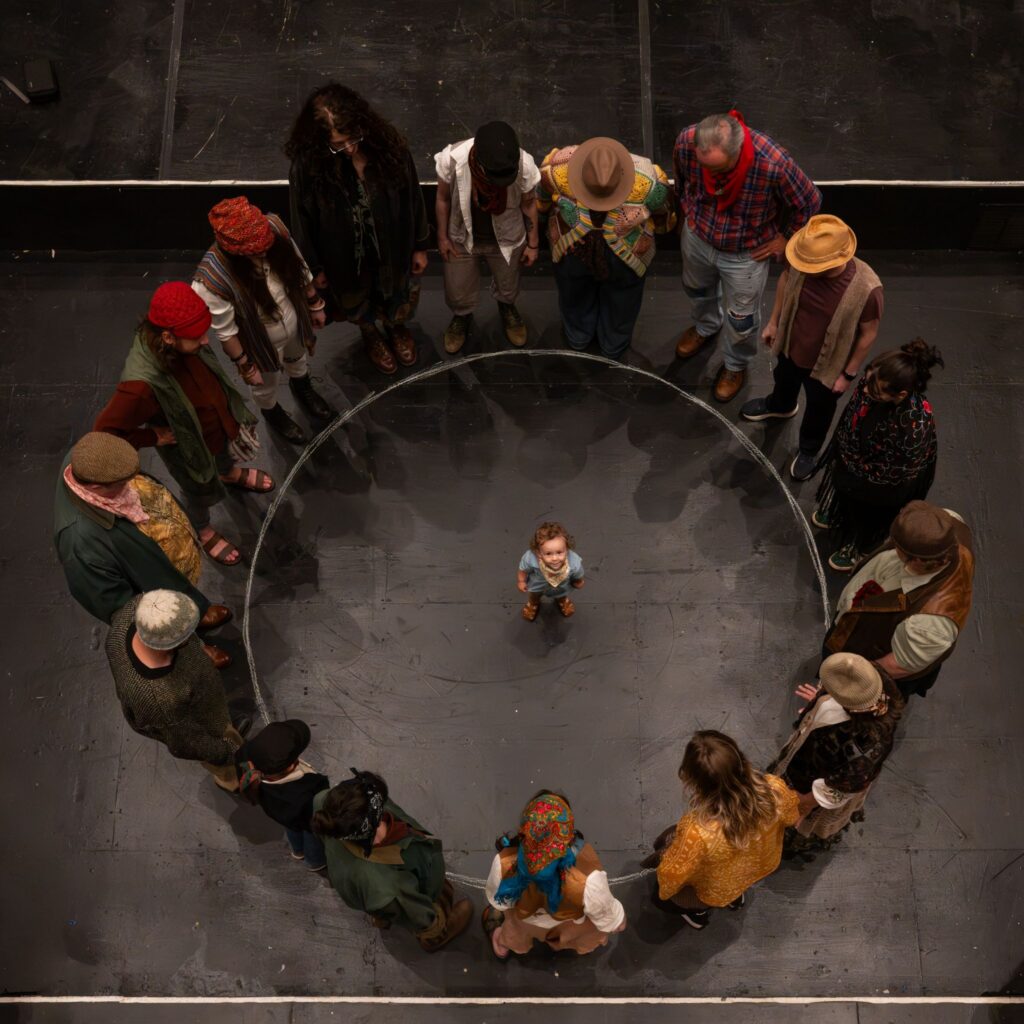
During an overthrow of the government, Natella (Haydn Haring), the wealthy wife of the city governor, flees the violence, accidentally abandoning her baby along the way. Grusha (Bella Hersman), a servant, saves the child. Two years later, Grusha gets an unpleasant surprise when Natella resurfaces and demands the return of the baby. The matter goes to court where the judge, Azdak (Andrew Akre), devises a clever test to decide who is the real mother.
The material strikes a very personal chord for Holdren, who became a mother 14 months ago. “My partner and I are on our parenthood journey, you know, and it also was really appealing to do this,” Holdren says. “To think about motherhood and to do this story that has this child at the middle of it.”
She’s particularly touched by the scene in which Grusha rescues the baby while her fellow servants warn her against it. “She’s sort of standing there in the middle of all this violence, being like, ‘What do I do?’ And these other servants are like, ‘Don’t!,’ ‘Put it down!,’ ‘Leave it!’ ‘He’s not your responsibility!,’ ‘Get out of here!’ And one of them says, ‘I’m telling you, if he had the plague, he couldn’t be more dangerous.’ And she’s like, ‘He doesn’t have the plague. He looks at me. He’s human.’
“And I just love that little line—‘He’s human’—because in a way, that’s so much of what’s happening in the play. … This is a human being. And really, that’s sort of like a microcosm for what I think Brecht is trying to do overall.”
Holdren thinks Brecht is reminding us that the vicious acts we commit stem from depersonalization: “We’re only able to do these things by convincing ourselves, in some part of our souls, that the people that we’re doing them to aren’t human, right?…
“One of the really beautiful things that exists at the middle of Brecht is this sort of really collectivist kind of belief in, if we could all just slow down and see each other’s humanity. You know, maybe there would be much less cruelty in the world.”
On a mission
Live Arts veteran Adrienne Oliver takes over as executive artistic director
Jacobson Oliver grew up on the Live Arts stage, first as an actress, then as a director, producer, and teaching artist. Now, she’ll lead the 37-year-old organization as its first executive artistic director.
Oliver’s family moved to the Charlottesville area in 1998, and she attended her first Live Arts play soon afterward.
“I was very bound and determined at the time to spend my life on stage, which has evolved for me,” Oliver says.
She acted in her first Live Arts show at the age of 14, then went on to train at the American Academy of Dramatic Arts, study film and media at the University of Virginia, and earn an MFA in studio art from the School of the Art Institute of Chicago. She also worked as an instructional specialist with Albemarle County Public Schools for eight years.
In 2022 Oliver was named Live Arts’ director of new works, overseeing three seasons of Waterworks, an annual festival that produces dozens of plays from around the world. Currently, Oliver is producing the musical Come from Away, which opens October 23 at Live Arts.
Oliver’s appointment “comes at a critical time for the organization, as it rallies to meet the challenging post-pandemic demands of creating theater with diminishing resources and a need to rebuild audiences,” said Live Arts Board President Miller Murray Susen in a press statement. “The Board has total faith that Adrienne is the leader to meet this moment.”
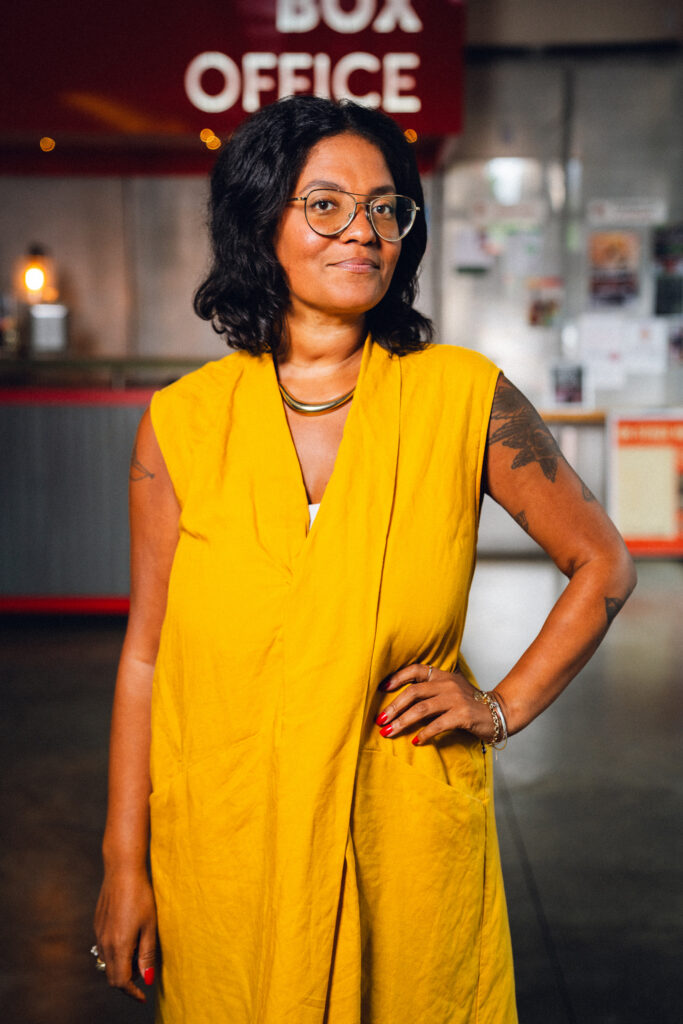
Although Oliver admits theater faces plenty of challenges in the post-pandemic landscape, she says the situation is not a new one. “The arts, theater, and nonprofit sectors are experiencing shared struggles, challenges, barriers across the nation—probably globally,” Oliver says. “We can point to the past six years as a part of that. But we can also say that these are industries that have always experienced struggles and have been fraught in some kind of ways: under-supported and these sorts of things. … Our problems may be common, but I believe that solutions are local.”
One of Oliver’s priorities in her new role is community outreach and increased inclusivity.
“I’m very excited about building and stoking even more community partnerships, both downtown and across the community. We’re working together to serve our people.”
It’s important to her that Live Arts is seen as a welcoming place.
“The work of building that community: It’s our mission,” she says. “… If you are someone who feels connected to Live Arts, or someone who has been connected to Live Arts, if you’re a person who’s returning again, or you have this fond memory, you carry that energy of forging theater and community with you. …This is a theater. This is a space. This is a community that we make together.”
Oliver will also spearhead programming the remainder of Live Arts’ 2026-2027 season. The Caucasian Chalk Circle by Bertolt Brecht opens September 4, followed by Come from Away, and an original adaptation of Charles Dickens’ A Christmas Carol by Daniel Kunkle and Susen on December 10. The second half of the schedule has yet to be announced. Live Arts’ seasons traditionally have an overarching theme, and Oliver intends to maintain that concept.
“A sort of driving question, in my view, has always been regarding anything that we program: But why?” Oliver says. “Why here and why right now?”
The goal is finding “a larger conversation happening between titles,” says Oliver. “My approach is going to be to come in and really think about the shared question or inquiry that the three shows already programmed are asking and to extend from there.”