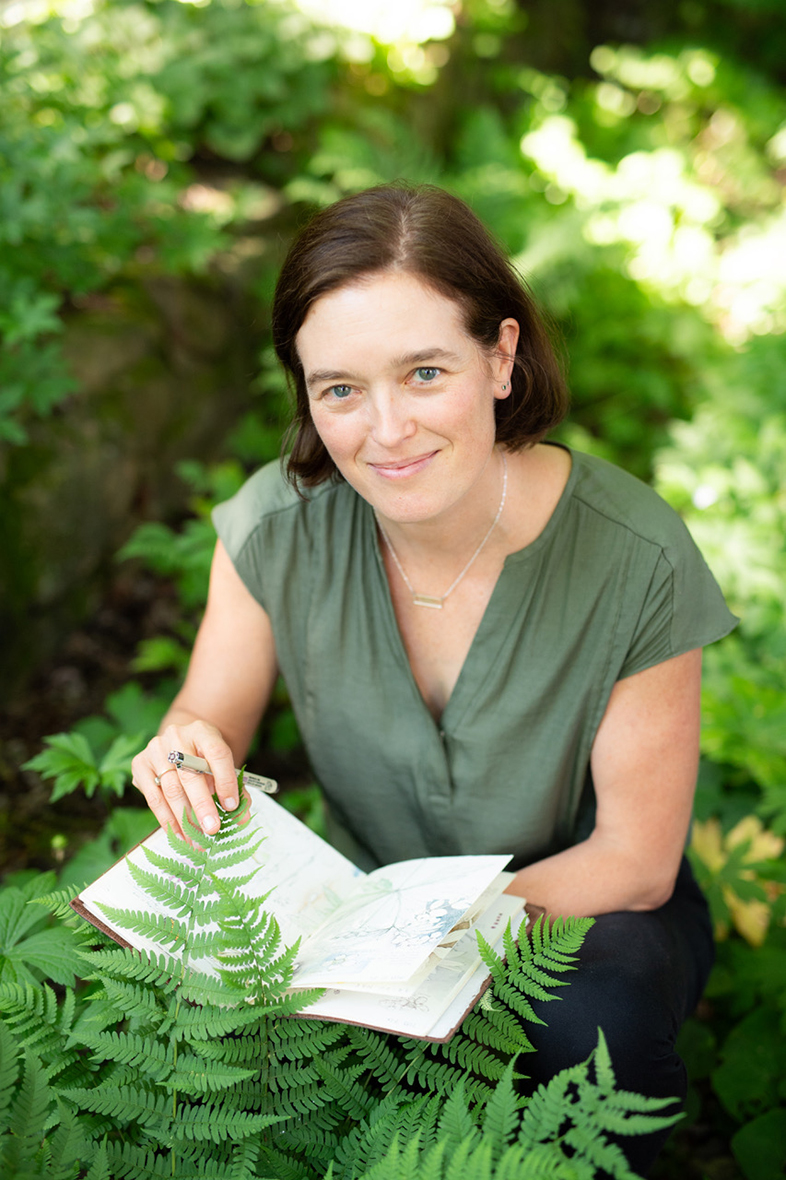
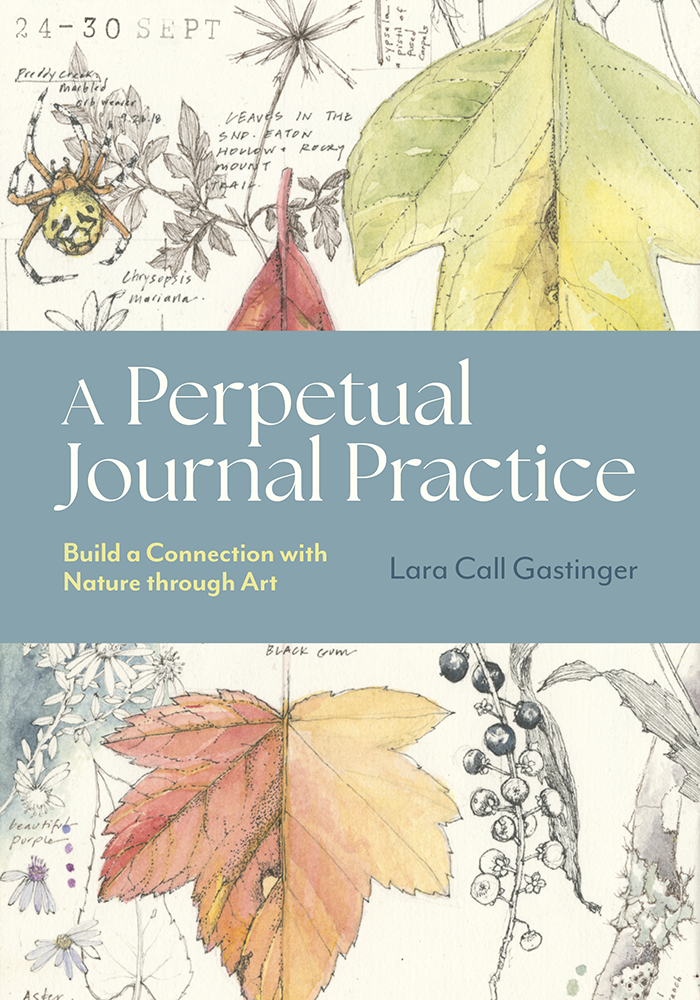
As an artist and botanical illustrator, Lara Call Gastinger’s work reflects our local environment, detailing native plants near her Charlottesville home and in the nearby mountains. She was the chief illustrator for the Flora of Virginia Project, a botanical reference book and app cataloging the rich biodiversity of our Commonwealth, and she is also widely known for her perpetual journals, which detail the natural world across all four seasons and over multiple years. Her new book, A Perpetual Journal Practice: Building a Connection with Nature through Art, is an accessible and inspirational guide for those interested in starting their own.
Perpetual journals are intended to be an inviting and forgiving method for artists but also gardeners, hikers, and anyone else interested in native plants. There’s no need to already know the names of the plants one observes or to be skilled at drawing or illustration.
The framework for the perpetual journal is elegantly simple: Set up a blank book so that each two-page spread is dedicated to a week in the year, then make one entry per week and return year after year to add more observations. Each entry can be a simple written observation, a drawing of something in the natural world, or a more intricate rendering, depending on the person doing the journaling. “Over time, the spreads became layered … built up slowly and incrementally over the years,” writes Gastinger, reflecting on her own experience of perpetual journaling. “Some drawings were simple, some were very detailed or in full color.”
Gastinger assuages common fears that keep people from drawing by sharing examples of her own learning process and stressing that the quality of art created is less important than the curiosity and openness to learning that is inherent to the practice. “You can always just write notes or do little stick drawings of little flowers,” instructs Gastinger. “It can start really basic.” The process is one of developing skills as a naturalist and an artist—either as a beginner or with an eye toward honing specific knowledge areas or techniques.
“The world feels hopeful when a small community is created through a shared passion like that of the perpetual journal.” Lara Call Gastinger
The idea started in 2001, inspired by a project Gastinger completed with a local couple who hired her to create an illustrated journal of the changing seasons on their property. “That was such a rewarding experience,” she says. “I wanted to embody it into a regular practice that wasn’t hard to maintain. This is a format that’s set up in bite-size drawings on a weekly basis, which works well. … Once you set up the book and the dates, it’s okay if you miss a week or a month or even a year because you will go back one day.”
She adds, “Right now, there’s a lot of interest in nature sketching … just being out in nature and getting away from your screens—I think all of this is really good. But you can’t just draw. … You have to have a format and a structure or else it’s not going to proceed. This perpetual journal practice helps instill that, with a little bit of a framework.”
The pages of the book detail this framework alongside advice on specific drawing techniques, tips on maintaining the pace, and recommendations for selecting a journal, pens, watercolors and brushes, and other supplies, including snacks. The book also features Gastinger’s precise and lush illustrations, including one of her journals that is reproduced in full for the reader to page through and reference.
Gastinger highlights others’ work as well, featuring excerpts from journalers around the world who she connected with on social media. She started hosting live drawing sessions on Instagram, where viewers could see her artwork come to life on the page, early in the COVID-19 pandemic. Six years later, she continues to maintain a schedule of weekly sessions—monthly in the summer—which attract between 100 and 200 viewers on average. These drawing sessions are interactive, offering participants the chance to chime in with what they’ve been adding to their perpetual journals, representing different regions, seasons, and types of native plants. “The world feels hopeful when a small community is created through a shared passion like that of the perpetual journal,” writes Gastinger.
In the book, Gastinger also addresses how perpetual journaling can provide insights into the impacts of the climate crisis, globally and locally, describing changes that she’s noticed through her own journals. She reflects, “It becomes a record. It’s exciting. But climate change has changed it dramatically. Things are two to three weeks earlier than when I started. It just makes you feel like the climate crisis is happening here, everywhere. Everyone is being impacted.”
Addressing widespread plant blindness, in which many people don’t know the flora and fauna they live alongside, Gastinger suggests that noticing is a way to motivate steps to address these impacts of climate change in our own region. “Directing your focus toward finding something new each week will open your eyes to overlooked things in nature. … Being curious, asking questions, describing details, and wondering are the first steps.”