A new sporting event debuted over the summer, a form of mental gymnastics in which the less you “know,” the better you do.
At the inaugural Psi Games in early August, “perceptualists” competed in trials of mindsight, remote viewing, precognition, psychokinesis, and dowsing. On game day, 19 perceptualists—percepts for short—huddled in a corner of the Jefferson Ballroom in the Omni Charlottesville Hotel. In the audience sat ESP hobbyists, consciousness researchers, energy healers, and UFO enthusiasts.
Psi is an umbrella term for parapsychological mental phenomena. Event producers say a “psychic Olympics” will do what decades of controlled laboratory studies have not: convince the public that mindsight (extraocular vision), remote viewing (non-local perception), and precognition (future insight) are real, measurable, and widely attainable.
“We have a lot of people doing really awesome things in the lab,” said Psi Games founder Hakim Isler as he kicked off the event. “But how do we make that real for everybody?” Isler says the Games will harness play to boost performance in ways restrictive lab experiments cannot.
A panel of judges flanked the right side of the stage, with Games commentators on the left. Before each trial, a purple AI avatar, “Veda,” appeared on screens to relay instructions and encourage players to believe in their abilities to transcend time and space.
Seeing without eyes
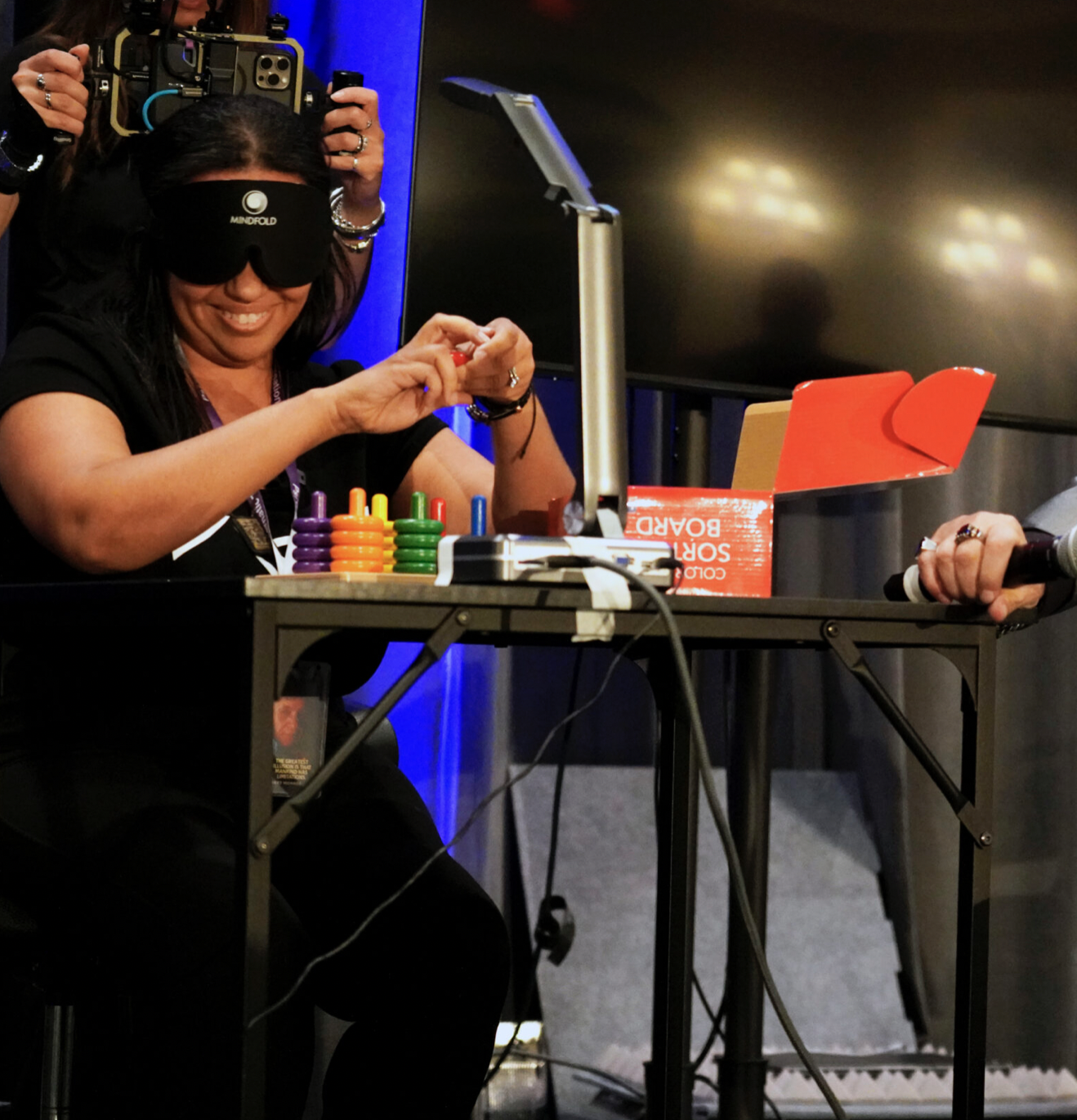
Notable feats came from Dalia Burgoin and her daughter Lidu, whose mindsight and telepathy demonstrations evoked gasps from the audience. The two-part mindsight event tested participants’ ability to see blindfolded. Participants wore blackout eye masks and were tasked with placing 24 colored rings onto six posts of the same colors in under five minutes.
Initial results were underwhelming. One competitor matched two out of 24 rings, two others matched three and a third got five. Two engineers in the front row whipped out their phones to calculate what results chance alone would be expected to produce (four). In a tie-breaker, Ryan Desbien, a social worker and motorbike racer from Colorado, matched eight out of 24 rings. He wiped away tears. “I just wanted to show my family that it is real,” he said.
His feat was soon eclipsed by Utah resident Dalia Burgoin, who matched all 24 rings in under a minute. The crowd was on its feet. The Games emcee lay down on the stage. “This is one of the moments where, before the first person ever broke the four-minute mile, no one thought it could be done,” said commentator and manifestation expert Amy Westmoreland.
Burgoin, an energy healer, said she was initially worried her “windows,” which allow her to see without eyes, wouldn’t open. “Basically, we have these openings all over where you can see as if it is in real time,” Burgoin said. Mindsight, or non-ocular vision, is a natural ability that can be honed with practice, says Rob Freeman, Burgoin’s coach and founder of Vision Without Eyes. Freeman suggests the training helps to quiet the “bullying” analytical left brain, activating right brain intuitive perception.
Reports of non-ocular vision have circulated for decades and across cultures. David del Rosario of the Institute of Advanced Neuroscience of Barcelona presented results of a non-ocular vision pilot study at The Science of Consciousness Conference in July. The experiment was designed, said del Rosario, to address criticism of extraocular vision by the scientific community: inadequate blindfolds, subtle cuing by facilitators, and the lack of peer-reviewed research. In the color identification trials presented at the conference, blindfolded children trained in “extraocular vision” identified colored cards at rates higher than chance. The pilot study’s positive results suggest further research is warranted, said del Rosario.
To counter critiques of “nose-peeking,” or seeing through an opening in the eye mask, percept Burgoin says she has used three layers of blindfolding: an eye mask, eye tape, and pirate-style patches. The second mindsight trial tested distance. Isler stood eight feet away, holding a square of colored poster board. After each correct answer, he stepped back in four-foot increments. Burgoin correctly identified every color—even when Isler reached the far end of the ballroom and, in a twist, raised two boards at once. “Every one of us can do this,” Burgoin said. “We just don’t think we can.”
Mind to mind communication
Mindsight panel judge Dr. Diane Hennacy Powell, a neuropsychiatrist involved in research with the Burgoins, claims that psychic abilities are more common in prodigies, autistic savants, and individuals with certain brain injuries. Powell’s work was featured in “The Telepathy Tapes,” a popular 2024 podcast that drew criticism for using the methodology Spelling 2 Communicate. In the series, mothers of nonverbal autistic children hold letter boards while the children point to spell out answers. This led some to suggest mothers were subconsciously cueing their children.
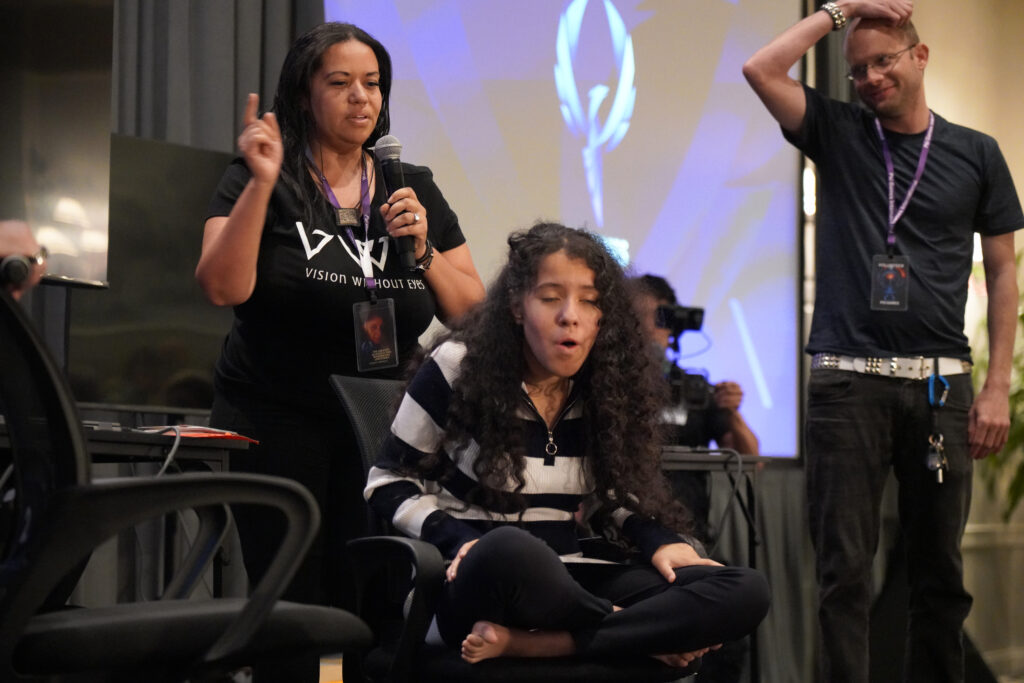
Burgoin addressed the critiques during two telepathy demonstrations with her 14-year-old nonverbal autistic daughter, Lidu. Burgoin says her daughter needs a spelling board and assistance due to sensory motor issues. Lidu’s first challenge was to use telepathy to identify a card randomly selected from an illustrated deck of motivational messages, while the second was to answer a question posed by an audience member.
Burgoin placed a transparent letter board in front of her, adding she would “hold it very still.” Lidu pointed and Burgoin said the letter “f.” Then Lidu began naming the letters on her own, slowly spelling out an accurate description of the card’s illustration, “fish on water.” She smiled and then plugged her ears before the crowd applauded. There were perceptible movements of the letterboard as Lidu spelled, hovering over various letters before selecting one. However, at times she quickly moved from one letter to the next or rapidly moved across the board, which could make it harder to attribute the movement to a subtle nudge by her mother.
Powell says an ideal telepathy protocol would be for children to type answers themselves in different rooms than their communication partners. For future research, she says she will try to use children with more than one communication partner where one can be the telepathic “sender,” while the one working directly with the child wouldn’t know the target.
According to a May 2025 Gallup Poll, “Paranormal Phenomena Met With Skepticism in U.S.,” 29 percent of U.S. adults believed in telepathy, and 21 percent were unsure. As for clairvoyance, or “the power of the mind to know the past and predict the future,” 26 percent believed in it and 23 percent were unsure.
Laboratory experiments on telepathy date back to the research of J.B. Rhine at Duke University in the 1930s, and dream telepathy research at Maimonides Medical Center in the 1960s and 1970s. They continue today with “telephone telepathy” tests and Ganzfeld studies. The telephone experiments test whether the common experience of “knowing” who is calling is a case of telepathy. In the Ganzfeld, sensory input is minimized to induce a state thought to enhance psi abilities, a stark contrast to the Psi Games, where the audience was encouraged to cheer loudly.
This is the point, explains the Psi Games founder Isler, a remote viewer and mind sight practitioner who describes himself as the Black MacGyver, is also a survivalist who appeared on Discovery Channel’s “Naked and Afraid.” He says Ingo Swann, one of the creators of remote viewing protocols, believed one should be able to perform psi in a foxhole. “Anytime, anywhere, you should be able to use these talents—these skills—because they’re part of you,” he said.
Remote viewing: psychoenergetic perception
According to the International Remote Viewers Association, “Remote viewing is a mental faculty that allows a perceiver (a viewer) to describe or give details about a target that is inaccessible to normal senses due to distance, time, or shielding.” The U.S. government revealed in 1995 that it spent decades testing the usefulness of remote viewing as an intuitive intelligence-gathering tool in its Star Gate program. A Department of Defense manual, Coordinate Remote Viewing (1986), describes it as “a method of psychoenergetic perception.”
Public interest in remote viewing has grown since, with a proliferation of training programs and protocols, many of which were developed by original Star Gate researchers like Paul Smith and Dale Graff, who spoke at the Psi Games. RV practitioners discuss their sessions and techniques on forums such as Reddit’s r/remoteviewing.
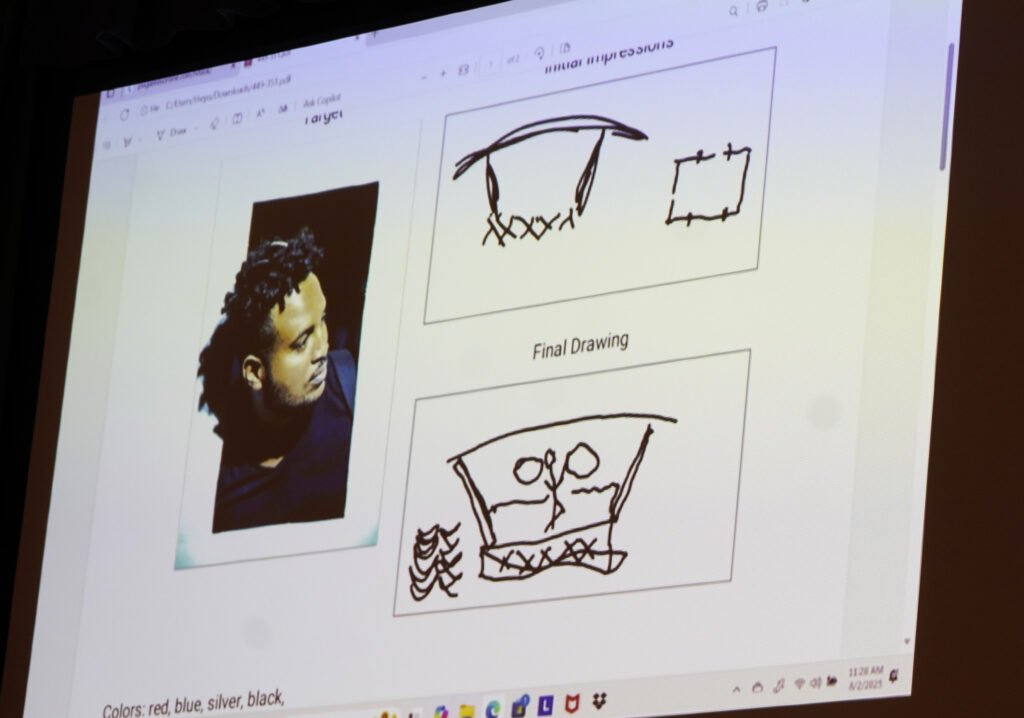
In the remote viewing trials, participants sat in psi pods, desks shrouded in foam. Their task: Describe unknown photos randomly selected by AI. Participants first created a rough sketch of the image, then described its colors, shapes, and lines, and finally produced a complete drawing. An AI judge and a panel of seasoned remote viewers evaluated the results.
The first round was challenging as some targets were difficult to decipher even after they were unveiled. The target of the first and winning effort, by Australian chiropractor Tony Mustac, was a photo of a multicolored glass ensemble that resembled a luminous underwater garden in the style of Dale Chihuly.
The audience groaned when it was revealed. “What the heck is that?” asked panel judge Paul Smith, a retired Army major and author of The Essential Guide to Remote Viewing: The Secret Military Remote Perception Skill Anyone Can Learn. Mustac sketched a vase with what appeared to be stick flowers, among other doodles. His initial impressions were “Fun! Mischief! Feels like a roller coaster but not” and “Wohoo! [sic]”
The judges decided this did convey the whimsy of the glass shapes.
Commentator and illusionist Chris Ramsay said the initial drawing, also called an ideogram, can be the most accurate. “That one’s the most crucial because that’s before you’ve done your analytical overlay,” Ramsay said. The term for this in remote viewing is AOL. Remote viewing protocols suggest using adjectives rather than nouns. “You don’t want to name things because that is left brain,” said RV commentator Alan Steinfeld, host of the YouTube series “New Realities.”
Controlled precognition
In the precognition event, percepts were shown a series of numbers, one of which was linked to a hidden image, and they had to predict which one concealed the target. Oklahoma percept David Tran won the challenge, finishing well ahead of the others and prompting the emcee to press him for lottery numbers. Tran, who works in data analytics, said he’d long known of his psi abilities but believes they are untapped and unstructured. “I want to get engaged with our community and learn more about myself and the special gift that we’re sort of developing as a species,” he said.
Precognition functions as a survival instinct, warning of possible danger, said Games commentator Jordan Crowder, a TikTok creator. This task, he said, asks percepts to invoke that instinct intentionally. “If you can kind of see into the future a little bit, imagine how that could change your life,” he said.