Updated September 28, 2026: Amid a civil rights investigation by the Virginia Attorney General’s office into its traffic stop practices, newly updated data from the Greene County Sheriff’s Office shows that deputies there pulled over even more Latino drivers than previously disclosed.
Nearly 25 percent of the drivers the office stopped in June 2026 were Latino, compared to the 17 percent the sheriff’s office originally reported. On June 23, during one of the largest of the sheriff’s office’s ongoing immigration raids with U.S. Immigration and Customs Enforcement, 43 of the 73 stops it made—58.9 percent—involved Latino drivers. Census data shows that Latinos represent just 12 percent of Virginia’s population.
GCSO initially failed to report at least 41 stops it made in June 2026 to the Virginia State Police, as state law requires. In late September, it updated VSP’s public database with 40 of those stops from June 23, days after C-VILLE asked the office why they were missing. One stop from that day listed in the department’s internal call logs remains unreported.
The sheriff’s office says that even during immigration raids, it’s pulling over drivers solely for traffic enforcement purposes. Virginia law forbids law enforcement from stopping drivers based on their perceived race or ethnicity. The data GCSO should have reported to VSP in June logs each stopped driver’s ethnicity, among other factors, to determine how well it and other agencies are obeying that law.
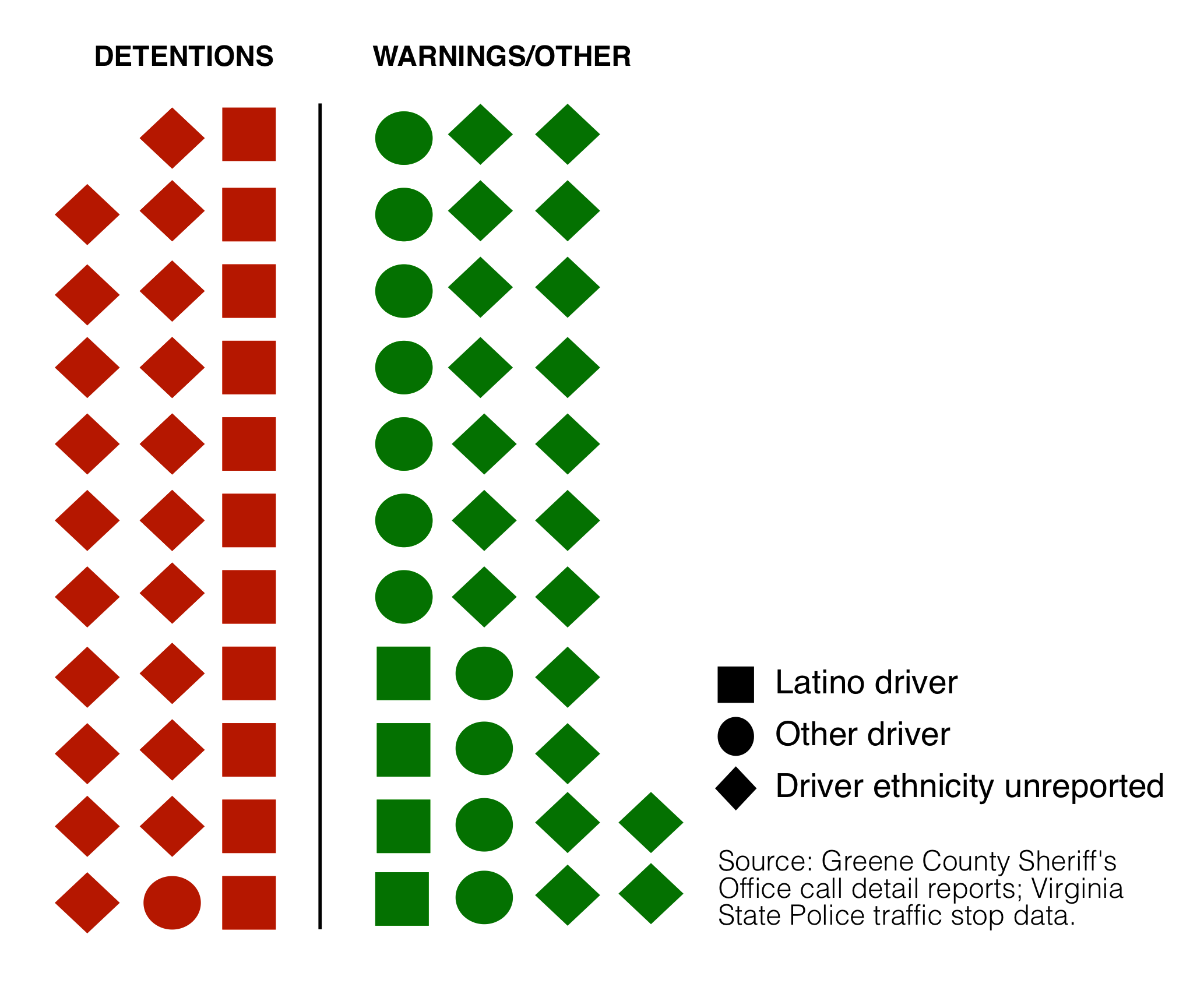
Of the previously unreported calls from June 23, roughly two-thirds involve Latino drivers. Twenty of those 28 calls end with one or more people in the vehicle detained. The youngest driver detained, per VSP data, was 17.
Six of the other eight stops involving Latino motorists ended in warnings, including one in which call logs say a deputy initially detained one person and summoned the sheriff’s detainee transport van. The deputy released the person eight minutes later; the van never reached the scene.
VSP lists one further stop as “no enforcement action taken,” with no descriptive details in call logs. Another stop, which remains unreported in VSP data, involved deputies’ unsuccessful pursuit of a driver they attempted to detain; he fled into the woods and escaped.
VSP’s data entry guidelines suggest that the office should have reported this stop.
Only one non-Latino driver among the previously unreported stops did not receive a warning. Per VSP data, deputies arrested a 31-year-old white male on DUI charges in the day’s last recorded stop.
On September 9, C-VILLE asked the Greene County Sheriff’s Office about the missing traffic stops. The office never responded. But on September 12, emails obtained via FOIA show the sheriff’s office’s records specialist emailing VSP to ask about submitting stops “that were forgotten to be entered.”
“We do try our best to have all information entered and completed by the due date, unfortunately it didn’t happen this time,” the specialist writes, adding, “[W]hat does that mean for our office if they are late?” Virginia law does not specify penalties for agencies that fail to properly report traffic stops.
The same specialist previously emailed VSP July 20 to update two clerical errors in June’s data. It’s not clear why the sheriff’s office found those mistakes then, but failed to notice the 41 unreported stops until early September.
Original story follows:
The Greene County Sheriff’s Office did not report dozens of traffic stops it made during its June 23 immigration raids to a public statewide database, in apparent violation of state law.
In data it sent to the Virginia State Police, the sheriff’s office detailed 27 traffic stops between 4:50am and 1:30pm that day, out of 32 in all.
But the sheriff’s internal call detail reports, obtained through a Freedom of Information Act request and shared with C-VILLE, reveal that deputies actually pulled over 67 drivers during that period. Across those 40 missing stops, call logs show that deputies and U.S. Immigration and Customs Enforcement agents detained at least 33 people.
It’s not clear whether the sheriff’s office even collected data on these encounters, as Virginia law requires. The sheriff’s office is fighting a civil rights investigation by the Virginia attorney general into whether it illegally used ethnic bias when deciding which drivers to stop. Without the missing data, we cannot know how many Latino drivers Greene deputies pulled over on June 23.
Under the Community Policing Act of 2020, Virginia police officers and sheriff’s deputies must gather specific information, including the driver’s race and ethnicity, every time they stop a vehicle for traffic violations or other crimes. The act bars law enforcement from stopping drivers based on “perceived ethnicity,” among other biases. Agencies must collect and submit stop data to the state police to help measure whether they’re obeying that law.
By matching unique ID numbers on each call report to identical numbers in VSP data, C-VILLE determined which calls were missing from VSP’s database. The call reports list deputies and units at each stop, arrival and departure times, and messages between dispatchers and deputies, often including whether officers issued warnings or detained people. Even when records don’t directly describe detentions, other call data, including the movements of units that transport detainees, provide evidence that deputies took people into custody. Driver names and other information are redacted.
Records show no evident differences between reported and unreported calls. Every call record is marked “Nature: TRAFFIC STOP.” Both reported and unreported stops end with detentions or warnings.
According to ICE, it worked with the sheriff’s office to detain 49 people on June 23. The sheriff’s call logs appear to show at least 50 detentions that day.
The odd man out, per court records and stop data, is Gene Conner, a 54-year-old white Spotsylvania resident. Deputies pulled him over for alleged traffic violations, then arrested him on a warrant from Prince William County. He’s currently free on bond awaiting trial on felony charges of making written threats. No other calls that day mention outstanding warrants. Among reported calls resulting in detention, Conner is the only non-Latino person arrested.
Of the stops not reported to VSP, 20 involve detentions, while 14 end with a warning. Six more contain no information indicating how they were resolved. Two other call reports that lack such details in internal records show up in VSP data, which notes that those encounters resulted in a warning.
None of the missing stops appears to fit VSP’s exemptions for stops that agencies don’t need to record: traffic accidents, warrant service, or momentary, uneventful checkpoint stops.
A review of the data suggests VSP isn’t responsible for any gaps in Greene County’s reported data. The traffic stop records GCSO submitted for June, which C-VILLE obtained via a FOIA request, exactly match those currently listed in VSP’s database.
The missing traffic stop data could help clarify whether Greene deputies are using illegal bias-based profiling when pulling over drivers. The Supreme Court has ruled that ICE officers can ethnically profile drivers for immigration enforcement. But in interviews and two separate video recordings, both the Greene County Sheriff’s Office and ICE officials have stated that the sheriff’s office was only conducting traffic enforcement on June 23.
When asked whether it was common for Community Policing Act submissions to leave out significant numbers of traffic stops, the VSP deferred the question to individual agencies. The Charlottesville and Albemarle police departments, when asked how often they had to resubmit data to address gaps in their reporting, and how large those gaps tended to be, referred questions to the Virginia State Police.
“Resubmissions occur routinely,” a VSP spokesperson says. “Virginia State Police also reviews all submitted data for quality control.” According to VSP, the Greene County Sheriff’s Office has transmitted 25 traffic stop data submissions in the 19 months since January 2025.
VSP instructs law enforcement agencies to submit any missing records with the following month’s data. FOIA’d records from GCSO show that it didn’t amend or add to the VSP data for its June 2026 stops in its July 2026 submission.
C-VILLE sent a FOIA request to the Greene County Sheriff’s Office, asking for traffic stop data tied to the calls missing from VSP’s database. GCSO denied the request September 8, citing exemptions in FOIA law.
Sheriff Steven S. Smith and Major J.L. White, both of whom call records show participating in the June 23 Greene County operation, had not responded to C-VILLE’s questions about the missing traffic stops at press time.