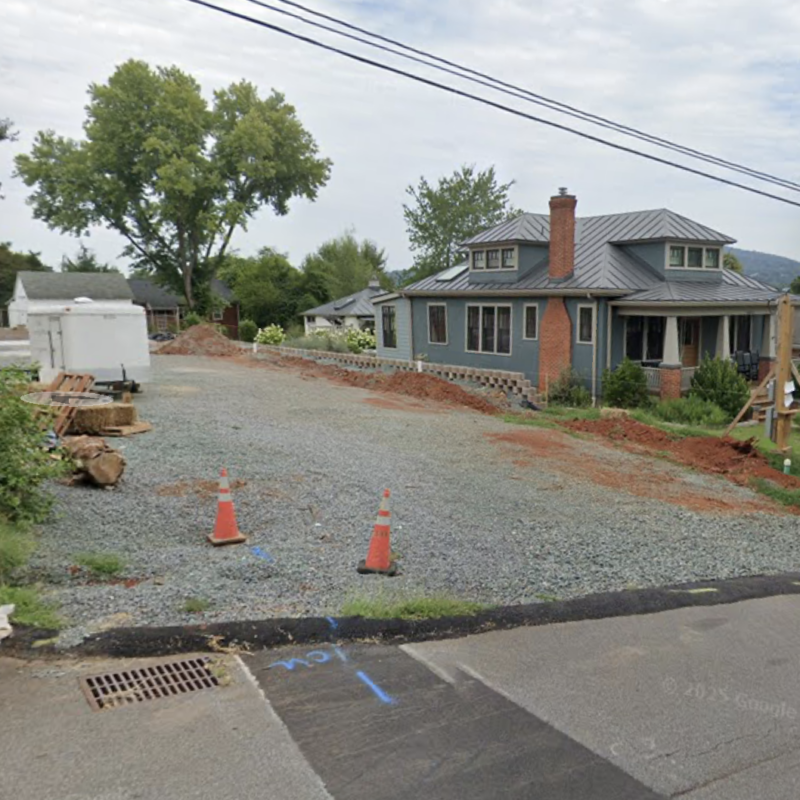
“How was his English?” an unseen man asks Greene County sheriff’s deputy Capt. Brian Shifflett, as he climbs back into his cruiser a little after 11am on June 23.
“Pretty good,” says Shifflett. He’s just pulled over a driver, supposedly for speeding in rainy conditions on a rural road near Stanardsville. But Shifflett and his waiting passenger never discuss traffic violations. The few words they exchange in the next minute or so involve only whether the stopped driver is a U.S. citizen.
There are two possibilities for what happened in Greene County that morning:
1. Hispanic motorists suddenly began driving unsafely, and violating traffic laws, in the vicinity of U.S. 29 and U.S. 33 in Ruckersville at rates more than four times greater than their share of Virginia’s population.
2. During its immigration raid that day in cooperation with ICE, and in the months leading up to it, the Greene County Sheriff’s Office appears to have illegally stopped drivers based on their ethnicity.
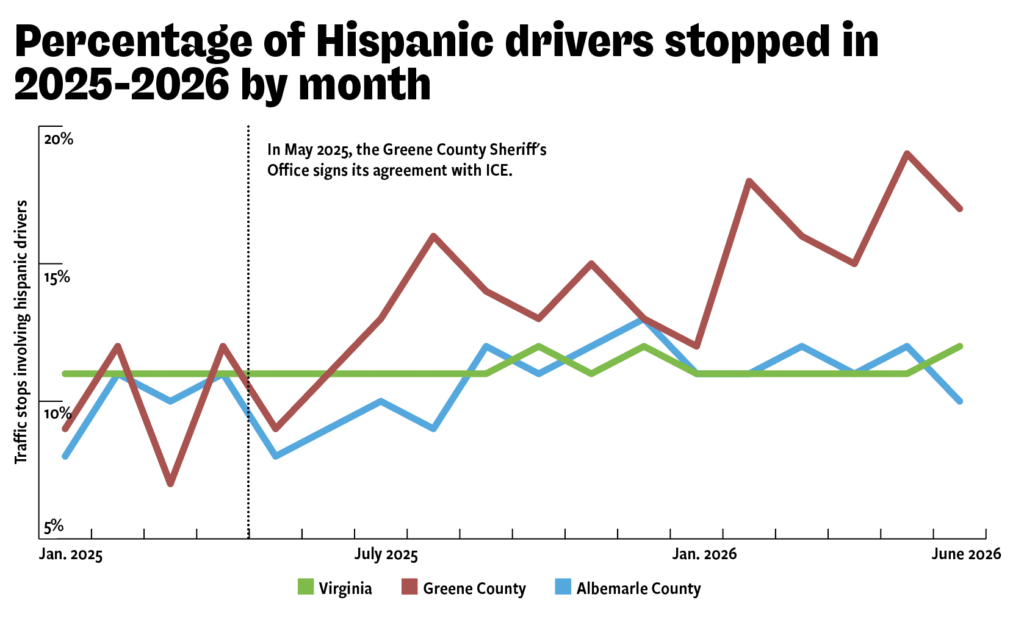
Traffic stop data from Greene County shows deputies pulling over a disproportionate and rising percentage of Hispanic drivers after signing its May 2025 agreement to cooperate with ICE. (C-VILLE is using the same language as the data we analyzed, which employs the term “Hispanic.”)
The Virginia Community Policing Act, which became law in 2020, forbids sheriffs and other law enforcement agencies from using “biased-based profiling,” including a person’s “perceived race [or] ethnicity,” during traffic stops or any other duties.
ICE reported detaining 49 people in Ruckersville June 23, including at least one Charlottesville resident, according to a family member C-VILLE interviewed. In interviews and traffic stop videos provided to C-VILLE, the county sheriff, a deputy, and a federal immigration officer all state that Greene County deputies were pulling over drivers that day for traffic enforcement purposes—not immigration enforcement, where the Supreme Court has ruled that federal officers can stop people based on ethnicity.
The 287(g) agreement between ICE and the Greene County Sheriff’s Office notes that participating officers are still bound by state law: “When engaged in immigration enforcement activities, no participating [law enforcement agency] personnel will be … required to fail to abide by restrictions or limitations as may otherwise be imposed by law, unless doing so would violate federal law.”
Profiling in action
In a June 25 interview, C-VILLE asked Greene County Sheriff Steven S. Smith what criteria his deputies used to pull people over on June 23. “Same as we do with all vehicles,” Smith said. “People that give us a reason to stop them, we stop them.”
Asked what reasons those might be, Smith said, “I wasn’t with all of them. I don’t know what their reasons were.” He listed “speeding, crossing center line, swerving, running red light, just stuff like that, traffic infractions,” as typical reasons why his deputies might stop someone.
In a July 16 interview with The Daily Progress, Smith further denied accusations that his office singled out Latinos during the June 23 sweeps. “We don’t discriminate just against one race,” he told the Progress’ Eli Lerdau. “We don’t just randomly go to people and ask them if they’re illegal or not. We have to have some kind of interaction with them; either we get a call about a domestic [dispute] or we stop them for drunk driving or a traffic offense.”
Footage from June 23 provided by the sheriff’s office under a Freedom of Information Act request shows one of those traffic stops. Shifflett, the office’s captain of patrol, approaches a stopped flatbed truck that is carrying an excavator. The video does not show the driver’s face, and his audio is faint and difficult to hear. Coordinates embedded in the video and landmarks visible in the footage, along with the driver’s stated age, match details in an entry in the traffic stop data that lists the driver as Hispanic. No other traffic stops reported that day took place on that road.
Polite and cheerful, Shifflett tells the driver, “We’re out here doing a bunch of traffic enforcement.” He says the driver was going 47 in a 35 zone, and that he can barely make out the truck’s license plate. The driver says he was going 40—”your speed might be a little off,” Shifflett suggests—and while the video’s low resolution makes it difficult to discern, the truck’s rear license plate appears to be hung crookedly but fully visible. Shifflett asks the man for his ID and walks it back to his cruiser.
After he and his passenger discuss how well the driver spoke English, Shifflett appears to type the driver’s license number into a laptop mounted on the cruiser’s dashboard.
A few seconds later, someone in the vehicle—the voice is faint, but sounds like Shifflett—says in surprise, “Damn! U.S. citizen! … Damn! Really?”
After another minute or so, Shifflett leaves his cruiser to return the driver’s ID. “Sorry it took me so long,” he says, “I had to fill out a little form. You be safe and don’t work too hard.” He does not issue the driver a citation for allegedly driving 12 miles per hour over the speed limit in a large vehicle in what Shifflett describes in the video as rainy conditions. Traffic stop data for the incident says the driver was pulled over for speeding and issued a warning.
Two other June 23 bodycam videos from Shifflett show him detaining people he has already determined lack legal status. In one, he jovially asks a man in a high-visibility vest who has just been handcuffed by another officer why he looks so sad: “Girl doing this stuff to you, man? You gotta tell her to do better than that. She’ll turn your neck up!”
In another, he arrests a driver whose brother, apparently a child, is left to wait in the back seat for his mother to come pick him up. “We’ll be right back with you, buddy,” Shifflett tells the child, as masked agents lead his handcuffed brother away. “Don’t be upset, okay?”
A fourth video shows Shifflett once again releasing a briefly detained man who allegedly broke traffic laws without a citation, shortly after determining that he’s a legal resident.
“You think everybody’s illegal, right?” the driver says, after telling Shifflett he’s a U.S. citizen.
“No, sir, we don’t think that,” Shifflett replies. He then takes the driver’s license back to his cruiser to check his citizenship status, telling someone else in the vehicle, “Run that.”
An offscreen voice says of the driver, “He’s an LPR [lawful permanent resident] at least.”
“So he’s good?” Shifflett says. Asking no further questions aloud, he returns to the driver and hands him his ID. An ICE agent—seen in another video of the same incident taken by the driver and provided to C-VILLE—continues to interrogate the driver. “Answer his questions for him, man,” Shifflett tells the driver, knowing by now that he’s in the country legally. “Make it easier, bud.”
All of the detained drivers and passengers visible in the four bodycam videos are Hispanic. Neither Shifflett nor the sheriff’s office responded to questions C-VILLE sent, on July 9 and multiple subsequent occasions, about the traffic stops and the circumstances around them.
“The job of local and state police is to keep Virginians safe, not carry out the Trump administration’s anti-immigrant agenda,” says Sophia Gregg, senior immigrants’ rights attorney for the ACLU of Virginia. “While officers have considerable discretion in whether to issue traffic tickets, they do not have discretion to target people based on their perceived national origin, race, or ethnicity.”
On June 25, C-VILLE submitted a Freedom of Information Act request to the Greene County Sheriff’s Office requesting any correspondence between ICE and the office in the month before the raid, including emails, documents, and duty rosters for the June 23 operations.
After initially denying the request, Maj. J.L. White told us August 4 that any such documents “do not exist at the sheriff’s office.”
Stops by the numbers
The same 2020 law that banned ethnic profiling in traffic stops also required every Virginia law enforcement agency to gather detailed data for every stop and share it with the Virginia State Police. That data shows that Greene deputies are pulling over Hispanic drivers at rates that considerably exceed those drivers’ share of even the statewide population.
Hispanic or Latino residents represented roughly 11.5 percent of Virginia’s population in 2024, nearly 7.5 percent of Greene County’s population, and 7.9 percent of Albemarle’s, according to the most recent available census figures.
Between January and May 2025, an average of 10 percent of drivers pulled over each month in Greene County were Hispanic, according to data provided by the sheriff’s office to the Virginia State Police. That average rose to 14 percent from June through December 2025, after the county began its 287(g) agreement. From January through June 2026, Hispanic drivers averaged 16 percent of total stops.
During this time, comparable figures from neighboring Albemarle County and Virginia as a whole have remained mostly steady, and close to the statewide percentage of Hispanic residents. Statewide population is probably the fairest comparison for traffic stops, since data shows that many people pulled over in Greene and Albemarle counties don’t reside there.
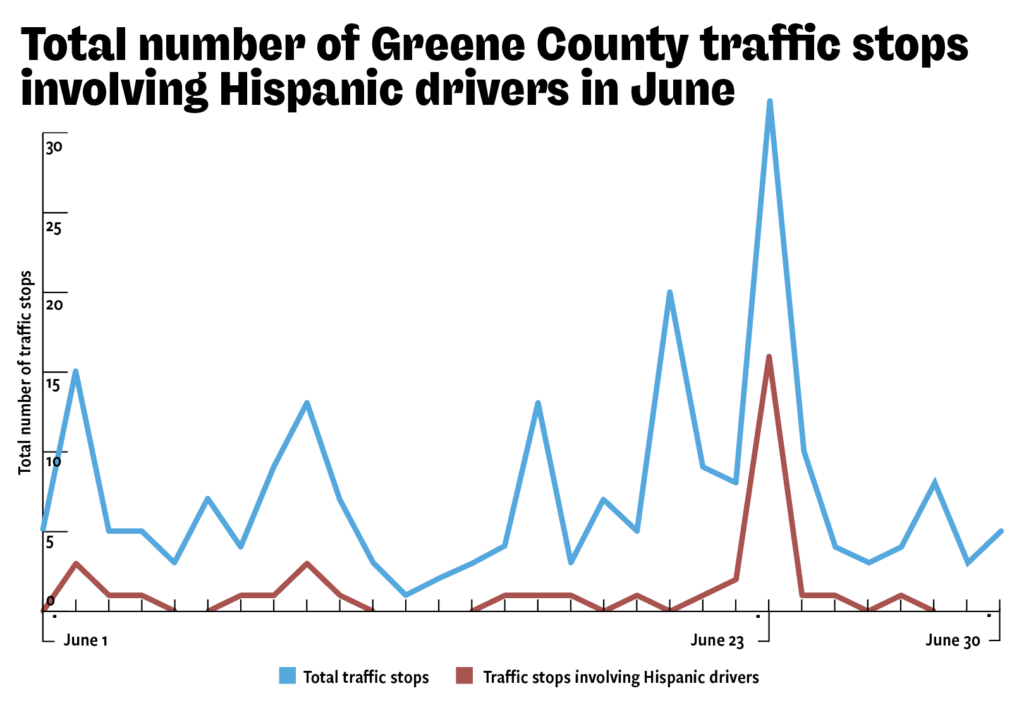
On June 23, 16 of the 32 drivers stopped in Greene County—50 percent—were Hispanic. That’s both the highest absolute number, and second-highest percentage, of Hispanic drivers stopped in the county in a single day all year.
Statewide, the highest day for traffic stops was June 9; 14 percent of the more than 4,500 traffic stops in Virginia that day involved Hispanic drivers. Albemarle County peaked at 71 stops on June 8, 18 percent of which involved Hispanic drivers.
On May 14, Greene deputies pulled over 13 drivers, seven of whom—54 percent—were Hispanic. Beyond that, the proportion of Hispanic drivers pulled over in Greene hasn’t exceeded 40 percent on any day this year.
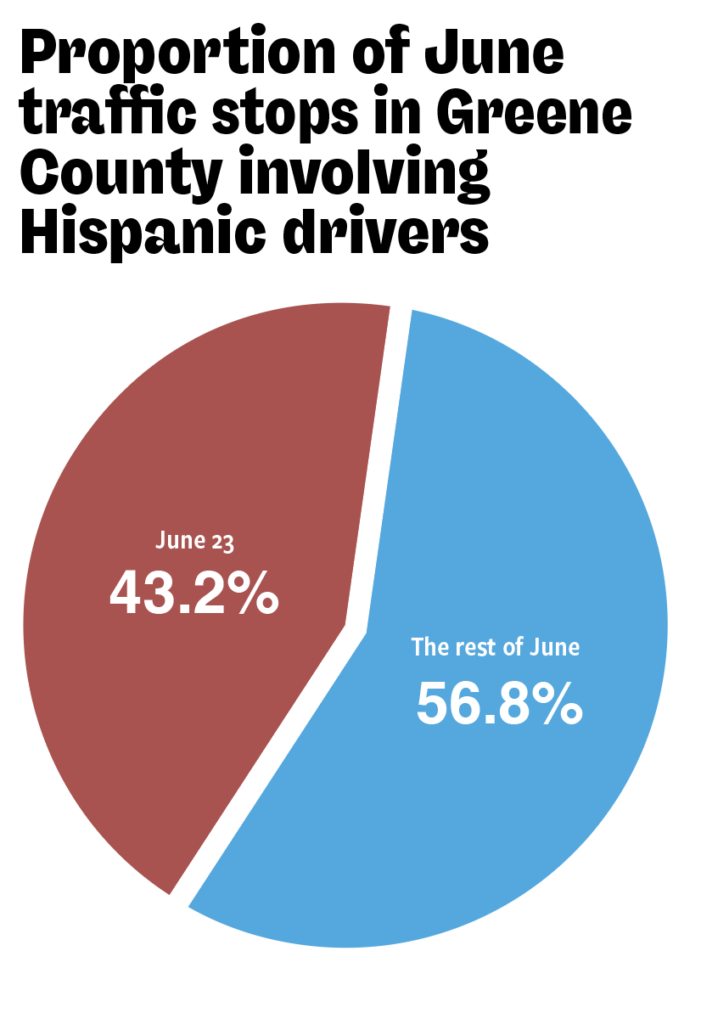
June 23’s 16 stops represented 43 percent of all the Hispanic drivers pulled over in Greene that month. By comparison, the Hispanic drivers pulled over on Virginia and Albemarle’s peak stop days represented a respective 4.8 percent and 14.6 percent of all Hispanic-driver stops that month.
If Greene was pulling over Hispanic drivers at a rate equal to their proportion of Virginia’s population, it would have stopped 25 such drivers for the entire month. Instead, it stopped 37. Hispanic drivers represented 17 percent of all Greene County traffic stops in June.
Even as Greene County deputies pull over larger percentages of Hispanic drivers, they’re making fewer traffic stops overall. Total stops have fallen every year since a recent peak in 2023; if trends from the first half of this year continue, the number of stops will once again shrink year over year in 2026, by roughly 12 percent. But by those projections, the total number of traffic stops involving Hispanic drivers would rise by 22 percent.
Since 2020, state law has required all sheriff’s offices to post a link to the traffic stop data they gather “on a website that is maintained by the sheriff or on any other website on which the sheriff generally posts information and that is available to the public or that clearly describes how the public may access such data.” Archived versions of the Greene County Sheriff’s Office site from July 2020 onward show no clearly visible or easily accessible link posted.
In response to questions from C-VILLE, the sheriff’s office posted a link to the information, first on Facebook on July 20, and then on a new design for its website unveiled several days later. The sheriff’s office did not respond to questions about whether it had previously posted that information anywhere on its site.
Hands tied?
As reported in The Daily Progress, Greene supervisors said they were unable to follow Virginia law and terminate the sheriff’s office’s 287(g) contract with ICE for fear of a lawsuit from the federal government. The agreement was accompanied by federal grants the county has already spent, supervisors say, and they worry that ICE will sue them to recoup that funding.
But the county’s 287(g) agreement, obtained by Charlottesville Tomorrow through a February 2026 FOIA request, includes no such provision. “Whether or not the [law enforcement agency] receives financial reimbursement for such costs through a federal grant or other funding mechanism is not material to this [memorandum of agreement],” the agreement notes on page five. The document states that the sheriff’s office will be responsible for all costs for participating deputies’ salaries and benefits, transportation, and equipment.
The agreement includes no provision for ICE to claw back money it’s spent on a local agency, nor penalties for agencies that withdraw from the agreement. “Termination by the LEA shall be provided, in writing, to the local Field Office,” the contract states; this is the only instruction it provides on how agencies should end their cooperation.

Virginia has recently joined New Mexico, Maine, and Maryland in enacting laws banning 287(g) agreements. Online searches yield no mention of ICE or the federal government suing departments who ended their contracts.
When asked whether other documents the county signed with ICE might include the threat of a lawsuit, Steve Catalano, chair of the Greene County Board of Supervisors, referred inquiries to the sheriff’s office.
“The sheriff is a constitutional officer, which means he determines how best to keep Greene County a safe community,” Catalano says. “The decisions and details of those contracts are between him and the federal government, as are the implications created by that partnership.”
On July 28, C-VILLE sent the data we gathered to the office of Virginia Attorney General Jay Jones, asking whether the disparity in traffic stops violated state law.
On August 5, the attorney general’s office opened a civil rights investigation into the Greene County Sheriff’s Office. C-VILLE obtained a copy of the letter of inquiry informing the sheriff of the investigation. “OAG has reviewed allegations that GCSO may be conducting traffic stops in violation of state law and the Constitution,” the letter states.
Among other information, the letter requests copies of the sheriff’s office’s policies related to traffic stops, immigration enforcement, and ICE collaboration; documents, communications, audio and video related to traffic stops that led to immigration actions; complaints the office has received about traffic stops for the past 10 years; and any changes to the office’s policy since July 1. The letter gives the sheriff’s office until September 4 to produce that information.
“While we can’t comment on any specific or potential investigations, the Office of Civil Rights within the attorney general’s office is responsible for accepting complaints of alleged violations of individuals’ rights,” says spokesperson Rae Pickett. “This Office enforces anti-discrimination laws in employment, public accommodations, education, and housing contexts, as well as in certain law enforcement matters that demonstrate patterns or practices of police misconduct. Individuals who believe they have been discriminated against can submit complaints online, by mail, or by email.”
When asked about the inquiry letter C-VILLE obtained, Pickett confirmed that the attorney general’s office had sent it, but otherwise declined to comment.
C-VILLE asked the Greene County Sheriff’s Office and the county’s board of supervisors about the investigation. At press time, the board declined to comment, and the sheriff’s office had not responded.