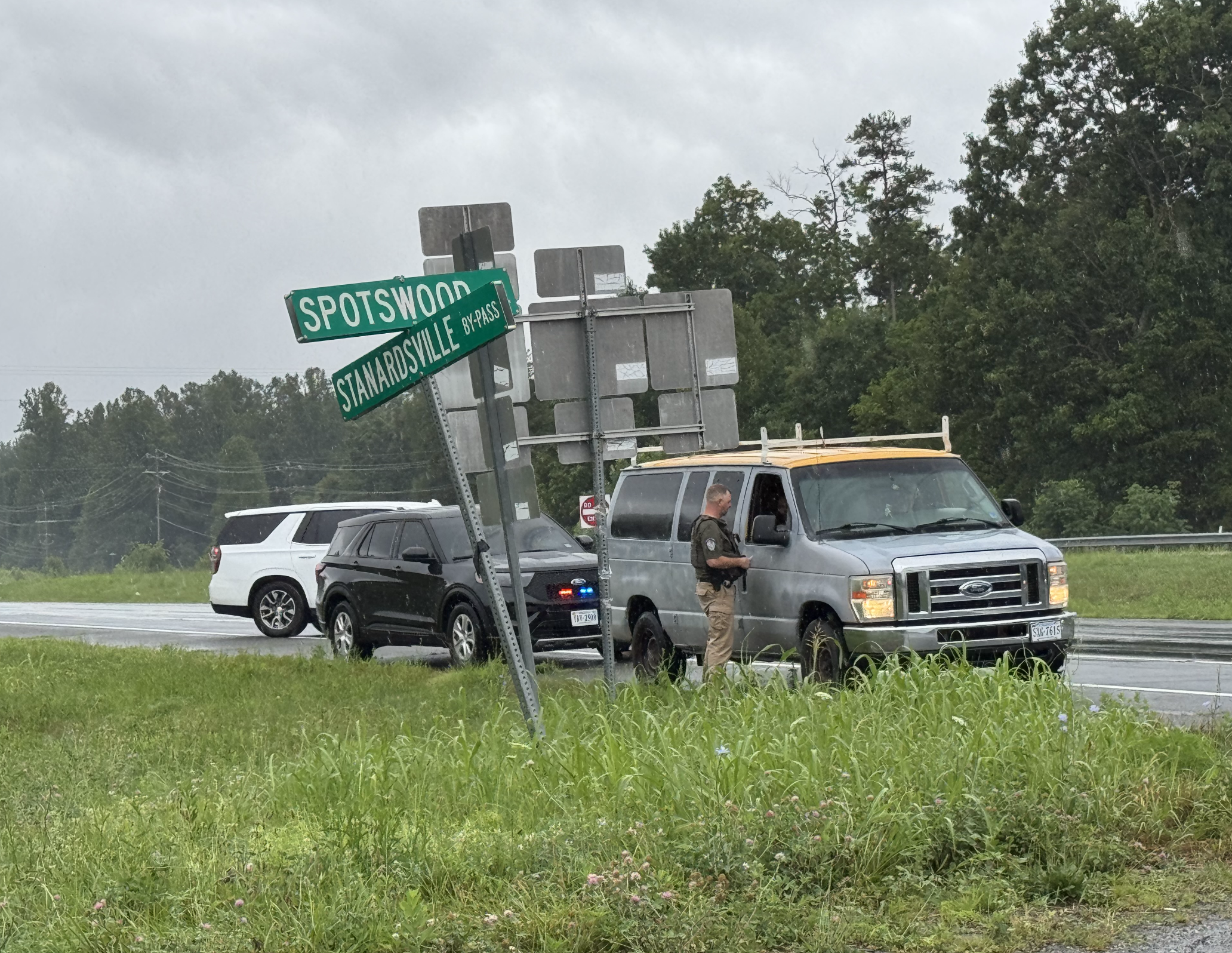
Mass detentions in Ruckersville on June 23 were an escalation in an ongoing effort to expunge undocumented immigrants from our area, according to eyewitnesses, family members, and people detained.
The operation, a joint effort between the Greene County Sheriff’s Office and U.S. Immigration and Customs Enforcement, had been active since at least June 2, says one anonymous source. Another said similar sweeps occurred three months ago.
On July 2, The New York Times reported that ICE detention operations surged over a five-day period, with the goal of arresting 2,000 people every day for deportation.
“We are not sending any of our crews to do work in Greene County,” says a local source in the construction industry. “We have a number of Hispanic team members as well as others who came to the U.S. as refugees working for us full time, and I fear for their safety.”
An ICE spokesperson confirmed that the June 23 raids detained 49 people. Greene County Sheriff Steven S. Smith confirmed that his department had cooperated with ICE under a 287(g) agreement. A new state law which took effect July 1 severely limits and effectively bars these agreements in most circumstances.
In a June 25 interview, Smith expressed doubts that the new law applies to his office, though its text makes clear that it does. “We don’t answer to the governor,” Smith said. “We answer to the citizens of the counties we live in. We were sworn to uphold the law and to protect our citizens, and that’s what I will continue to do.”
Bait and switch
Statements and videos provided to C-VILLE describe and depict Greene County deputies stopping motorists for alleged traffic infractions throughout June. After those stops, immigration enforcement officers moved in to question drivers.
One source, whom we’ll call Alex, says a relative who’s a U.S. citizen was pulled over around 6:10am on June 23 by a sheriff’s deputy after officers saw him filming a traffic stop near the Starbucks at 244 Stoneridge Dr. N, just north of the Route 29-U.S. 33 intersection.
A video of that initial stop shows officers surrounding a white van that has been pulled to the roadside.
“When [my relative] crossed the light to head toward Lowe’s,” Alex says, “they were already following him, and the sheriff pulled him over claiming the light was red and that he ran it, but that was not true. The light was yellow.”
Alex says a sheriff’s deputy threatened their family member with felony charges if he did not provide ID. “The sheriff directly asked about his immigration status. He asked whether he was a citizen or a legal resident. He did not ask for a driver’s license—he asked for his green card.”
According to Alex, the sheriff returned the ID and “told [their relative] everything was fine,” but ICE agents began interrogating him immediately afterward, “asking how he became a citizen.”
In a second video recorded by Alex’s relative, an officer in military gear, with a facemask covering everything but his eyes, identifies himself as immigration enforcement to an unidentified driver whom he has stopped in the Lowe’s parking lot. Landmarks in the video match the store’s location at 385 Stoneridge Dr.
The video shows the masked agent telling the unidentified driver, “I hope you weren’t lying.” When the driver says a deputy already checked his immigration status, the agent replies, “He’s not an immigration officer. I am.. He pulls over for traffic, I [check] for immigration.”
The agent denies the unknown driver’s accusations that he was pulled over because he’s Hispanic, confirms he’s a legal resident, and lets him go.
‘We contribute to this country’
A woman we’ll identify as Lara, 48, agreed to an interview on condition of anonymity, fearing for her safety and that of her family. Her brother and her 74-year-old father, whom we’re calling Armand, were detained by ICE the morning of June 3.
Armand, Lara says, had lived in Virginia since 2004, and was a semi-retired landscaper who volunteered with their Catholic church. .The church that Lara says she and her father attended had no record of him, but a church employee says that’s common; undocumented parishioners often don’t register with the church for fear that the information could be used to trace them.
“My dad has never been so much as pulled over by the police,” Lara says through an interpreter. “He has never committed any crimes. He’s had the best attitude. He follows the rules. He pays his taxes. We contribute to this country.”
A search of Armand’s name in statewide court records found only one potential match: a pair of traffic tickets, for driving without a license and following too closely, issued in 2022 near Richmond to someone with the same first and last name. The first of those tickets was paid in full, while the other was dismissed in traffic court.
Lara says Armand and her brother, a Ruckersville resident, were driving to Lowe’s around 9am on June 3, when they were stopped by a sheriff’s deputy. Her brother had misplaced his driver’s license, but obtained a temporary paper form from the DMV giving him permission to drive.
Lara says her brothers “don’t drink beer, they don’t drive over the limit. They’ve been an example to me.”
Both men were allegedly taken into custody when Lara’s brother did not answer the deputy’s question about what country they were from.“There [were] immediately other agents that came. My dad said it was four,” says Lara.“They asked for their ID and then arrested them.”
While drivers must provide immigration papers if asked for them, “you have the right to remain silent and do not have to discuss your immigration or citizenship status with police, immigration agents, or any other officials,” according to the American Civil Liberties Union. “You do not have to answer questions about where you were born, whether you are a U.S. citizen, or how you entered the country.”
“They treated my dad very poorly,” Lara says. “My dad is 74 years old, and they’re forcing him around.”
According to Lara, her father saw the immigration officers who arrested him fist-bump each other in celebration “like someone who had won a trophy.”
“It just hurts that the officials are proud of what they’re doing,” Lara says. “And in Stanardsville, they had a town hall meeting with the sheriff, and my brother’s neighbor asked the sheriff, ‘Why are you doing this? Are you not embarrassed of what you’re doing?’ And he said, ‘Well, I’m only arresting criminals.’ And she said, ‘Well, my neighbors were not criminals.’”
By 1pm that day, Lara says, her father had been detained at the Rockingham-Harrisonburg Regional Jail, which also collaborates with ICE through an intergovernmental service agreement. Armand told Lara that officials offered him a choice: Spend six to 11 months in detention while contesting his case, or sign papers and leave the country in five to eight days.. Armand signed.
After 10 days in the for-profit Farmville Detention Center, Armand was flown to Mississippi, Texas, and then finally Chiapas, Mexico—more than 14 hours and 700 miles from where Armand’s Mexican family members live.
“We’re not from [Chiapas],” Lara says. “My dad doesn’t know that area.”
Lara and her family were lucky enough to find someone who could drive Armand to safety. But the ordeal reportedly damaged her father’s health: “He was sick for like a month.”
Lara’s brother, who was arrested with Armand, remains in detention. She reports another brother has been detained without bail by ICE since June 23.Her mother is “in the hospital, because she won’t eat since she found out what’s happened to my dad.”
Parallel accounts
Another person, whom we’ll call Bailey, was detained by sheriff’s deputies and ICE, and agreed to speak with C-VILLE on condition of anonymity with the assistance of a translator. They were reportedly detained on June 2 after an officer with the Greene County sheriff’s deputy pulled them over.
“I just feel like ICE stopped us without any motive, anything more than the color of our skin,” Bailey says. “They told me that I have a broken taillight on the driver’s side, but that was a lie.”
Even if an initial traffic stop is made under false pretenses, a resulting immigration detention may not be deemed “fruit of the poisonous tree,” according to ACLU-VA Senior Immigrants’ Rights Attorney Sophia Gregg.
“It depends,” says Gregg, “Criminal and immigration law treat evidence resulting from an unlawful arrest differently.”
After giving the sheriff’s deputy their license and registration, ICE allegedly approached both sides of Bailey’s vehicle.
“When the [sheriff’s deputy] came back with my documentation, he gave it back to me, and he asked me where I was born,” says Bailey. “I told him that I was uncomfortable with answering that question. … When I said that I couldn’t answer that question, he just told me, ‘Okay, you’re under arrest.’”
At that point, Bailey was allegedly handcuffed and put in the back of a sheriff’s office vehicle. Their relative, who was in the passenger seat when they were pulled over, was reportedly questioned alone outside for five to 10 minutes.
Bailey’s relative gave the agents their Consular ID and country of origin. The agents allegedly did not return the ID.
In the squad car, Bailey and their relative were taken to an area behind the Greene County Sheriff’s Office where they were allegedly shackled around the wrists, ankles, and stomach while waiting for agents to arrive with more detainees.
“After the van was full, they started, like, celebrating—you know how they like fist-bump … because they already had their trip full,” Bailey says, reporting five people were in the van initially. “After that they took us to Harrisonburg.”
Bailey was reportedly separated from their relative shortly after arriving in Harrisonburg, then taken for questioning by agents who urged them to sign deportation papers.
“They told me I could either sign voluntarily, and in three months I could possibly apply for a visa, or I could go for the other option, where I will have to go in front of a judge,” says Bailey “They said they didn’t recommend … that because I could be locked up for like a year without bond.”
When Bailey refused to sign deportation orders or give information about their family, agents allegedly insisted they needed Bailey’s spouse’s name in case of an emergency—and continued pressing for information.
“The guy next to him, who was with [the agent], told me, ‘Don’t be stubborn. You guys, everything you see in the news is fake. You guys are putting the noose around your neck by yourself by doing this,’” says Bailey “Then he was telling me, ‘Stop being stubborn, you’re not going to have a right for a bond. But that’s what you wanna do? We’re just asking your [spouse’s] name in case of emergency. … Where we’re sending you, what if, like, something happened to you?’”
One of the interrogators then reportedly told Bailey they could die at Farmville Detention Center. The conversation devolved, ending with an agent allegedly throwing papers down and telling Bailey they could “do whatever [they] wanted,” but should eat the food available as there would be no way to take it with them, before walking away.
The agent allegedly returned 20 minutes later, asked again if Bailey would voluntarily sign the orders, then walked off saying something to the effect of “this motherfucker” to another agent when they refused. The agent reportedly came back after questioning the interviewee’s relative and taunted Bailey with their relative’s decision to sign the deportation order.
Bailey was able to contact a family member on a five-minute phone call while in Harrisonburg, updating them on the situation and where Bailey and their relative were heading: Farmville Detention Center.
Over the course of the drive there, ICE picked up more people in Chantilly and other localities, bringing the van’s occupancy to around 18 people.
Bailey and their relative reportedly remained shackled from the time they were behind the Greene County Sheriff’s Office until they got to Farmville around midnight. Things did not improve when they arrived.
“We waited in the waiting room the whole time” during processing, says Bailey. “Everyone was just sleeping on the concrete floor there [in] the waiting room. … We pretty much didn’t finish until around 6 or 7pm on Wednesday.”
Bailey was able to stay with their relative through Wednesday, but was then sent away to the dorms. “I told my [relative], well you already signed, you should be on your way to Mexico here soon,” they say. “They told me that, once [the relative] leaves, they will let me know. But I don’t know if they just forgot or just didn’t tell me, but I never got to say bye.”
Inside detention
The Farmville Detention Center had an average monthly, 24-hour population of 599 people as of March 10, according to data obtained by the Deportation Data Project via records requests and analyzed by the Vera Institute of Justice. Tracking down more current data about the detainee population is difficult, with some required public reports even redacting the information.
On June 24, C-VILLE called the Farmville Detention Center with questions about how many detainees had been transferred there on June 23. During the conversation, male voices in the background could be heard laughing and joking about a “hot date” and talking about “that inside pocket here [in men’s pants] we put our rubbers in.”
In an ICE Office of Detention Oversight report, FDC scored a “Good” rating during an April 21 to 23 inspection this year, with one deficiency in the “Medical Care” category—a missing health assessment in one detainee’s files—identified in its standards.
Bailey reports conditions inside are far from “Good.”
During their more than two weeks in Farmville, Bailey was only allowed outside for “recreational” three times. “You just breathe in, and you’re like, ‘I’m actually breathing, you know, natural air,’” they say. “It was eight of us per bunker, and it was like 88 of us in the dorm. We only have like three showers for like 88 of us, like three toilets.”
Bailey and their dormmates reportedly used chairs to try and establish some level of privacy when using the bathroom, as there are allegedly cameras facing the toilets. Shower stalls are a bit more covered, but the bathroom’s hygiene as described by the interviewee is questionable.
“Where we eat, it was literally right next to the bathrooms. … It was divided by a four[-foot] wall, and I don’t think that’s really hygienic,” Bailey adds. “Also whenever we brush our teeth, we have to use the sink that is kinda the same as the toilet.”
While they were able to leave detention June 17 after their family got in contact with an immigration lawyer, Bailey remains uncertain about the status of their immigration case and bond.
Gregg confirmed, “everyone in government custody has the right to consult with an attorney.” In ICE custody, detainees have the right to hire an attorney, contact their country’s consulate, and give their immigration number or “A-number” to a family member, per the Virginia ACLU.
Protecting whom, from what?
“I understand that some people may not agree with every law we are tasked with enforcing,” Smith said in a June 25 Facebook post. “However, our responsibility is not to decide which laws to enforce—it is to enforce the laws and serve our community professionally and fairly.”
Using data from ICE and the FBI, a 2017 analysis from the Center for American Progress found that “sanctuary communities,” where local law enforcement does not cooperate in enforcing federal immigration law, are generally safer and more prosperous than counties like Greene—with 35.5 fewer crimes committed per 10,000 people..
A 2019 study by The Marshall Project found no connection between the presence of undocumented immigrants and a community’s crime rates. And a 2025 analysis by the right-wing Cato Institute showed that incarceration rates for both legal and undocumented immigrants are lower for those of native-born Americans, suggesting that immigrants commit fewer crimes. “Illegal immigrants are half as likely to be incarcerated as native-born Americans, and legal immigrants are 74 percent less likely to be incarcerated,” wrote the study’s author, Alex Nowrasteh.
The Greene County Sheriff’s Office prominently lists “putting citizens first” on its website. “Local law enforcement is prohibited from discriminating against anyone on the basis of national origin,” says Gregg. “Under Virginia law, … the Attorney General, an attorney for the Commonwealth, or a city or county attorney can seek judicial relief against any Virginia law enforcement agency for violating the new law restricting 287(g) or other agreements with immigration officials. Individuals who have had their rights violated under a 287(g) agreement should file a complaint with the Attorney General and their county or city attorney’s office.”
Detentions in the region appear to have continued after June 23. ICE stopped at least one person behind the baseball field at Porterfield Park in Orange, Virginia, on Friday, June 26, as captured in a Facebook video. The Orange County Sheriff’s Office does not have a 287(g) agreement with ICE, and received no information about ICE’s operation in Orange before or after the fact, according to public information officer Adam Schienschang.
“I feel like [the sheriff] is doing wrong. … Everyone was congratulating him, saying that he is protecting the community. But he is not,” says Bailey. “We are not criminals, he is treating us like we are criminals. We are hardworking people. … He should focus on the actual criminals that harm the community, not us, the workers.”
“We don’t understand why this is happening,” Lara says. “We are contributing positively and we try to follow the rules here.”
“It’s [at] the point where we just try to avoid that road, because we know that if we go down that road, the sheriff is 100 percent going to stop us,” she says. “Instead of protecting us, he’s just instilling fear. We are terrified.”
This is an updated version of this story. The original article was uploaded online on July 2.