New Columbia, Pennsylvania, is farm country—green fields, modest homes, and rolling hills. And sometimes, a horrible stink.
Ken Flewelling lives in one of those homes, at the bottom of one of those hills, about two and a half miles from that stench. Two large-scale pig farms reside in the valley across from his house, he says.
“Quarterly they introduce new piglets,” Flewelling says. “They grow them for 90 days and get them to a certain point and then send them off to market.”
State paperwork shows one of those farms first applying to raise large numbers of animals in what’s known as a concentrated animal feeding operation—CAFO—in June 2011. By January 13, 2013, during a routine inspection, that farm housed 3,700 pigs in a pair of long rectangular barns, atop a giant concrete pit filled two feet deep with their manure.
On November 30, 2012, Flewelling filed a complaint with the U.S. Environmental Protection Agency. “Entire valley area effected [sic] with over whelming [sic] smell of animal waste,” the complaint reads in the EPA’s records. “[S]mell begins at the post office and continues two miles to my home.”
“When [the pig farms] came in there were days when you opened your door and you couldn’t breathe,” Flewelling says. “It was an overwhelming stench. It was only for a day or so. They said it would never stink.”
When you pack that many animals in one place, the government takes an interest in their prodigious poop. The EPA regulates farms with more than 2,500 swine as large CAFOs, and treats any pollution they produce as a “point source”—subject to the same restrictions as chemicals spewing from a factory pipe. Pennsylvania records show the hog farm’s owner cited for water pollution or waste-spreading violations three different times between 2014 and 2017.
But for farms whose livestock counts fall below the EPA’s thresholds for “large CAFO” status, the law starts getting laissez-faire. As part of a more lenient permit process, farmers must file a nutrient management plan, or NMP. This self-reported document establishes how much excess animal poop they’ll be spreading on fields as fertilizer, and where it’ll go.
“When Congress passed the Clean Water Act, they exempted agricultural stormwater pollution from point source permitting requirements,” says Leon Szeptycki, a UVA professor and an expert in water law and policy. “If you’re a CAFO and you get a nutrient management plan and you comply with [it] and there’s a huge rainstorm, and all the animal waste that you spread gets sloshed into the creek, that’s a discharge. But if you’ve complied with your permit, you haven’t violated the Clean Water Act.”
The farmers who owned that Pennsylvania hog CAFO sold it in 2019, and moved to a property in Scottsville, in southern Albemarle County. That’s not when the trouble began.
The trouble, the lawsuits, the two-front war, all of it started later—just before the turkeys arrived.
Ashley Troxell has a warm smile and, in the calm and confident way she speaks, a core of steel. But when she talks about why she and her husband Broc sold a “fifth-generation family farm” to move to Scottsville, she starts to cry. Sitting at her long wooden kitchen table, emotion choking her voice, she explains that they came to Virginia “to make sure we could stay together as a family through whatever trials we faced.”
The Troxells asked for privacy regarding the precise reasons for that move; it involved a serious family medical situation. “Having to drive [three and a half hours] to take care of [medical needs] and leaving a family farm at home with [our] children—I was pregnant with my fourth—to run the show, knowing that we needed to separate for six to eight months, leave [my husband] with children at home alone to raise hogs, raise beef cattle, raise crops, is not a decision that anyone easily wants to make,” she says.
The more than 400 acres they purchased for $3 million in 2019, with help from Ashley’s parents, included Glendower House, a historic home built in 1808. It lacked the fencing, barns, or other infrastructure the Troxells say they needed. But it was close to medical care at the University of Virginia, Broc says, and had a motivated seller willing to match their budget.
“Within the first year of moving here, our house burned to the ground,” Ashley says. “We moved into a 900-square-foot cottage and lived [there] for 18 months. I had a 9-month-old.”
Greg and Joan Swanberg live just downhill from the Troxells. Their home of more than 20 years, Mill House, was built in 1790; it was originally part of the same estate as Glendower.
“We were thrilled to have a farm family move in, and we were thrilled that they were going to have cows,” Joan says. “There had been nobody there on that property in the 10 years or more that we had lived there.”
“For over two years, we would see each other regularly,” Greg says. When the Swanbergs’ grandchildren visited, they’d play with the Troxells’ four kids.
Logging trucks rumbled up and down the dirt road to Glendower for a year, felling and hauling off trees. “[Broc] told us that they were trying to raise money [from] the timber so he could afford the fencing for his cows,” Joan says. “We were happy to put up with it … because we thought the little family farmers next door [needed] money for their fencing.”
In summer 2022, the Troxells started building a large barn to the south of their house.
“[Greg] had asked me one day, ‘What are you doing?’” Broc Troxell says. He’s soft-spoken, Carhartt-clad, with a reddish beard streaked with encroaching gray. “I said, ‘We’re just building some barns,’ and I didn’t elaborate. And he’s like, ‘Are you going to store hay in them?’ And I was like, ‘No.’”
“I had numerous, more than a dozen conversations,” Greg says. “And it was how much hay he was going to need because how many cows, and it was ‘cows, cows, cows,’ and ‘I need a hay barn.’”
Then the Swanbergs saw a second, identical barn rising next to the first. “At that point, we were like, ‘This isn’t [a] hay barn,’” says Joan. “We weren’t that stupid, I don’t think.”
“Well, I was,” Greg says.
“That’s one of the things that upset me the most with them,” Broc says, “is [Greg] flat out told me, ‘You lied to me,’ and I’m like, ‘No, I didn’t tell you anything. You are the one that was under the assumption of that.’”
According to Greg, he eventually brought up the second barn and the long construction process with Broc. “And he said, ‘Well, we’re done. ‘We’ve been done for a while, but we’re waiting on Cargill to finish up their part of the work.’”
Greg says he asked Broc what Cargill—the Minnesota-based agricultural giant and the United States’ largest privately held company by annual sales—had to do with his hay barn. “And that’s when he said, ‘Well, they’re turkey barns, is what they are.’ And that was the end of the conversation.”
“That very day, Greg called the [Virginia Department of Environmental Quality] and said, ‘Explain to me why we weren’t informed,’” Joan says. “And the DEQ told my husband they did not know there [was] a turkey operation.”
On July 12, 2023, a DEQ representative emailed Cargill to track down the Troxells and let them know about the permits they needed. The same day, emails record the Troxells contacting DEQ to start that process, filing a registration statement, and mailing neighbors their required 30-day notice letters. By that point, the Troxells were already slated to get their first batch of birds. DEQ had to remind them to push the delivery date back until neighbors had a chance to comment.
The Troxells say they did everything Albemarle County asked of them, and didn’t know about DEQ requirements until the agency got in touch with them. “It wasn’t like we were trying to fly under the radar,” Broc says.
For more than 23 years, Craig Watts raised chickens in a North Carolina CAFO. Today he works for the Socially Responsible Agriculture Project, helping farmers like him who’ve grown disillusioned with large-scale farming find other crops like mushrooms or lettuce that can work within their existing infrastructure.
Poultry companies, known as integrators, own the birds and the feed, and they control any vaccinations and medications the birds receive. The farmers who grow those birds get paid based on the final weight, number, and health of the birds they deliver back to the integrator. “I’m not really selling a chicken,” Watts says. “I’m basically just selling my labor.”
“When the bird’s alive, it’s the company’s,” he says. “When it dies, it’s yours. When the feed’s in the bin, it’s the company’s. But when the bird poops it out, it’s yours. … It all runs under the guise of agricultural operations, which—these things are industrial.”
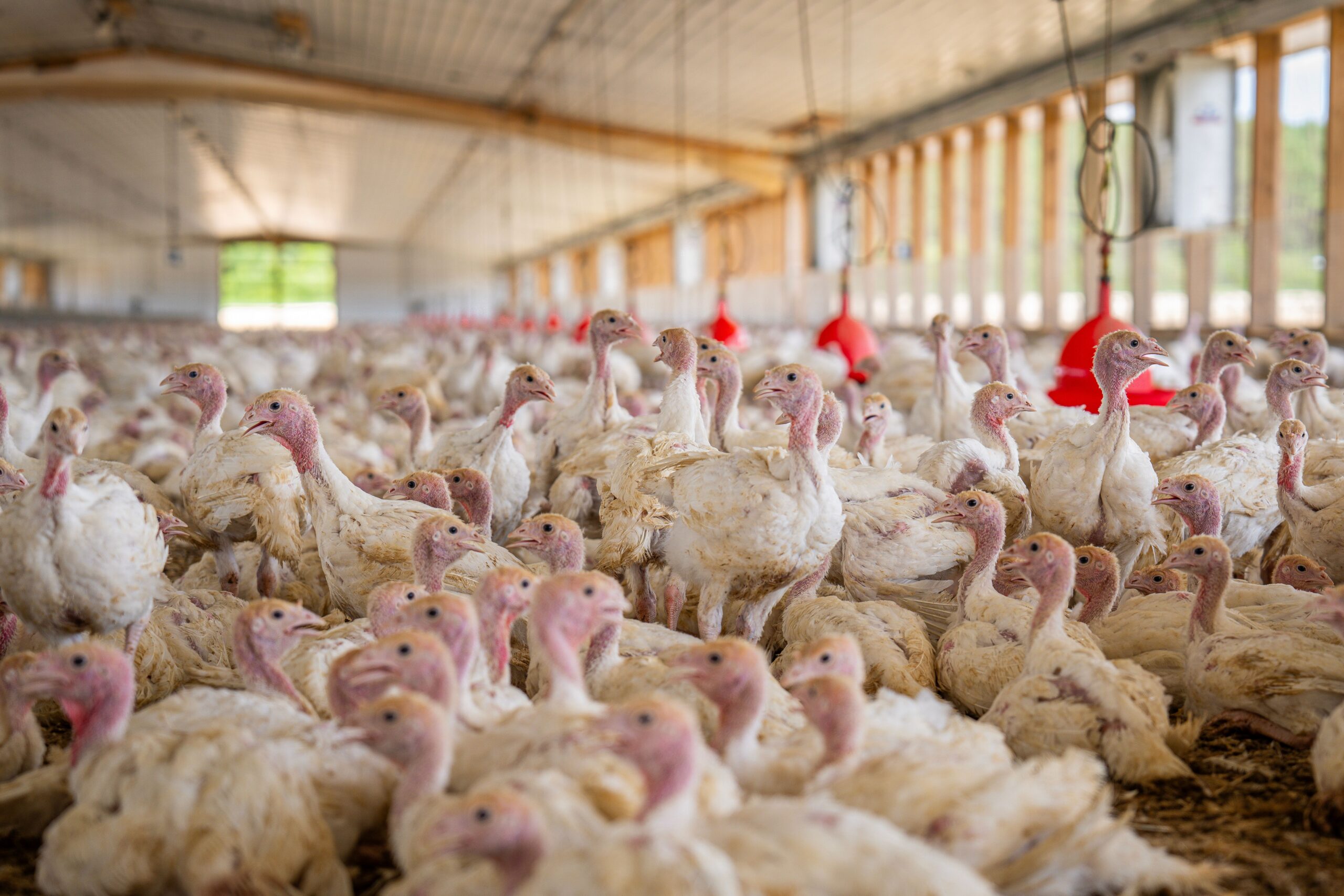
The Troxells keep a total of 51,000 birds—4,000 fewer than the EPA threshold for a large CAFO—in a pair of rectangular barns south of their house. Per county filings, each barn measures 63 feet wide by 704 feet long, taking up nearly an acre of land apiece.
“I hate it when people use the term ‘factory farm,’” Broc Troxell says. “There is nothing factory about that. Our blood, sweat, and tears go into that year-round, every day. My kids work it.”
“Just because they’re in a climate-controlled environment doesn’t make it a factory,” Ashley Troxell says. She says decades-old germs lying dormant in the dirt can ravage livestock without warning, to say nothing of roving predators in the air and on the ground, making the barns a safer place for the flocks.
“Those birds live a better life than we do,” Broc says. “I mean, they have the best ventilation you could have. They have feed 24/7, water 24/7.” He says he, his wife, and their kids provide enrichment for the turkeys, from wiffle balls they can chase around the barn to turkey-sized slides made out of scrap wood. “They aren’t crowded like everybody paints the picture to be.”
Depending on the sex and breed, turkeys can grow to between one and four feet long. At 43,586 square feet each according to court filings, the Troxells’ barns would provide a minimum of 1.71 square feet apiece for 25,500 birds—slightly bigger than three and a half iPads.
In 2024, the DEQ compiled a spreadsheet of selected farms they wanted to inspect that year, including 58 turkey-growing operations across Virginia. The spreadsheet listed each farm’s number of birds. Of the turkey farms inspected that year, 81 percent had fewer birds than the Troxells keep.
The Troxells say they always planned to grow birds. Ashley says farmers learn not to put all their proverbial eggs in one basket. Cows or crops alone aren’t sufficient insurance against a bad year. “Turkeys gave us that opportunity to have another aspect of diversification,” she says, “so that there was always another set of income.”
The only local hurdle the Troxells needed to clear, according to county filings, was a stormwater management plan, originally filed June 8, 2021. Records show that they proved to the county’s satisfaction that they’d build the barns and a series of pipes and ditches beneath them to ensure that nothing leached out of the barn itself during heavy rains.
The Troxells don’t let visitors within a few hundred yards of their barns. “Biosecurity,” Broc says. Unwitting visitors could bring in germs, within themselves or tracked in from soil on their shoes, that could decimate a flock.
From the top of a rise south of the barns, against a panorama of hills quilted in late October’s fall color, you can see large fans churning at the far end of each barn. Sensors monitor real-time temperature, moisture, and air quality, and adjust those fans to keep the birds healthy.
At more than 100 yards, there’s no detectable odor from the barns, even as the fans spin, and even as Broc says there are still birds—40-pounders, close to finished, ready soon for Thanksgiving tables—inside. The Swanbergs later confirm this, saying a shipment left the Troxells’ farm days afterward.
The Troxells say they built the barns above and beyond requirements, to be good neighbors. “We sunk it down into the ground,” says Broc, “which cost us even more money for excavation, so the end where our tunnel fans come out, [the air] would literally hit a bank and go up.”
Another neighbor says that at night, as the air cools and descends, it tends to bring a stink settling down upon their house.
That stink comes from turkey poop. In state paperwork, the Troxells estimate that the birds they raise generate 1,326 tons of manure every year.
Applied to soil in the right quantities, the ammonia in turkey litter makes a valuable fertilizer, releasing crucial nitrogen into the dirt. But if it builds up as a gas in poultry houses, ammonia can harm birds and humans alike while encouraging bacterial growth. Released into the air, it can acidify nearby soils and streams. The Virginia Department of Environmental Quality says it doesn’t regulate ammonia as an air pollutant.
But Virginia law does say that all that poop has to go somewhere. Anyone with this much poultry—11,000 or more turkeys, confined for 45 days or more in a 12-month period, in a lot or facility where crops aren’t also being grown—must get a state permit for poultry waste, and a nutrient management plan written by a planner from Virginia’s Department of Conservation and Recreation.
Virginia doesn’t regulate how animal waste should be treated before it’s applied to land. But Broc says that every time a flock of birds leaves the barns, he and his family pile up and carefully compost the accumulated poop. With long thermometers, they measure the temperature within the pile as they turn and mix it, making sure the natural heat of the composting process reaches temperatures sufficient to kill any pathogens inside. If there were ever pathogens to begin with, he says, he’d know; integrators test flocks for germs and share those results with their growers.
“It’s like garden soil,” Ashley says of the composted litter. “If we’re not taking care of our litter in the barn, it’s not going to have as great of a benefit to us on our fields.”
(Hobey Bauhan, president of the Virginia Poultry Federation, says composting litter isn’t a typical grower procedure, though sometimes it naturally composts while it’s being stored. Bauhan says the USDA does test carcasses and meat for pathogens before they enter the food supply, but he hasn’t heard of growers receiving those results.)
The Troxells say that they’ve never produced enough litter in their barns to cover the cropland they want to fertilize for silage or grain to sell over the winter. “It’s always been half to two-thirds of what was allowed,” Ashley says.
NMPs on file appear to confirm this. Even in 2026, when the Troxells say they came closest to the limit, they still reported using around 50 more tons of litter than they recorded their barns producing.
“A nutrient management plan is a guideline,” Ashley says. “It’s not like the Holy Grail.”
That’s a problem, says environmental lawyer Andrew Young. “Through my legal work, we found that nutrient management plans are very infrequently complied with.” Sometimes, he says, approved plans’ math for how much waste the land can hold is completely wrong. “Farmers are spreading basically uncalculated amounts of poultry litter and animal waste on their fields, and there’s really no oversight.”
“A nutrient management plan, you can bend the information any way you want to if you own it,” says Craig Watts. “How do you know how much litter came out of those houses? Who’s keeping up with that? It’s all voluntary.”
Watts says that when farms apply poultry manure for the nitrogen it provides, they can also leave the soil with more phosphorus and metals than it can absorb—especially if lots of CAFOs cluster around the same processing plant. “We call it too much shit, not enough dirt. And so it’s got to go somewhere. I mean, if you overapply it, it’s going to wind up in a stream and a creek, and eventually into the ocean, I guess.”
On December 8, 2022, with plans for the turkey barns proceeding, the Troxells placed their land under a conservation easement with the Land Trust of Virginia. Many of their neighbors, including the Swanbergs, have done the same through other organizations.
“We want this to be able to stay a family farm for our kids and their kids,” says Broc. “I have no desire to see 100 houses pop up. … We wanted to do an easement to protect it from that kind of stuff, and also to show that we are good stewards of the land.”
“I need this ground to produce for me,” he says. “I don’t want to ruin it.”
Virginia and federal law allows landowners to place their property under perpetual easements that protect natural resources, promote clean air and water, preserve historical and architectural features, or ensure the land will remain available for forestry, recreation, or, yes, agriculture. James Van Vranken, a conservation program planner for Albemarle County, says there were roughly 619 conservation easements in Albemarle at last count, covering more than 115,000 acres. That’s nearly one out of every four acres in the county. Albemarle County itself holds 213 of those easements, while others reside with assorted nonprofit land trusts.
Landowners still own land they place under easement. They can still sell it. They just have to follow rules on how the land can be used, negotiated with the easement holder. A farm placed under conservation easement can never be plowed under to build a housing development.
In exchange, owners get spectacular tax breaks. Federally, farmers and ranchers can deduct their entire annual income for up to 15 years or the land’s market value, whichever limit they hit first. Virginia offers a state tax break totaling 40 percent of fair value, up to $20,000 per year. Some localities offer further tax breaks; Albemarle doesn’t.
“The taxes here are ridiculous,” says Ashley, when asked about breaks from the easement.
Broc notes that while he was initially expecting a nice reduction in his tax bills, rising county assessments on his land offset any hoped-for benefits. “I don’t know that it’s a break.”
The Troxells’ conservation easement says that any time the property owner clears land, they have to use the Virginia Department of Forestry’s best management practices to “control erosion and protect water quality.”
Those best practices say anyone harvesting timber has to leave a buffer of trees and plants at least 50 feet wide on either side of a stream; only half those trees, at most, can get cut down.
That applies whether the stream is perennial—always flowing—or intermittent—flowing just some of the time. Remember this.
Ashton Cole is executive director of the Land Trust of Virginia, the nonprofit that holds the Troxells’ easement. When asked about the trust’s stewardship of that easement, Cole said that the Troxells, to his knowledge, are in compliance with its standards.
The Troxells’ neighbors disagree.
There’s a triangle of land along the Troxells’ eastern property line, at the north end of a patch marked in their NMPs as Field 15. It snugs up to the border of Totier Creek Farm, a nearly $3.5 million property purchased in 2020 by Sophie Massie and Charlie Alvis. Aerial photos as far back as 1937 show a thick, consistent tree canopy there.
In the late summer and early fall of 2023, the Troxells started clearing that land, and started a war.
Broc and Ashley Troxell say the owners of Totier Creek Farm asked them to clear-cut the land in question, to eradicate a virulent invasive species known as tree of heaven.
“We invited them to the table you’re sitting at, and we discussed the tree of heaven, the problems with it, how it was encroaching on their property, and they asked if we would do something about it before it became a nuisance to them,” Ashley says. “And what we said was, we do not have the funds right now, but we will make it happen.”
Massie and Alvis mostly declined to speak on the record, but on this point, Alvis said, “The Troxells’ story doesn’t add up.” He provided a screenshot of text messages in which he asked Broc if he and Massie could come over and talk to the Troxells, with Broc agreeing. It’s dated November 19, 2023.
Alvis also provided a satellite photo of the Troxells’ farm, showing that triangular field completely cleared, down to red earth. It was captured on October 13, 2023, a month before the conversation in which the Troxells say Massie and Alvis asked them to clear the land.
Asked about the differing stories, Ashley says everything happened as she described it. “This is the only time they were invited to my home specifically. … We had done other clearing that was not that specific piece that was all approved for land conversion, and then we had cleared the piece in question after they had approached us.”
U.S. Geological Survey maps show an intermittent stream flowing through that northern triangular tip of Field 15, off the Troxells’ land and across Totier Creek Farm, into Totier Creek. (So does a 2022 map the Troxells presented to Albemarle County, in an ultimately unsuccessful bid to secure a conservation easement from the county.) Totier Creek, in turn, feeds the reservoir that provides all of Scottsville’s drinking water.
On March 23, 2024, Alvis filed a complaint with the Virginia Department of Agriculture and Consumer Services, alleging that sediment from the cleared land was washing through that stream, across his property, and into Totier Creek, polluting the water with nutrients and bacteria from manure applied to the field.
The Troxells argue that the stream in question isn’t really a stream. Ashley begins quoting a definition from memory: “It’s actually an ephemeral stream, which is ‘a water course that carries water only during and for a short duration, immediately after precipitation events such as rain or snowmelt.’” In court documents, their lawyers refer to it as a “puddle” or “trickles.”
In his complaint, Alvis alleged that the Troxells were spreading turkey poop on that part of the field, which hadn’t yet been added to their NMP. Investigators found no evidence of this; the Troxells were applying a completely legal mix of hay and cow manure. Though the Troxells voluntarily include their cattle and those cows’ manure in their NMPs, they don’t keep a herd large enough for the state to regulate where that manure goes.
Photos from April and May 2024 show a thin wisp of vegetation on either side of the stream, and a single tree left standing. The field remains bare earth, muddy and puddled after rains, with occasional scatters of hay or manure.
The Troxells say that during the clear-cutting, the logging equipment broke open a natural spring, sending water flowing. This aligns with one of VDACS’ findings, but leaves out another: The clear-cutting stripped the stream banks, making rains more likely to carry sediment into the water.
Another satellite photo provided by Alvis, captured August 9, 2023, shows most of the field cleared and barren. But the immediate area along the stream retains a thick tree canopy, which appears to comply with the forestry best practices the Troxells’ conservation easement requires. It’s not clear whether that photo was taken while crews were in the process of cutting down trees along the stream, or whether those trees were separately cut at some later date before October.
“All of the work that has been done on our property and will be done in the future is done above and beyond what is required,” Broc says, when asked about the August image. “We are stewards of what we have been given and aim to do what is best no matter what.”
“Based on the evidence collected,” the VDACS investigation form from April 8, 2024, concludes, “I recommend the claim that this agricultural activity is causing or will cause water pollution be determined to be: Founded.”
Virginia law tends to bend to agriculture, but 1996’s Agricultural Stewardship Act has teeth. If VDACS finds a farmer causing pollution, the agency can demand a plan to fix it. This starts by asking nicely, but can escalate to legal action, fines of up to $5,000 per offense, per day, and liens to collect those fines.
Here, VDACS only needed to ask. “We had already had a plan in place, and they just confirmed that plan and put it on paper,” Ashley says.
While VDACS and the Troxells worked together, more rains came. Photos from May 6, 2024, show downpours washing even more dirt off the Troxells’ land and into the stream, which flows opaque and orange.
By May 22, 2024, the Troxells had filed a plan with VDACS to fix the broken spring, stabilize the stream banks with hay, plant crops and grass in the field, and maintain a 30-foot permanent area of vegetation on either side of the stream. They’d even completed some of the initial steps. A September check-in found improvements under way, even after heavy rains.
By June 2025, paperwork shows the Troxells had met all of VDACS’s requirements. Photos depicted the once-empty field and stream banks thick with grasses. In late October 2026, that healthy vegetation continued to grow.
But for the Troxells’ neighbors on Totier Creek Farm, all this apparently was too little, too late.
“If you have a problem with somebody,” Ashley Troxell says, “the first step is to go approach that person, and meet at a table, have a meal, have a discussion, and people aren’t willing to do that.”
When the Troxells sent out their initial 30-day notice letters announcing the turkey barns, “there was no letter sent out by [Alvis and Massie], who are the most disgusted about us,” Ashley says. “There was no response sent back from them complaining about what we were doing at that point.”
“When we first were up in arms about this and talking to our neighbors,” says Joan Swanberg, “[Massie and Alvis] were like, ‘Listen, we get along with these people great, and we don’t want any trouble.’”
“They had odor issues, and they even offered to help the Troxells buy equipment to mitigate odor, and so they were continuing a dialog with them,” she says. “That is what [Massie and Alvis] were doing, and then eventually Broc Troxell just stopped talking to them.”
Instead, records show, Massie, Alvis, and possibly others started filing complaints with any regulator that would listen. Between April 2024 and November 2025, DEQ and VDACS received six different complaints or concerns about the Troxells, with allegations ranging from improper waste spreading to burning plastic pesticide jugs. Five come from Massie or Alvis; a sixth has the complainant’s identity redacted.
But aside from the stripped-bare stream banks of Field 15, investigators consistently reported nothing wrong. The worst rebuke they issued the Troxells was a gentle reminder not to spread poultry litter on windy days, just to be safe. Routine DEQ inspections in July 2024 and August 2025 found the Troxells’ farm following every applicable law and procedure.
“Every time DEQ or VDACS or anybody comes out here, it’s three or four hours of your day—I don’t want to say wasted, but it’s wasted,” Broc says. “I don’t know how many times DEQ has been here. Honestly, I lost count. Every time they call and they’re like, you do not have to allow us on your property.” Broc says he never refuses. “If I am screwing up, I want to know it so I can fix it. But they don’t tell me that I’m screwing up. There’s nothing to fix.”
On March 16, 2026, Massie and Alvis launched the next phase in their war with their neighbors: Their Totier Creek Farm, LLC sued the Troxells in Albemarle Circuit Court. The plaintiffs asserted that the Troxells were infringing upon their water rights by polluting the streams that flow off the Troxells’ land and onto Totier Creek Farm. The suit alleged that the Troxells violated their nutrient management plan by spreading waste where they shouldn’t, and their conservation easement by clear-cutting stream banks contrary to best practices. Both, they alleged, polluted streams on Totier Creek Farm.
The plaintiffs emphasized that they didn’t want money from the Troxells. They only wanted them to follow the rules, and clean up the mess.
Under the riparian doctrine, Virginia law says that if you own land, you own the surface water flowing across it. You have the right to use that water however you like, as long as you don’t ruin it for any neighbors you share it with.
The plaintiffs provided five sets of water quality data from eight locations along Totier Creek and the borders of the Troxells’ land. Many of those samples, the plaintiffs said, showed dangerous levels of E. coli bacteria, which prevented the occupants of Totier Creek Farm from using the streams on their property.
E. coli is, basically, poop bacteria. Many forms of it live happily in our guts, benign. But other strains can sicken humans and animals. Since 2002, the DEQ has listed Totier Creek as impaired for E. coli, meaning bacteria levels in the creek frequently exceed state water standards.
The Rivanna Water & Sewer Authority operates the Scottsville Water Treatment Plant, which pulls water from both Totier Creek and the reservoir it feeds. RWSA primarily focuses on the quality of finished water that the plant produces, says spokesperson Westley Kern. Regular tests show that the treated water is clean and safe. “If we were to start seeing concerns on the finished water side, we would begin investigating the raw water source more closely,” Kern says. “We haven’t needed to do that.”
Totier Creek Farm and the Troxells are still arguing over the private test numbers in court. Individually, the tests can show alarmingly large bacterial counts, particularly in two sites that flow directly off the Troxells’ fields and into streams that lead to Totier Creek Farm’s property. But some of those samples were gathered right after heavy rains, when E. coli levels in any stream would already be temporarily high. And there aren’t enough samples gathered from the same places to meet state standards for establishing dangerous bacteria levels.
The Troxells’ lawyers point to different data, gathered weekly over this past summer by volunteers for the nonprofit Totier Creek Watershed Association, where Charlie Alvis serves on the board of directors. Those numbers, calculated to state standards, allegedly land well below legal limits for E. coli.
But Andrew Young, a fellow director who designed those tests, says they don’t necessarily prove or disprove anything. “It’s like the first layer of knowledge about what’s in the water on any given Thursday in the summertime,” he says. The drought conditions that withered Virginia last summer tend to lower E. coli counts in surface water, since there’s no rain to wash waste off the land.
Craig Watts, the former CAFO farmer, says he’s visited Totier Creek Farm. “If … the environmental folks are telling the other folks that everybody’s following the rules and nothing’s wrong, but then when they’re testing water samples, they’re coming out hot as pistols, I just tell you the rules aren’t very much,” Watts says. “There need to be some screws tightened there, it sounds like.”
Virginia and other states mostly offer voluntary programs that pay farmers to take measures on their farms that will reduce water pollution; the carrot, not the stick. The state’s nutrient management plans regulate nitrogen, phosphorus, and potassium. But they’re silent on bacteria, ammonia, and other products of large-scale turkey farming.
“We, as a nation, are struggling with how to manage pollution from agriculture,” says UVA’s Leon Szeptycki. “Virginia could, if it chose, go much farther than the Clean Water Act in terms of regulation, but it hasn’t.”
In court, Massie and Alvis have argued that they can no longer let their dogs play in the creek; their veterinarian allegedly told them it wouldn’t be safe for the animals. They say they’re worried that they can’t use the water to help raise their own herd of cattle. But the Troxells’ lawyers have asserted that under Virginia law, higher levels of E. coli alone aren’t a cause for legal action.
The Troxells’ lawyers have made two arguments that the DEQ contradicts. First, the lawyers say that under Virginia law, the Troxells’ operation is neither a CAFO nor even a plain animal feeding operation. It does confine animals for at least 45 days out of the year, but those turkeys are raised on the same “lot or facility” where they’re growing crops.
“The second part of the definition refers to the area in which the animals are being [fed] and maintained, not the crop fields,” says DEQ spokesperson Sarah Pentecost. “This area is the growing houses, in the case of a turkey-growing operation.” No crops grow on or immediately around the Troxells’ turkey barns.
Second, the Troxells’ lawyers say the allegedly polluted waters on Totier Creek Farm don’t qualify for regulation under Virginia and federal law. Since they’re allegedly too shallow to swim in, they can’t meet the EPA’s standards for “primary contact recreational waters,” where the law says there’s “the potential for ingestion of, or immersion in, water.”
“All surface waters in the state are expected to meet primary contact recreational criteria,” Pentecost says.
“The Troxells’ record speaks for itself,” Alvis says. “We will defend our private property rights against these harmful practices.”
At press time, that case continues to grind through the courts. But four days before it was filed, another unexpected event upended the Troxells’ business—and would, within months, lead them to launch a second legal war even as they continued to fight the first.
Craig Watts describes large-scale poultry farming as a ruthless business, where integrators squeeze growers by demanding costly infrastructure improvements tied to onerous loans, and arbitrarily punish growers by sending them fewer flocks to raise. “I’ve seen some mysterious stuff happen to growers who had big mouths,” he says.
But the Troxells say they loved working with Cargill. “We had a fantastic experience,” Ashley says. Broc says they were one of the company’s top growers.
In January 2026, Cargill announced it would sell its turkey business to California-based Pitman Family Farms. Federal court filings say a Pitman representative met with the Troxells on January 21 about the deal, which closed March 21.
On April 10, Pitman says the Troxells refused a shipment of birds. On May 1, the Troxells told Pitman that any contract it thought it had with them was null and void. And on August 3, Pitman sued the Troxells in federal court.
“We had a contract with Cargill,” Broc says. “We didn’t deny [Pitman] to bring birds. We just told them we did not want to place any poults here until we had a contract.”
“We would have needed feed,” says Ashley. “We would have needed supplies. We would have needed a contract to state how we were supposed to raise them, with what specific rules and regulations, with a game plan, and we were never given any of those things.”
In court, the Troxells argue that because Cargill exercised such extensive control over every aspect of raising their birds, the Troxells’ choice to work with Cargill was a “personal service contract,” tied to Cargill’s unique character and reputation.
Pitman insists it owns the Troxells’ contract. The agreement includes more than $588,000 that Cargill paid the Troxells to fund their turkey barns’ construction. For each month of their 15-year-contract, Cargill would shrink that obligation. But if the Troxells ever broke their deal, they’d have to pay back whatever remained.
Pitman says the Troxells owe more than $480,000—part of the nearly $1.4 million in alleged debts and damages from un-grown flocks it’s seeking.
Asked whether the chance to escape a nearly half-million-dollar obligation factored into their decision to split from Pitman, the Troxells say no. “It was more about what’s morally right and what’s ethical,” Broc says.
Since the spring, the Troxells say they’ve been working with a new, Virginia-based integrator they decline to name. “Their values, their ethics, and their integrity completely align with the way our farm is designed and what we wholeheartedly believe,” Ashley says.
As both cases proceed, the Troxells have a GoFundMe set up in their name as of October 22, seeking $40,000 to help them “fight a malicious lawsuit.” At press time, it had received 29 donations totaling $4,325.
Neighbors and Scottsville residents fear that the Troxells’ operation will be the first of many. Earlier this year, rumors flew that a coalition of Mennonite families from elsewhere in Virginia might be buying up land for a CAFO cluster of their own. Those worries seem to have abated; the families are coming, but not, by all reports, to build more giant poultry barns.
Still, community concerns persist. After public comments spurred its August 5 vote to commission a study on CAFO regulations in other counties, the Albemarle County Board of Supervisors received that information September 2. The report notes that local rules can’t control farms’ odor, noise, or dust. The Board of Supervisors hasn’t yet announced what next steps it will take on CAFOs.
“Unlike several neighboring counties, Albemarle does not have an ordinance protecting water and the environment from intensive poultry feeding operations, and that makes Albemarle County a prime location for future CAFOs,” says Scottsville resident Adelaide O’Brien. She says CAFOs pose ecological and health risks to their neighbors, citing a June 2026 study in which researchers linked living near CAFOs, including poultry farms, to small but significant increases in cancer rates in California, Iowa, and Texas.
Hamilton “Chip” Moses serves on the Albemarle County board of directors for the Piedmont Environmental Council. With CAFOs, “there’s always prodigious use of water, large amounts of excrement, and air pollution that goes with the excrement, as well as a host of other risks to human health, particularly because of the farming practices used,” he says. Moses cites bird flu, with its potential to jump to humans or cows in close contact, and listeria, a potentially deadly bacteria, as two of the biggest human health threats CAFOs pose.
Groundwater also worries him, both in potential pollution from agricultural runoff, and in how much water CAFOs consume. “Southern Albemarle County is water-challenged. One of the well drillers that operates here told me not long ago that they routinely have low yields and … a number of failing wells here.”
Kenny Sites of KRS Excavation and Well Drilling in Shipman says productive wells above 200 feet are getting harder to find in Scottsville in particular—partly because of the underlying geology, and partly because of “26 years of below-average rainfall.”
“Over the years, we’ve had to drill replacement wells,” Sites says. “They produced good water 10, 20 years ago, but now they’re running out of water because the water table’s dropping.”
Based on a growing turkey’s average daily water consumption, a single flock the size of the Troxells’ might guzzle a million gallons of water over 18 weeks. At three flocks a year, that’s 3 million gallons, roughly equal to 25 American households’ annual water use. For comparison, the entirety of UVA consumed 24.4 million gallons in 2025.
At Mill House, Joan and Greg Swanberg stay inside on days when their air quality sensor tells them the particulates are too high. There’s a two- to three-week period after turkey harvests, they say, when their entire house is covered in flies.
The Troxells express skepticism upon hearing this. “If they had a fly issue at their house, we would have a heck of a fly issue out there at the turkey houses, and we don’t,” Broc says.
But the Swanbergs took pictures. At first, they just look like exteriors of Mill House. Zooming in reveals thousands of flies speckling the white siding.
Two months before the Troxells announced their turkey barns, the Swanbergs put their house on the market. “Showings went from frequent in the first two months to no showings in late spring and summer that year,” Joan says. The house didn’t sell. Now they’re trying again.
“We have a new realtor now,” Joan says. “As he was talking about the property to other realtors, every first question was, ‘Is that turkey farm still there?’ So that makes me think that it has some impact.”
The Swanbergs say they’re tired—frustrated both with the Troxells and the county government, which they feel hasn’t done enough to regulate large-scale farming. But they insist they’re not the farmer-hating elitists the Troxells might imagine. “We moved to the country because we love this kind of community,” Joan says. “We have friends that are farmers.”
“Everybody gets hurt in this, including the Troxells,” she continues. “When you sign these contracts with these turkey providers, these big companies are out to make their own profit. They don’t care what happens to you.”
“We’re not the enemy,” Broc says. “Everything I do … I do it for next year or the next 50 years. I make my money off of topsoil. I don’t want to lose it.”
“If I make a mess and don’t clean it up,” he says, “it’s just going to make it worse for somebody else.”
In Pennsylvania, Ken Flewelling worries about the changes he’s seen in his community since the big hog CAFOs set up shop. Now, he says data centers are competing with commercial agriculture operations, testing small town governments’ planning, zoning, and infrastructure.
“After those operations came here, they kind of opened the door for future pig farmers,” Flewelling says. “That’s what I would be leery of if I was down there in Virginia. When your local government approve[s] an operation, they basically set a precedent … And then all the other people that want to follow suit or invest in that direction, all they gotta do is follow the blueprint.”
“If you walk the dog once,” he says, “you walk the dog forever.”