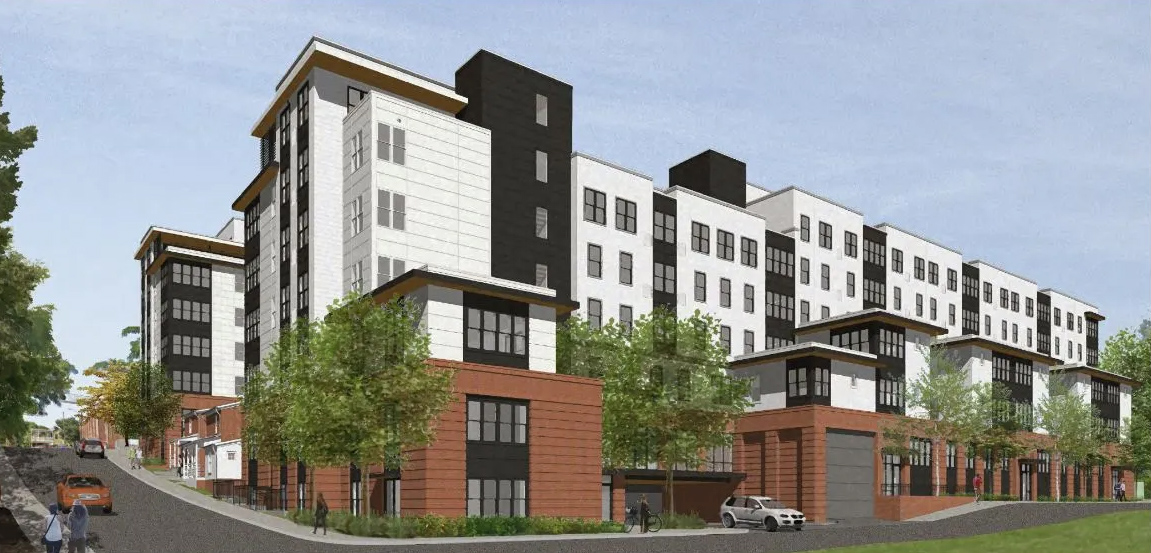
Proposed seven-story Fifeville building The Mark is closer to becoming a reality after city staff approved a key document required for the project to move forward. Mitchell/Matthews Architects & Planners
A proposal to build a seven-story building in Fifeville moved closer toward construction on August 20 when Charlottesville city staff approved a key document required for the project to proceed.
“This Development Plan shall be valid for a period of five years from the date of approval or until August 20, 2031,” wrote city planner Carrie Rainey in a letter to the Timmons Group, the civil engineering firm that developed schematics for what will be called The Mark.
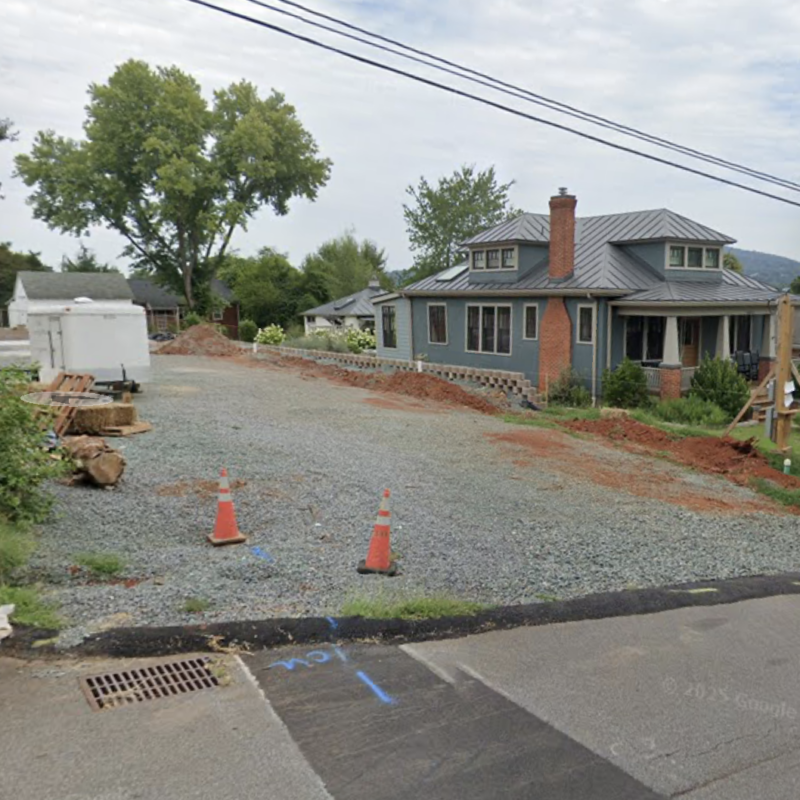
Landmark Properties of Athens, Georgia, has an option to buy five properties off of Seventh Street SW, just south of the east-west tracks owned by the Virginia Passenger Railway Authority. Engineers working for the company filed plans in October 2025 for a building with 180 units allowed under a new zoning code that went into effect in February 2024.
Staff in the city’s Department of Neighborhood Development Services denied the plan several times, but such an action is a routine part of the review process as developers work to address technical concerns. The city only allows four review cycles, but Deputy City Manager James Freas granted an additional review after a meeting with project engineers on August 6 because the required changes were minor.
The five properties are all within the Residential Mixed Use 5 district, which allows unlimited residential density. The prior designation for the land was Cherry Avenue Corridor, a mixed-use zone created in 2003 that also enabled density at the location. The primary difference is that under the old rules, City Council would have had to approve a special use permit, something that required a public hearing.
That step was eliminated during the Cville Plans Together initiative that saw creation of an Affordable Housing Plan in March 2021, as well as an update of the Comprehensive Plan later that year. The latter included a Future Land Use Map that called for this land to be “higher intensity residential.”
The same map designated land across Seventh Street NW as General Residential (Sensitive Communities), which called for protections to discourage displacement. When the new zoning was developed, the “sensitive” areas were all put in the Residential Neighborhood A district that has the least development rights in the city.
Last December, the Charlottesville Board of Architectural Review denied a Certificate of Appropriateness needed to incorporate two protected structures from the 19th century into the project. The developers appealed to the City Council and a 3-2 majority overruled the BAR.
The 2024 zoning code requires developers to hold a community meeting to take feedback on transportation-related issues. That meeting was held on June 24 and provided an opportunity for opponents of the project to express their greater concern, but no actions were required as a result.
Those opposed to the project also tried to persuade the Board of Zoning Appeals to overturn a determination that The Mark qualified as “student housing” under the zoning code because it is within a half-mile of the eastern edge of central Grounds. The BZA voted 3-2 to uphold that opinion.
The student housing designation allows Landmark Properties to avoid building units required to be affordable. Instead, the developer will pay a fee of $4,491,797, according to an affordable housing certification made as part of the development plan. This document also states there will be nine one-bedroom units, 13 two-bedroom units, 20 three-bedroom units, 66 four-bedroom units, 55 five-bedroom units, and 18 six-bedroom units.