Tristan Williams
As the unhoused encampment by the Rivanna River near Free Bridge grows, so have community concerns about sanitation—even though recent tests show very low levels of harmful bacteria in the water downstream. New temporary facilities provided by the city could help both the river and its new residents until Charlottesville can find a better solution.
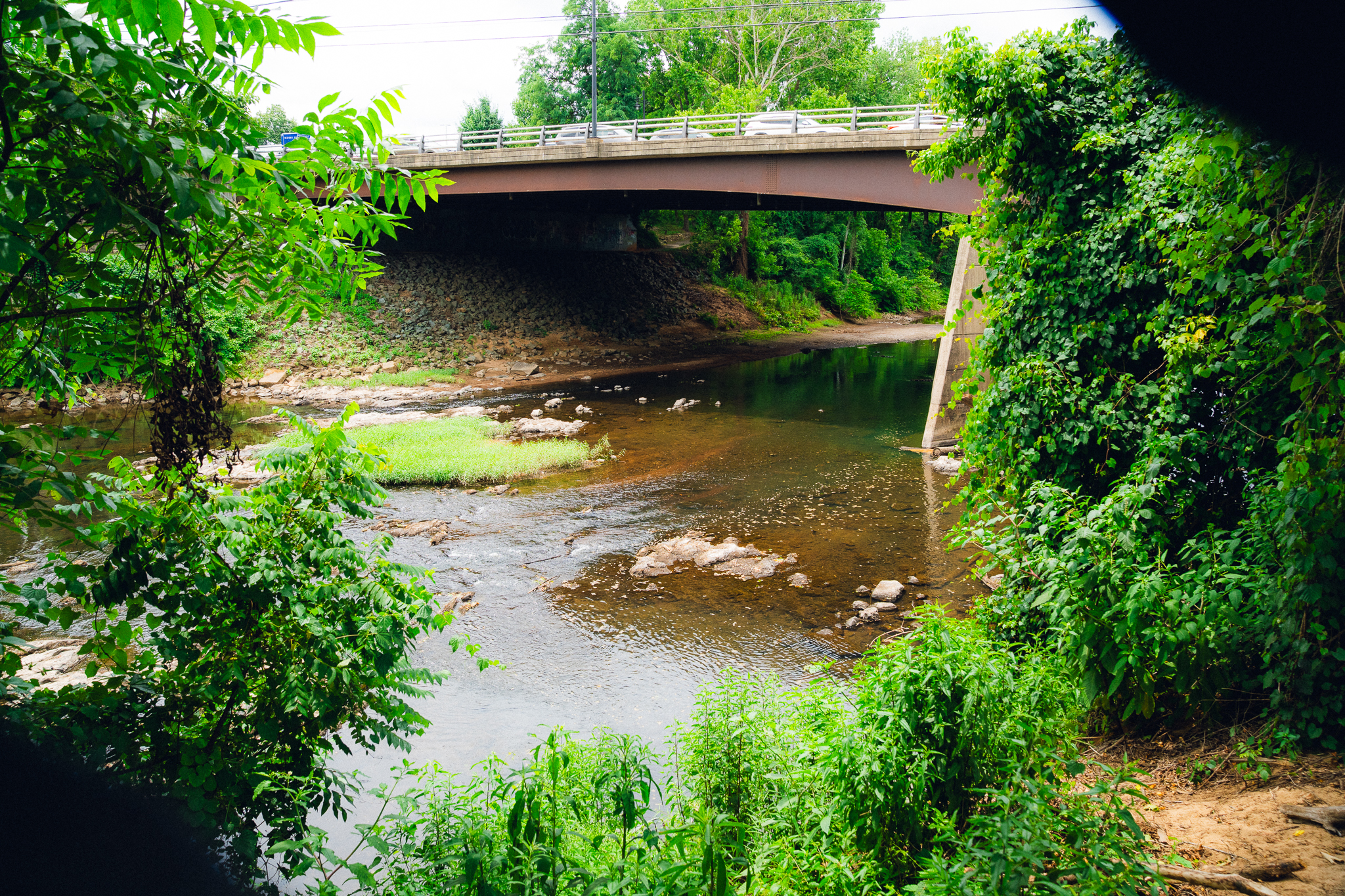
The city has placed two portable toilets, two handwashing stations, and a large garbage container on city-owned land leased by the Rivanna River Company south of Free Bridge, between the northern and southern portions of the encampment.
Gabe Silver, Rivanna River Co. co-founder, says the new amenities started arriving June 17. His company’s part of a public spaces working group, along with other local advocates, who’ve been working with the city for four months to add portable toilets. Silver says the toilets will be checked, cleaned, and restocked three times a week.
“I think the growth of the encampments on the Rivanna River are definitely giving people pause, and definitely hurting the brand of the Rivanna River, in terms of a pleasant recreational resource,” Silver says. “We’d love to see much better outcomes for the folks that are living down here and much better outcomes for the riverfront in general.”
City Parks & Recreation staff emptying garbage cans and cleaning up debris near the bridge say that trash there gets picked up daily. The city’s also set up sharps disposal boxes for used needles, but one Parks & Rec employee says he’s still finding needles bagged up and thrown in the garbage.
As of June 19, several encampment residents C-VILLE spoke to hadn’t yet heard of the new facilities. “That’s nice to know,” says Jerry Gentry, who installed gutters before drug use derailed his career. At his neat, well-kept tent, with a stone-lined path cleared through the encampment’s high summer weeds, Gentry says he’s mostly been using the bathroom at local businesses, and bathing in the river.
On the south end of the encampment, Dontae Jones says having accessible bathrooms close by is more convenient than his previous routine. “I would go to The Haven or something up the street,” says Jones, who’s been living at the encampment for nearly a year. “The Haven or any establishment that’s gonna allow a person to come in and use the bathroom, as long as you keep it clean and stuff, like, clean up after yourself.”
Though Silver says his staff have found more debris in the river since the encampment began, its presence doesn’t seem to be hurting the river’s water quality. For a decade now, “my staff, our tens of thousands of customers, my children, my children’s friends—we have all used the Rivanna River,” he says. “So we’re running this experiment of, is this healthy water to swim in, and we have never had someone get sick from the river.”
The nonprofit Rivanna Conservation Alliance regularly tests water samples from 21 sites along the Rivanna and its tributaries. The nearest testing site downstream from the encampment, at Riverview Park, found approximately 73.3 counts of E. coli bacteria per 100 mL of water on June 18, well below Virginia’s water quality standard for recreation (410 counts per 100 mL).
The current drought may explain those healthy readings. “It is usually only when we have heavy rainfall that E. coli levels become temporarily elevated in the Rivanna River,” says Lisa Wittenborn, the alliance’s executive director. Rain and runoff can flush animal waste from surrounding land, or human waste from leaking sewer pipes, into the river, driving bacteria levels up.
“When this happens, E. coli levels generally return to baseline within 48 to 72 hours,” she says. “No samples taken at Riverview in 2026 have reached or exceeded the water quality standard, likely due to the very dry weather conditions we are experiencing.”
“That being said, we’re sort of sitting in that position on the Rivanna riverfront right now where a flood would be really problematic environmentally and potentially tragic on a human scale, depending on its intensity,” Silver says.
“The Rivanna is a small river close to a mountain range, and so it rises quickly,” he says. “It would typically crest within 24 hours of a rain event, sometimes much quicker than that. In 2018, we saw the river rise to a point where it would have swept away most of the encampments that are here. It rose probably in eight hours to that level overnight.”
Wittenborn agrees, citing floods at or above the encampment’s current elevation in 2024 and 2025. In addition to the human toll, such flooding could sweep garbage from the camp into the river. “Once things get washed into the river,” Wittenborn says, cleaning it up “gets much more difficult, time-consuming, and expensive.”
Encampment residents didn’t seem to have solid plans for what they’d do if the river rose, beyond hoping it wouldn’t.
Asked what he’ll do if a flood hits, camper Forrest Jarred says simply, “I’ll float away.”