The Downtown Mall turns 50 this year. As a transplant to Charlottesville, the Mall has felt so intimately woven into the fabric of this beloved town that it’s hard to imagine a time before its existence. The Albemarle Charlottesville Historical Society’s exhibition “Then & Now: Charlottesville in the 1970s” allows visitors to time travel back to that transformational decade through newspaper articles, photos (with baby trees), and painted portraits of local pioneers.
What
Visiting the “Then & Now: Charlottesville in the 1970s” exhibition in the VAULT Virginia first-floor gallery.
Why
To better understand Charlottesville’s history and learn about pioneers (and artists) who brought about great change.
How it went
I learned a lot and left with a deeper understanding of our community.
I first happened upon “Then & Now” by accident, and it turned out to be a happy one indeed (imagine Bob Ross’ dulcet tones). The exhibition uses portraits by local artist and activist Frances Brand as focal points, and supplements her art with newspaper articles, photos, and other visual artifacts from the ’70s. Brand’s vibrant, colorful paintings show the influence of her time studying in Mexico, and her subjects are all local pioneers—people who broke ground (literally and figuratively) to be the first in their area of expertise.
I had the privilege of crashing a guided tour that ACHS Executive Director Olivia Brown was leading for a local organization. We started with photos of Main Street—from the time of its closure to vehicular traffic to the pedestrian mall it is today. Brown cheekily compared the disruption the construction caused then to the current work at the Mall crossings.
In Brand’s portrait of Charles Barbour, Charlottesville’s first Black city councilor and first Black mayor, he sports a patchwork coat of earthy red and green squares. It’s displayed beside an image of Barbour and other city councilors breaking ground on the Downtown Mall in 1974. The decision to change the way community members experienced the area wasn’t made without dissent. Local business owners feared the construction would disrupt their livelihoods. Another image shows intrepid pedestrians moving around construction equipment to patronize businesses.
“Then & Now” is about more than just the Mall’s origins. The likeness of Imogene Bunn, a local activist and nurse, graces another wall. Her portrait highlights kind eyes and features her in a dark dress with a crisp white collar that suggests trustworthiness. She was the first local nurse to provide house calls to Black and white patients alike. Bunn helped desegregate the University of Virginia hospital as well as the Woodrow Wilson Rehabilitation Center and Blue Ridge Sanatorium.
Nearby, Virginia Anne Scott’s long blond tresses grace the shoulders of her crimson sweater. She sought to transfer into UVA’s College of Arts & Sciences in 1969, before it was coed, and became one of several plaintiffs in a class action lawsuit on behalf of all women barred admittance to UVA based on their gender. The case forced UVA to become fully coed sooner than planned.
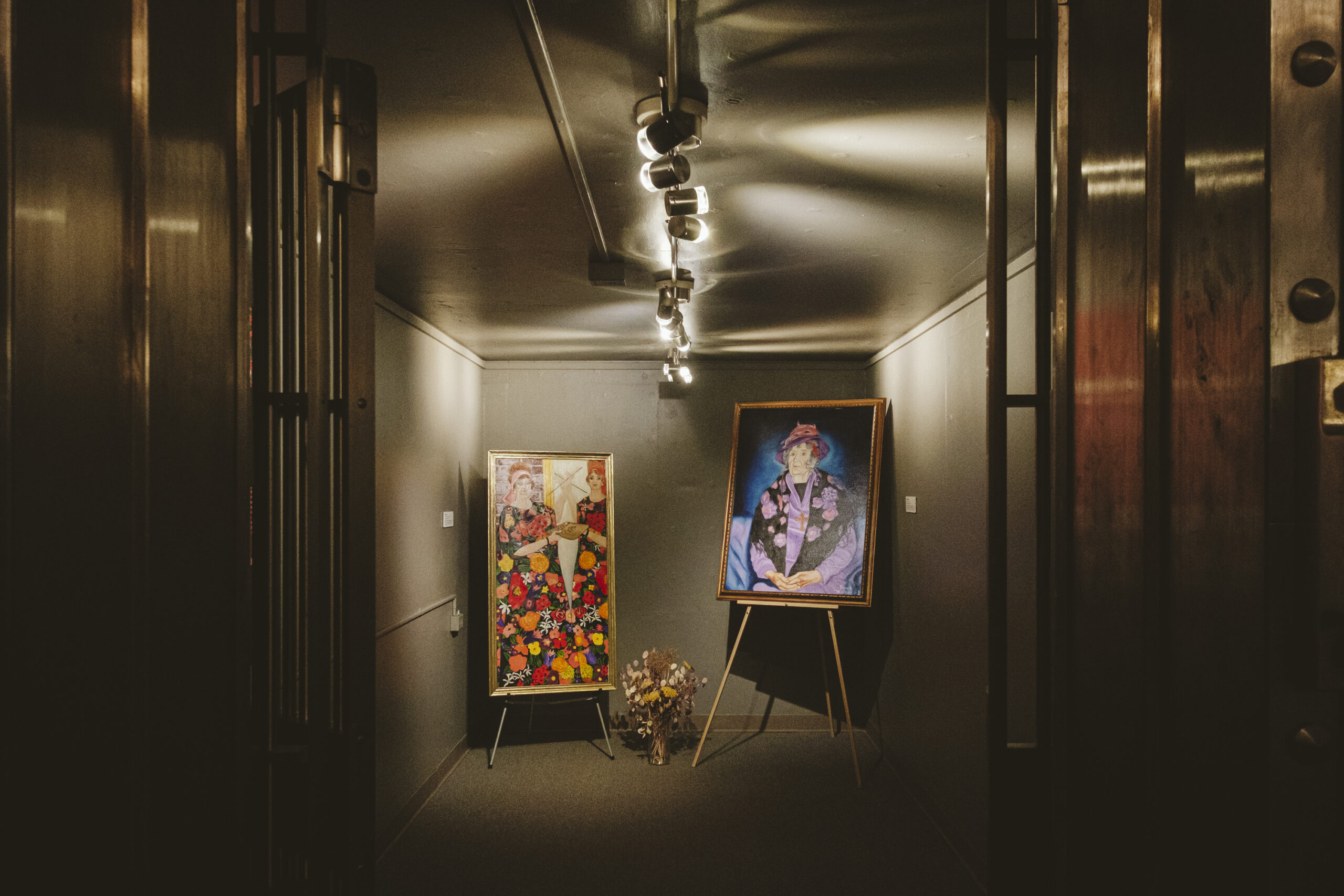
Perhaps my favorite weird, wonderful part of the exhibit are the portraits of Frances Brand herself, nestled into an actual bank vault leftover from the building’s past. One is a self-portrait in which Brand represented herself as much younger than she was at the time she painted it. The other is the only portrait in the exhibit that Brand didn’t paint. That 1983 piece is by Frank Walker, and it shows her at a finer vintage, looking just as colorful and eccentric as one would expect based on her artistic aesthetic.
“Then & Now” is open to the public Monday through Friday. Guided tours are available on Fridays from 9am to 5pm, through July.