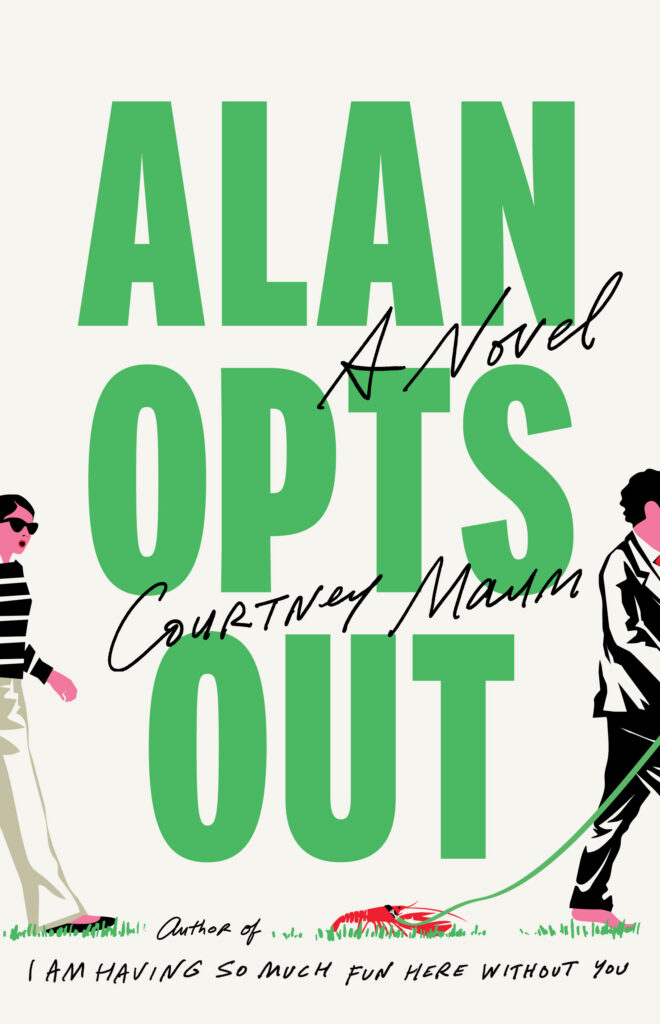
In the opening pages of Alan Opts Out by Courtney Maum, readers meet the titular character as he prepares for a big pitch—perhaps his biggest yet—to try to land a multimillion-dollar advertising contract with the U.S. Dairy Council. Alan is a successful man, but he and his family recently moved to a private seaside community in Connecticut, so the stakes are higher now. On top of that, his wife feels an uncontrollable need for a new backyard swimming pool—and the social clout that comes with it. Likewise, Alan really wants to nail this pitch and secure the contract for the money, yes, but also for his ego. He has a plan all worked out but—spoiler—things don’t go according to plan. Instead, Alan has an encounter that leaves his entire worldview in question.
It’s an interesting premise for a novel: A wealthy ad exec becomes disillusioned with consumerism and attempts to create a new life for himself and his family by opting out of mainstream culture and developing a conscience. A different novel may have taken this as a jumping-off point for an exploration of class and capitalism, patriarchal privilege, and nontraditional ways to create fulfillment and community. While Maum’s novel hints at these questions, it is ultimately more focused on farce than nuance.
Sure, Alan stops going to work as he begins to question the ethics of advertising. He stops wearing shoes. He starts living in his backyard, washing his hair in a neighbor’s bird bath. Most people in his gated community—including his family—find his new behaviors a bit odd but ultimately charming and even captivating in their feral masculinity. Alan’s so-called opting-out is only possible due to structural privilege that he—tellingly—does not actually cede.
As writer Johanna Hedva reflects in How to Tell When We Will Die, “Getting lost is not something that exists for those who benefit from the patriarchy. It’s impossible to be without your home when one is either the king of his land or has by divine right conquered and settled the land of his neighbor. In other words, getting lost is impossible because everything already belongs to you.”
Indeed, none of Alan’s actions actually distance him from, much less allow him to opt out of, the structures of upper class, white, straight, cis male privilege under global capitalism. He is the co-owner of the ad agency where he continues to pull a salary, forcing his assistant to drive to him for project approvals since he refuses to go to work or use a computer or phone. He reconnects with his daughters by asking his wife to go to the store to buy ingredients to make s’mores. He rekindles his marriage by helping his wife throw an over-the-top party to validate her social climbing. Alan has not opted out; he has simply outsourced his opting in to others.
At one point in the novel, Maum invokes the first months of the COVID-19 pandemic, writing, “For a while during COVID … they’d been truly grateful. … The downscaling forced by the pandemic had the potential to be transformative for humans and the earth that they’d been trashing, but that potential shriveled. … Alan hadn’t looked back. Nobody had.”
This reflection comes at a moment early in Alan’s crisis of conscience, when he is exploring what makes his life meaningful, how his actions impact others, and the shape his life could take if it weren’t defined by selling and buying things. It’s a moment that feels like a possible turning point in the book, where Alan could have really and truly opted out. He ponders working less, maybe even putting his kids in public school. But Alan settles for quirkiness instead, even going so far as to befriend a rescued lobster that he keeps as a pet in the backyard playhouse that he makes his home away from home.
Amidst all of this, Alan’s wife is working to raise her own social standing as well as that of her daughters and of Alan—all of which takes a lot of shopping and, hopefully, that new pool. She is unrelenting in her desire for more. She is also in the running to join a prestigious social club and must plan an unforgettable party in order to prove her worth to the other women. Vivian’s shopping lists and Amazon deliveries are hilariously over the top at first, but the gag begins to lose its punch as she continues to amass more and more stuff in the lead-up to the big event.
Lewis Carroll’s Alice in Wonderland provides the theme for the party as well as a corresponding structure and denouement to the novel as a whole. Once the party wraps up, the plot crash-lands with not one but two deus ex machinas, creating a disorienting ending that feels a bit like a dream. Except, imagine you have gone through the looking glass and the lesson you carry back with you is that, as Maum writes, “The answer was always money. Money was the remedy.” It turns out money can buy love … or at least a new pool.
And poolside or beachside is perhaps the perfect place to enjoy this novel’s light escapism and contemporary sense of humor. However, while humor can be a portal to exploring uncomfortable ideas, creating opportunities for transformation that might otherwise not be accessible, the humor in Alan Opts Out often feels like so many of Vivian’s purchases: Purely decorative—a trompe-l’oeil door that offers delight but leads nowhere.