Photo: Jack Looney
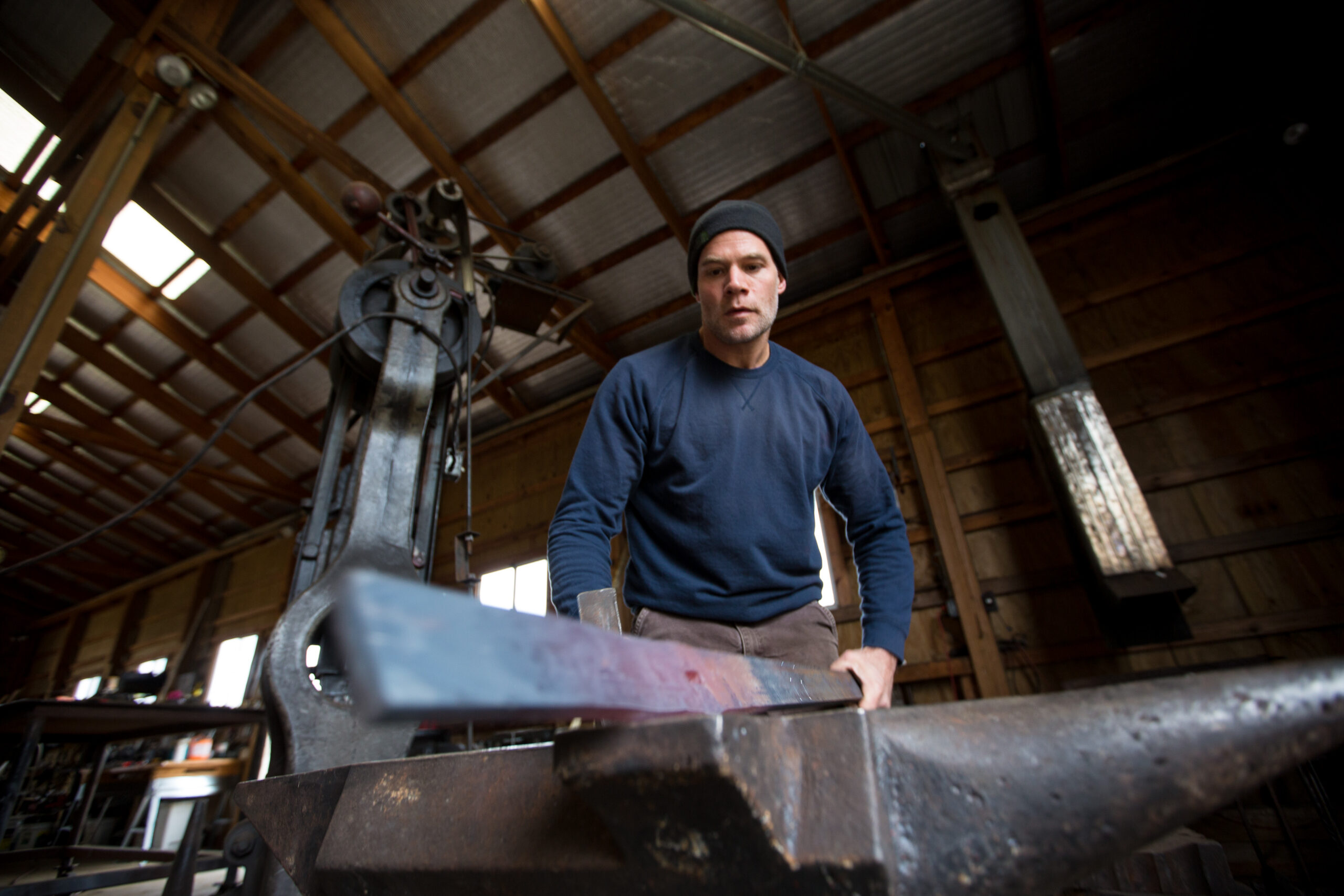
Blacksmithing is an ancient craft, but metalworker Edward Pelton has carved out a modern niche during his three decades in the studio. Pelton Metalworks produces architectural sculpture ranging from the functional to the ornate for contractors and designers, homeowners, and art aficionados.
Pelton, who lives in the Charlottesville-area home where he grew up, recently spoke to Abode about finding his way to the trade for which he was destined.
C-VILLE Abode: You’re in a tradethat seems to be dwindling. Is that a concern?
Edward Pelton: I would push back on that and put forward the idea that the rarer something is, the more valuable it becomes. I’ll tell you a story. My oldest daughter went off to school—she’s a business major—and in her first week of school, she told me she read that around 1900, there were 236,000 blacksmiths employed in America. Within about 20 years, that dwindled to about 12,000. But while the Industrial Revolution mechanized what we would traditionally call a blacksmith, people like me, in our own niche way, are flourishing.
How did you learn the trade?
I owe a great debt to people like Nol Putnam, Tom Joyce, and Francis Whitaker—all the guys that came before me. These were mostly back-to-the-land guys, hippies, basically. As early as the ’60s and ’70s, these were the guys that made blacksmithing cool. The generation before me, they rediscovered the knowledge required for blacksmithing and rescued it for the next generation.
I assume modern blacksmithing requires a unique skillset compared to the traditional trade.
I think there are some of the same skills, but you definitely have to be a different kind of person than someone who was making commodity products in the early 1900s. There was a time, depending on how far back you want to go, that blacksmiths did everything. I’m focused on a certain high-end architectural market. But I will also say that industrial smithing and forging are still very much alive. It’s just done with robots. No matter how much we change, the metal has not. It still reacts to heat, cold, tempering, forging. The metallurgical part of it is still very relevant even in the modern age.
What about blacksmithing is appealing to you?
I basically walked into a blacksmith shop in the early ’90s and never left. I fell in love with the ring of the anvil and the smell of the coal right from the get-go. Over 30 years, it’s never occurred to me to leave. This is what I’ve always wanted to do—to be gainfully employed as an architectural blacksmith. This is who I am. I finally found a place for my ADD. I have almost unlimited physical energy, even now. I love moving around and doing things with “my head, my heart, and my hands,” as Nol says.
When you work with clients, do they have a design in mind, or do you get to be creative?
It happens both ways. I often get a drawing from an architect, but I like to say that 85 percent of the design is done on the face of the anvil. We can draw things all day long, but a two-dimensional drawing on paper is not real. I also have private clients who come to me and say, “I want this pedestrian gate and I have a few images that I like—what do you think?” Those are the times when I get to do the bulk of the designing. It’s like the difference between being a singer, a songwriter, and a virtuoso. If someone gives you Beethoven’s 7th, you’re supposed to knock it out. You’re not rewriting it. But I almost always have creative involvement on a practical level. Function always comes first. It can’t just be pretty. If it’s a table, it can’t shimmy. If it’s a railing, it has to take lateral thrust. If it’s a gate, it has to swing.
Do you ever make art pieces and just hold them in inventory?
There have been a few times when I got involved with other artists, carpenters, and creatives. And I’ve definitely made a bunch of one-offs that I put in galleries. I love doing that. And it’s worth it when someone sees it and decides to buy it. But so many people come to me with ideas—I’ve developed lots of relationships with builders and architects—that it keeps me more than busy.
What’s your favorite thing to make?
The short answer is gates. I have a love/hate relationship with railings. There’s so much engineering and diligence required to get a slope-curve railing to follow a stair. It’s incredibly satisfying when it’s done, but it’s a different mindset. With gates, you have this big, beautiful palette. For some reason, that’s the thing that really resonates with me.
How would you describe your typical client?
I’ve been doing this for 30 years, and so I’ve done work all over the world. But happily—especially when my kids were young—most of my work is local. I live out in the Ivy area, and I used to joke with my guys in the shop that “we could put the railing on the truck, or we could just walk it through the woods.” Some of my clients are almost closer as the crow flies, and I feel really grateful for that.
Do your pieces fit better in traditional homes than they do in modern homes?
I think that’s one of the misconceptions about blacksmithing. Forge work in general can be amazingly sculptural and ornamental, but it can also be contemporary and clean. I have one particular customer that always says to me, “I don’t want any curlycues.”
I read that you made the sculptural railing that’s now outside Boylan Heights.
That’s going back to the ’90s. I worked on the restaurant there at the time, and they wanted an exterior piece that acted as a barrier to comply with ABC rules when they had the windows open. That was a really fun piece. I was riffing on contemporary work from Eastern Europe, where they have a very different design sense. I guess I was in my mid-20s at the time; I’m in my mid-50s now. The thing is, I think blacksmithing is actually pretty good for you. When I started, people were like, “hey, it’s not healthy.” And yeah, I’ve spent a lot of time standing in front of a coal fire and been around a lot of metal dust, but the movement and the fact that I stay on my feet has generally been good for me. Plus, I’m engaged in something that, even now, I still love.