It would be hard to find a better example of the resiliency of the human spirit than Edith Hern Fossett (1787–1854). Born into slavery at Monticello, Fossett was taken to Washington, D.C., when she was 15 to cook for Thomas Jefferson at the president’s house. She received instruction in French cuisine from Honoré Julien, George Washington’s former chef. Fossett would remain in Washington through Jefferson’s two terms, receiving a monthly $2 gratuity ($50 today). During her tenure, she bore three children with her husband, Joseph Fossett, the son of Mary Hemings, Sally Hemings’ much older half-sister. The couple saw each other rarely as Joseph remained at Monticello where he was head blacksmith. The position allowed him to keep a small percentage of the smithy’s profits.
In 1809, Edith returned to Monticello where she would remain the chief cook until Jefferson’s death. Jefferson’s will granted Joseph his freedom effective July 1827, but Edith and eight of their 10 children were put up for auction in January of that year. Joseph arranged for his brother-in-law, Jesse Scott, a free man of color, to purchase his wife and the two youngest children for $505. It took 10 years, but by 1837, Joseph, Edith, five children, and four grandchildren were all free.
The family moved to Cincinnati, Ohio, where they flourished. Two more children, who’d gained their freedom, eventually joined them. Two sons set up a successful catering enterprise and family members became actively involved in the abolitionist movement, helping numerous enslaved African Americans escape through the Underground Railroad.
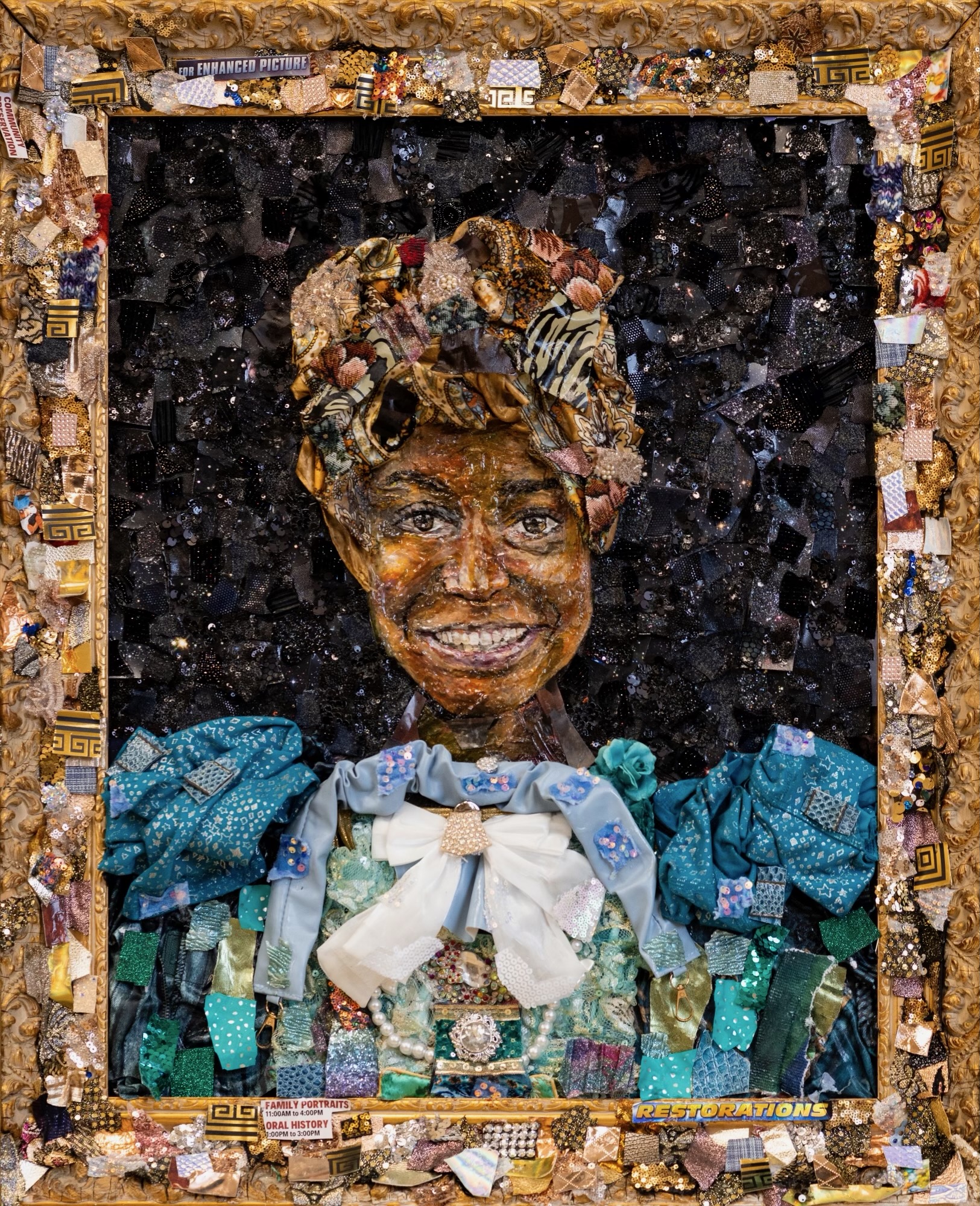
Fossett was the only one of four Monticello inhabitants selected for a show currently installed at Monticello’s visitor center who didn’t have a likeness. So, the staff commissioned Jabari Jefferson, a Washington, D.C.-based artist and descendant of Monticello’s enslaved community, to create one.
Jefferson approached the commission, which can be viewed by appointment until the completion of the Daniel P. Jordan Archaeology, Research, and Collections Complex in 2027, with “care and delicacy,” determined to show Fossett’s full humanity.
“She had a very rich life with a lot of joy,” says Jefferson. “She found love with someone who stood by her. She had 10 children, she learned a valuable skill, she experienced proximity and praise from the country’s elite. She was able, not only to gain her freedom, but also saw nearly all her children gain theirs.”
Using repurposed material—paper, jewelry, clothing—he gathered primarily from Monticello’s staff, Jefferson created a dazzling surface. To produce the volume, depth and luminosity of Edith’s radiant face, he applied multiple layers of oil glaze.
Gold is associated with the divine, in both African and Western traditions. Jefferson uses it in much the same way an Italian Renaissance or Russian icon artist would: to exalt his subject and endow her with a sense of divinity. What’s so striking about Jefferson’s portrait is how full of life it is—seeming almost to vibrate with energy. The gold, the bits of colored material that flash like jewels, and Fossett’s beaming face all animate the work and convey a sense of the powerful life force that existed within this remarkable woman.
“It’s not that I’m exaggerating her happiness; I’m opening up the conversation and going further,” Jefferson says. “You normally don’t see people who’ve experienced enslavement presented in portraits with any joy, charisma, or vibrancy. If I can create something that presents the humanity of a person, it can change how you view the institution of slavery.”