There’s a lot of cosmic coincidences in Anouk Steinke’s story. A few years ago, when she decided to semi-retire and leave her California home, a friend here “just happened” to find an online listing for an Orange County property he thought she’d like. The place was a renovated farmhouse in the middle of a large estate called Dutchmont—appropriate, since Steinke was born in The Netherlands. Since she couldn’t leave her animals behind (eight horses, two goats, and a pet steer), it helped that this property included a five-stall barn and lots of pasture. She saw the listing and loved the place, but thought it might be out of her price range. Her friend said roll the dice, so Steinke made what she thought was the lowest possible offer, and it was accepted.
The resulting match is perfect. While the estate goes back to a larger farm from the 18th century, Steinke’s renovated home is actually a 2009 conglomeration of three old farmhouses, a cabin, and an abandoned mill. Both an interior designer and an artist, she appreciates the historic touches and the building’s funky character. “They incorporated everything—there were no nails [in the farmhouse section], it was all [by] Amish builders,” Steinke says. Which isn’t to say she didn’t have to do some renovation.
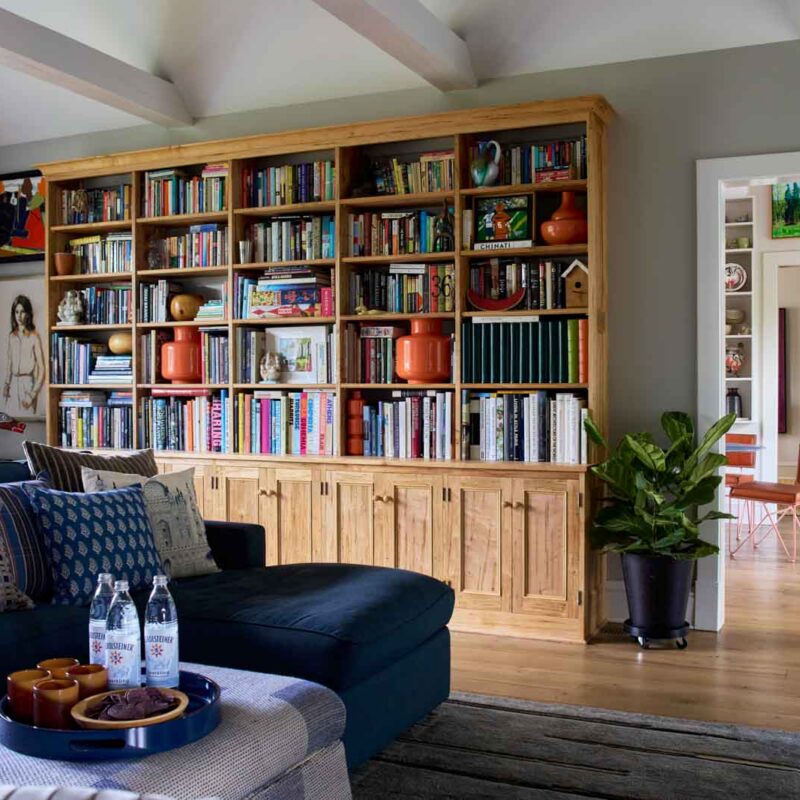
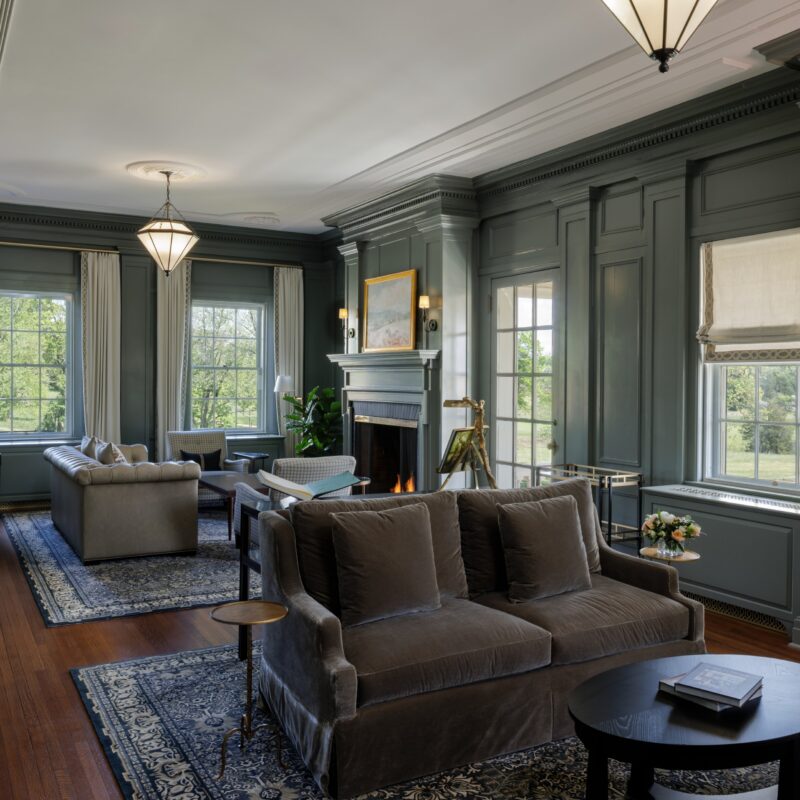
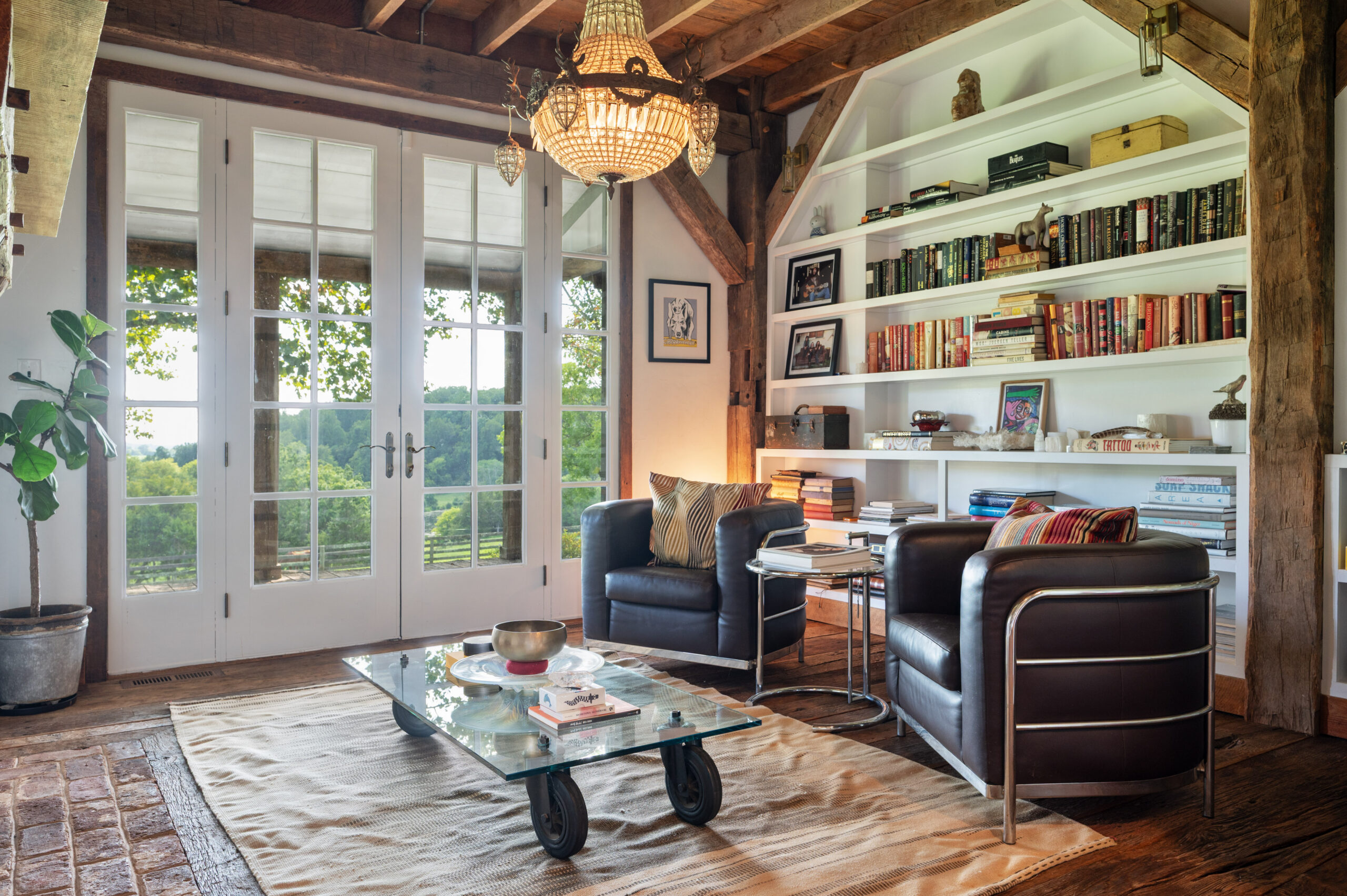
The bones of the house are still indisputably historic. The original post-and-beam construction is set off against white plaster walls. The floors are wide wood planking, of varying widths in various sections. The middle of the house contains the living and dining spaces—several of them. (“The house had three living rooms,” Steinke recalls. “What do you do with three living rooms?”) Her renovation opened the spaces up for better flow and definition. Now there is clearly a foyer, a living space, a dining area, and a library with floor-to-ceiling shelving and a focal fireplace. The interior is full of natural light, thanks to the oversize windows and the double door to the back patio overlooking the pastures and fields beyond.
When she bought the house, Steinke says, it was full of old and more ornate stuff—heavy furniture, plaster busts, large dark paintings in gilded frames. “It was hard to see its potential,” she recalls. Once the space was reorganized, her artistic taste and interior design skills made it shine.
Steinke describes her style as “minimalist bohemian:” a touch of Scandinavia, a love of texture, and a taste for contemporary art. A major influence is the style of the American West—well-worn Stetsons, antlers, leather, and saddle blankets abound. Most of the furniture is clean and modern, with comfy leather armchairs and sofas; the area rugs are old Orientals or Moroccan tribal rugs. The art is predominantly colorful abstracts or contemporary graphics.
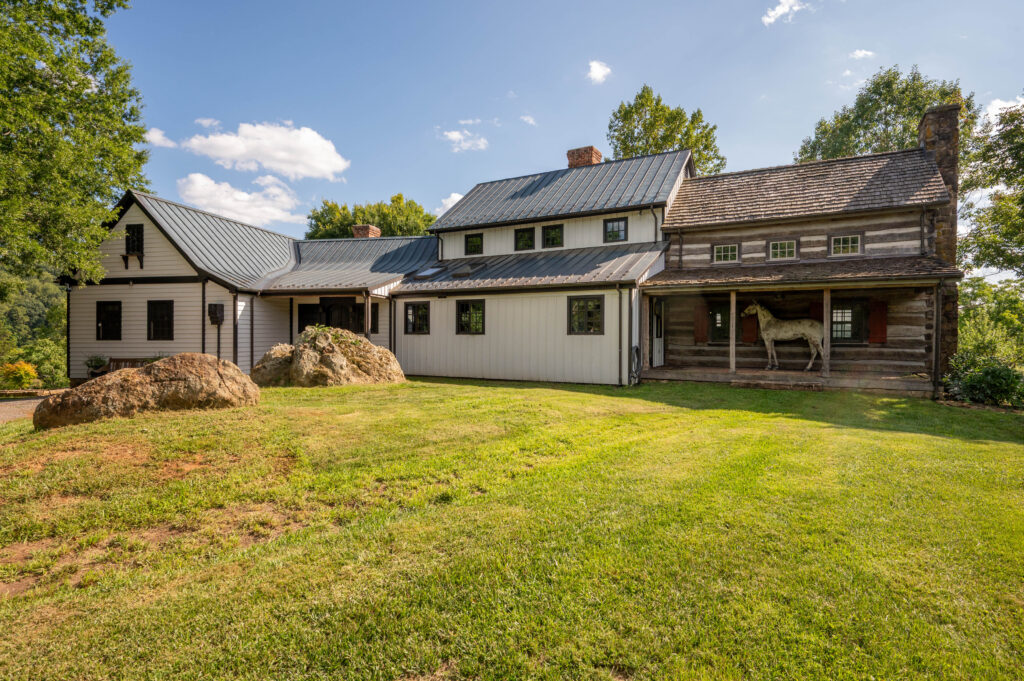
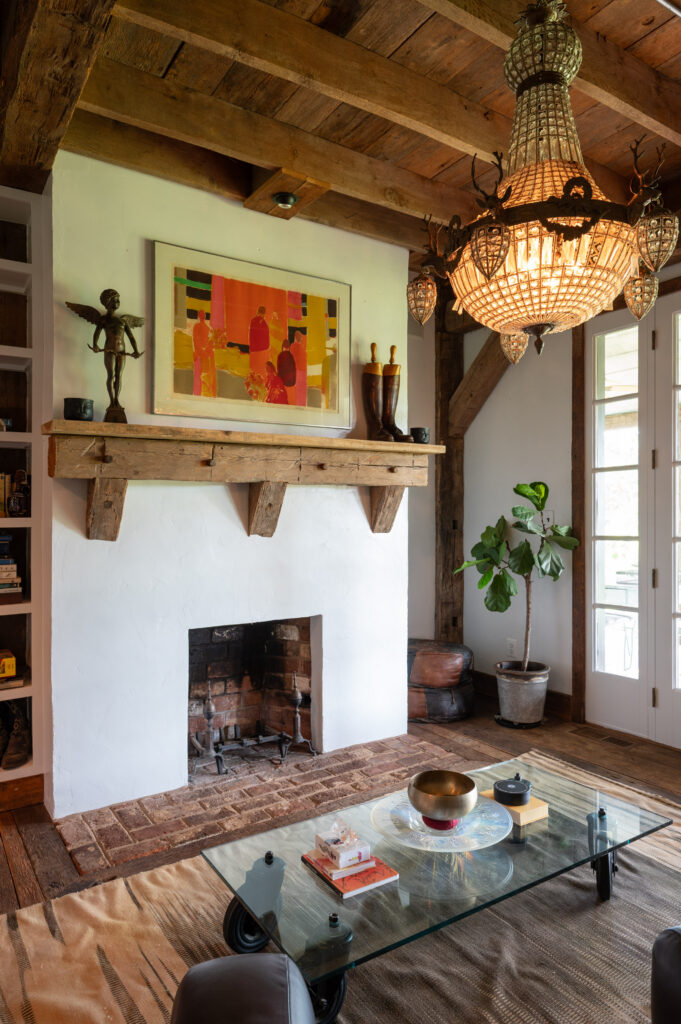
And then there are the funky touches. In her office, Steinke has a metal desk and filing cabinet that look like they came from a WWII government building. Hanging above the glass coffee table in the library is a perfectly incongruous ornate cut-glass chandelier decorated with metal stag’s heads—one of the few objects she kept from the original furnishings. In the back room is a well-filled Wurlitzer jukebox that belonged to Steinke’s father (and still works); hanging over it is a Roy Lichtenstein graphic. On the front porch is a full-sized wooden horse that once stood at the entrance to an Arizona mining ghost town.
From the way the house was cobbled together, it’s not surprising there are several stairways and tucked-away spaces. In the primary bedroom, Steinke replaced the floor-to-ceiling windows (“I like my bedroom darker”) and added a walk-in closet—with its featured piece being a six-foot 19th-century Oriental painted wardrobe/cabinet. The second-floor guest bathroom has retro black-and-white hexagonal tile, footed tub, and pedestal sink—and a silicone nightlight shaped like Miffy the rabbit, hero of a popular Dutch picture-book series.
The other end of the house is the almost completely reconstructed log cabin, now a cozy den with large, weathered leather sofas. Here too the mix of décor is surprising yet fitting. A stand-out piece is the traditional Western longhorn skull—completely covered in intricate and colorful beading by Ali Rouse, one of the artists represented in Steinke’s California gallery.
Throughout the house is the combination of contemporary, rescued, and classic that expresses Steinke’s style: a wooden country storage bench, a pair of chrome-and-leather barrel chairs, Bauhaus-style lighting, old doors with the paint half-scraped off—somehow it all works. Steinke has clearly made this new/old house her home: “It’s big but understated,” she says. “It’s just a cool place.”
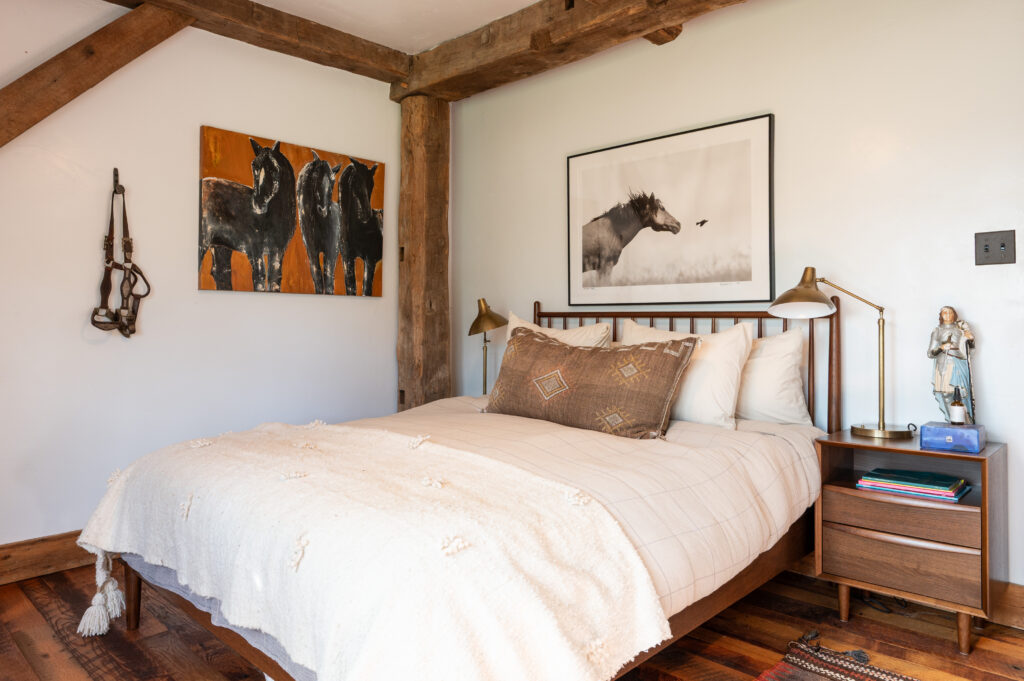
The art of the horse
It’s not surprising that Steinke has settled in horse county. “Horses have been a part of my life always,” she says. And horses—their spirit and their soul—are the subject of her artwork.
Working in mixed media using a palette knife, often incorporating other materials, from horsehair to fabric and clay, Steinke focuses her compositions on a single animal, usually in silhouette, occasionally with a human figure. “The character comes out more when it’s one horse—more horses make it a scene,” she says.
Right now, Steinke is working on a series of famous mounts—“royal horses,” she calls them. “For most of them, nobody knows their names.” While she will do occasional horse portrait commissions, what she is always searching for is “the soul of the horse; and sometimes, with one stroke …”
Now that she has more time to paint, Steinke is exploring relationships with local galleries, as well as selling through her website (she is currently producing some limited-edition prints). But horses will always be the center of her work. “Through my life, horses have kept me on my two feet, in check. They are my anchor.”