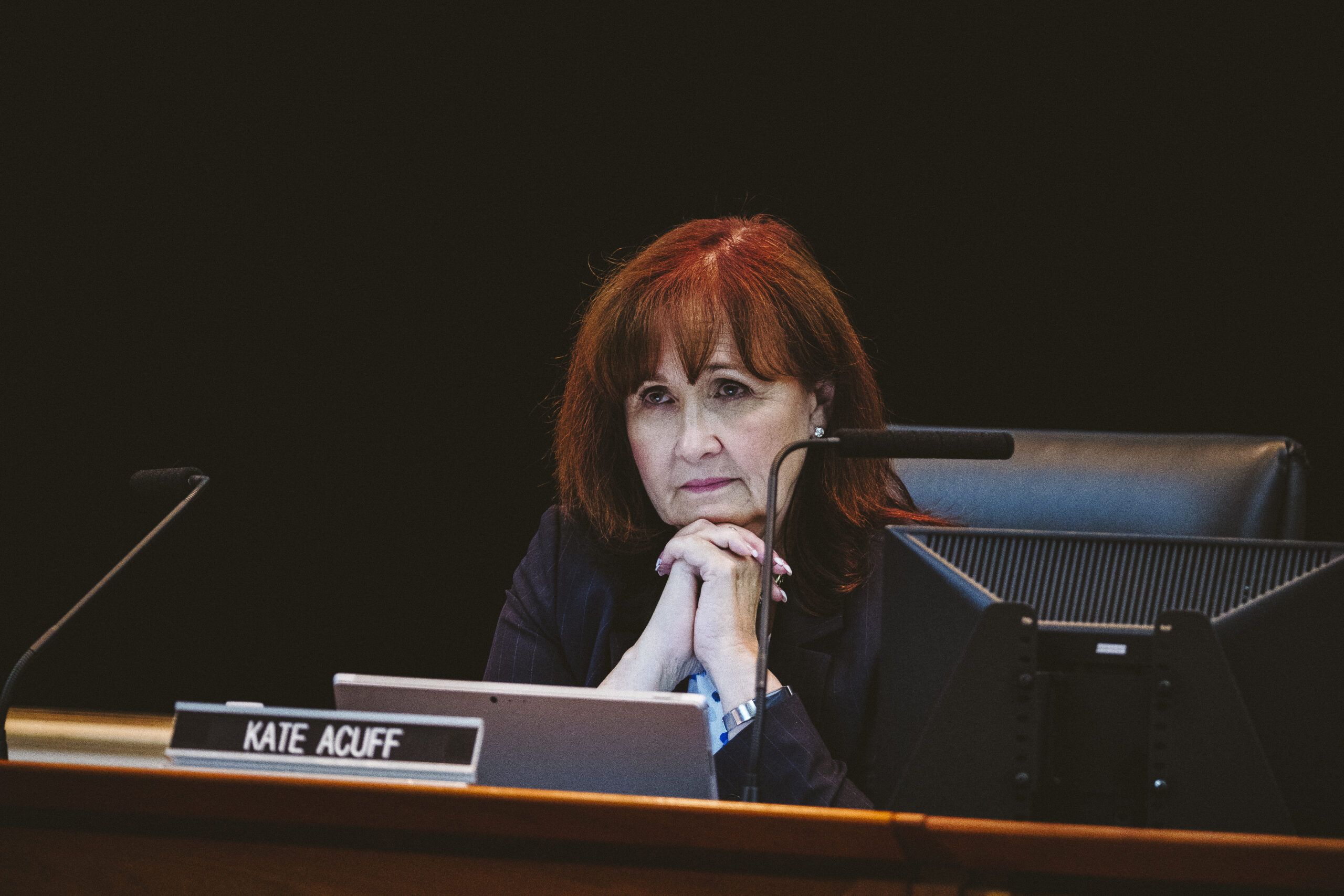
In the hours before the Albemarle County School Board met on June 11, board member Kate Acuff texted former superintendent Matthew Haas: “Call me when you have a second.” That night, the board would decide whether to ask Haas to resign amid a scandal over an employee accused of sexual misconduct with children.
Roughly three and a half hours later, Acuff added, “Bad,” and two minutes after that, “It won’t be in public.”
“But it’s going to happen?” Haas asked shortly after.
“Looks like it,” Acuff replied.
It’s difficult to confirm when these texts were sent; the messages, drawn from Haas’ phone, sometimes have timestamps hours earlier than events they apparently describe. But Acuff may have sent this last remark during the school board’s closed meeting, amid deliberations over Haas’ future.
As a recall effort attempts to remove Acuff from office, these messages—obtained via a Freedom of Information Act request by members of the community—appear to show a close friendship between Acuff and Haas that may have influenced Acuff’s supervision of the former superintendent.
Smiles and thumbs-up
Under Virginia law and local policy, the school board employs the superintendent. The board acts as the superintendent’s boss, and is charged with holding superintendents accountable for their performance.
“I do understand when people work together for a long time … there should be a level of friendship,” says ACPS Family Council member Lizzie Batman. “But it feels like this friendship was less looking out for students and more looking out for each other, or Dr. Acuff looking out for Dr. Haas.”
Throughout the texts, Acuff sends Haas cartoon emojis of herself expressing frustration or giving smiles and thumbs-up. She frequently praises Haas and expresses concern for him. In one February exchange, Haas replies to a redacted message from Acuff: “Aww you made my day, Kate, thank you,” with a blue heart emoji.
During the controversy over the district’s decision to transfer Greer Elementary’s principal to fill a vacancy at Crozet Elementary, Acuff repeatedly offers to show up to meetings with parents and faculty to backstop Haas. “Hope you are OK,” she texts on April 30. “I am no [sic] in the least questioning your decision but wondered if you would like me there as a silent supporter. … I will be your moral support from a distance…”
On May 3, Haas responds to another such offer: “I would appreciate it if you were there, Kate,” later adding, “it meant a lot to have you there.”
“I’ve known Dr. Haas since I joined the [school board] in 2014,” Acuff says. “I am friendly with Dr. Haas and have worked closely with him since he became superintendent [in 2017], particularly during times when I served as chair or vice chair. … I have not been shy about talking with him about his performance.”
Performance review
In a May 11 text exchange—roughly one month before allegations of child sexual abuse against former ACPS employee Michael Swiney became public knowledge—Acuff messaged Haas about performance reviews that occurred during her tenure as school board chair.
“Re your annual review,” Acuff writes, “I confess, when Chair, I urged [board] members to get their comments to you and I gave mine directly to you Chair or not. However, I did not submit anything to HR or compile a general report. [Current Chair Rebecca Berlin] wants to meet with me re process and whether there have been any support plans and such previously. You are always conscientious re your mid-year and year self reviews and my experience is that the [board] reviews have been reacting to that for the most part.”
“When something’s not working, when someone’s not doing what they’re supposed to, you need to have it documented so we don’t have a huge mess like this,” Batman says. “Because I believe a lot of what’s happening, a lot of the crazy things, come from the top.”
State law gives boards the power to evaluate school board members, but doesn’t specify a process. Instead, the law points toward guidelines set by the Virginia Department of Education. Of the four criteria those guidelines list, only one—student outcome measures—is required by law. Two of the other three optional criteria are self-reported by the superintendent to the board.
Acuff did not respond to questions about the evaluation process during her time as school board chair.
“We did [Haas’] evaluations, but there wasn’t a formal process in writing for a standard to go on from chair to chair,” says former at-large member Allison Spillman, who resigned from the school board in August. Spillman says she and Berlin were working on a formal process before the June revelation of Swiney’s arrest and charges.
“Dr. Haas gave [a] self evaluation,” Spillman says. “Each of the board members was asked to submit feedback to the chair, and then the chair would put something in writing to share with Dr. Haas.”
Spillman says there was no formal process for the board to address complaints about the superintendent’s conduct. Policy states that all concerns sent to the school board about any district employee “shall be referred to the Superintendent/Designee for decision.”
“I do know that complaints were told to me over the course of my tenure in Family Council,” says Batman. “People didn’t trust him. That was really what it came down to.”
Open and closed
On June 11, after telling Haas that “it looks like” something—likely the call for his resignation—will happen, Acuff adds, “I tried… I want to leave as well…” About 15 minutes later, she continues, “I’m going to leave before the next closed [session]. This stinks.”
Timestamps for Acuff’s texts indicate the above exchanges with Haas took place between 3:30 and 4pm. However, the messages refer to events that didn’t happen until after the closed session began at 4:45pm. The board didn’t begin a public meeting until 6:43pm.
“These text messages tell [Haas] everything we were doing in closed session,” Spillman says.
On two prior occasions, timestamps from Haas’ phone diverge from events they describe. One March exchange lists a specific time that suggests the texts are stamped three hours earlier than they actually occur. An April text from Acuff mentions Haas’ remarks at a school board meeting that night, where transcripts show he didn’t speak until nearly an hour after the listed time of Acuff’s message.
Virginia law does not prohibit attendees of a closed meeting from divulging what happens within it, nor impose any legal penalty for doing so. “However, if a board member chooses to make that information public, then it undermines the very reason that the meeting was closed,” school board member Ellen Osborne says.
In an interview on WINA Radio the day after the June 11 school board meeting, host Jay James told Acuff, “I want to stipulate this: Legally, you cannot discuss or reveal what is discussed in closed session, i.e. why it’s a closed session.”
“Exactly,” Acuff replied.
Acuff did not respond to C-VILLE’s questions about whether she had been texting with Haas during the first closed session on June 11. She left the meeting before its second closed session began at 8:26pm, reportedly feeling unwell. The remaining members voted unanimously to request Haas’ resignation.
‘Political nonsense’
Acuff now faces a recall campaign led by Albemarle County Republican Party chair Phil Riese, allegedly with bipartisan support. In an August 14 interview with WINA, Acuff told Cville Right Now’s Mike Barber that Haas informed her of a situation involving police and an employee placed on leave prior to June 3, when Spillman and other board members say they learned the details of Swiney’s case.
“I did not learn the substance of what was going on,” Acuff told Barber, “until all my colleagues learned it when the charges were brought.”
Virginia code instructs superintendents that “any neglect or violation by teachers of any of the laws or regulations shall be promptly reported to the school board.” Swiney was placed on leave in January.
In a final text to Haas on June 11, timestamped 5:49pm, Acuff writes, “I’m so sorry, Matt. This is unfair political nonsense and it leaves the Division in a bit of a mess.”
“Generally, I believe that poor decisions often come out of crisis situations,” Acuff says, when asked about that message, “and my primary concern during the first closed meeting wasn’t whether Dr. Haas should or shouldn’t be asked to resign. It was the speed at which the decisions were being made. Of course it was important to allay the concerns of the public. … However, the [board] agreed that a decisive action was needed. Ultimately, the buck stopped with the superintendent.”
“It’s not political nonsense,” Batman says in response. “Kids were put in danger. This is not political nonsense, and thinking that it is, is actually insane.”