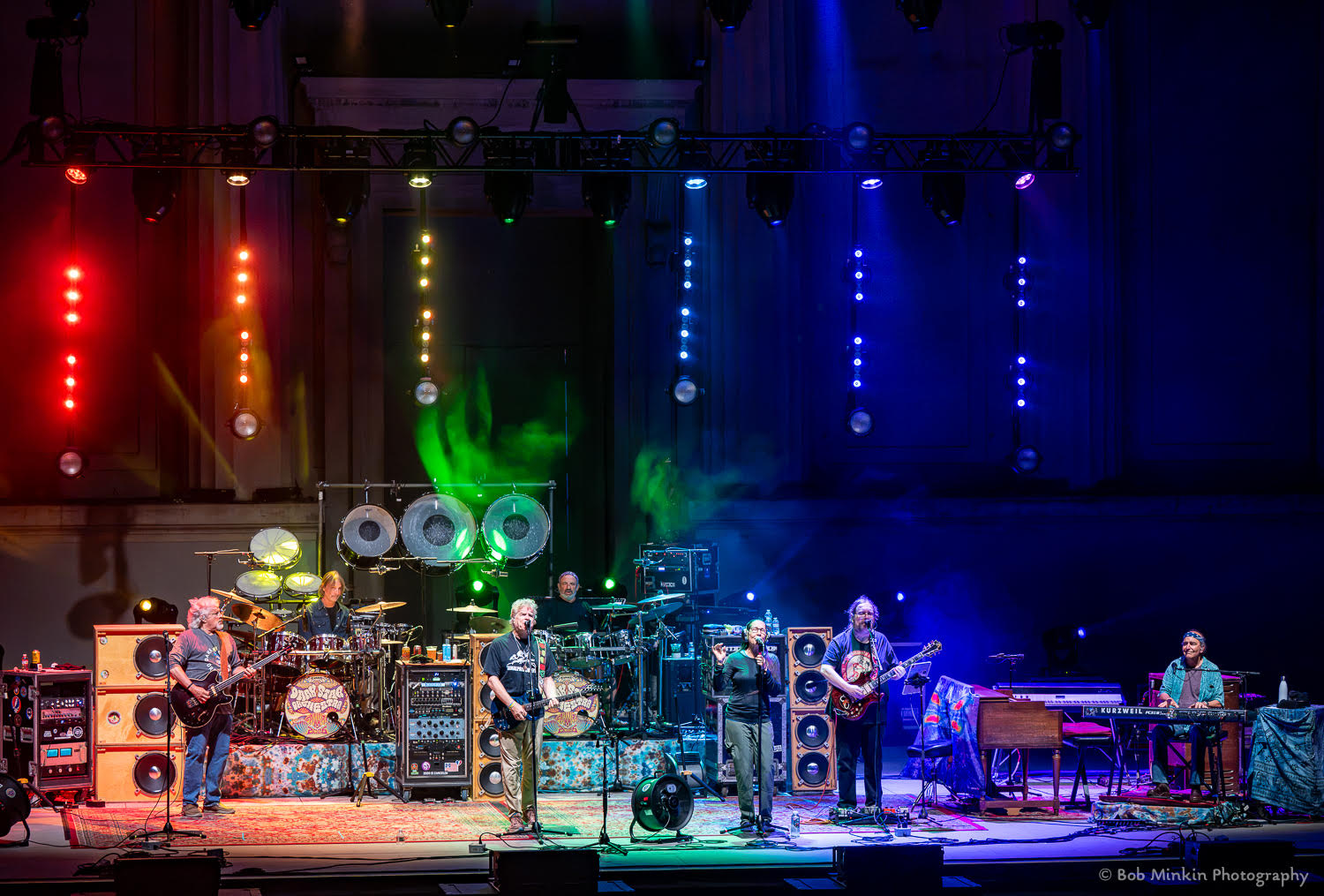
Dark Star Orchestra keeps the love alive in tribute to the Grateful Dead on September 10 at Ting Pavilion. Photo: Bob Minkin
According to Dark Star Orchestra percussionist Rob Koritz, the seven-piece cover band is “fanatical” about capturing the spirit of each Grateful Dead show it reenacts.
When DSO takes the Ting Pavilion stage on September 10, that attention to detail will be on display. But as Koritz told C-VILLE Weekly in a recent interview, exactly which show the band will do on any given night remains a mystery until the tour starts.
C-VILLE: Has DSO seen an uptick in attendance now that there’s no Grateful Dead iteration on the road?
Rob Koritz: The last three or four years have been really good, actually. And the thing I’ve noticed is that our audience is getting younger. These young people, who very well may never have seen the actual Grateful Dead, are getting turned on to this great music.
Why do you suppose that is?
Lots of different reasons, but I think some of it is a direct correlation to Dead & Company, with John Mayer being in that band. He brought in a whole different demographic. Another part of it is there’s people out there with really cool parents who are Deadheads. … Unfortunately, in the last two years, we lost Phil [Lesh], Donna [Jean Godchaux], and Bobby [Weir]. So, people want to celebrate them, and we’re an avenue that they can take to celebrate them and the music.
What other jam bands do you most appreciate?
Dead & Co. was a huge draw, and I saw them multiple times myself. I’m sure there’s young people out there these days who are fans of Goose and Dogs In A Pile and Daniel Donato; it goes in cycles. I admittedly don’t get a chance to see a lot of the newer jam bands. I do try to get out to festivals.
Dave Matthews Band became a big part of the jam scene. What’s your take on Charlottesville’s most well-known export?
There’s a love-hate relationship with that band for people. I’ve always loved them, partially because I’m a drummer and Carter Beauford’s one of the coolest, most innovative drummers ever. The Dave Matthews channel is one of the presets on XM in the car. I remember back in the day when we were first starting and they had just blown up, and we played at Trax. I always look forward to coming to Charlottesville—or even Richmond or Norfolk. Virginia has a strong jam band fan base.
Phil Lesh and Bob Weir have both played with you guys, correct?
Bobby played with us probably eight or 10 times. I think Phil played with us three times. Billy [Kreutzmann’s] played with us a couple times. Donna played with us dozens and dozens of times. She was a very good friend of ours. When an original member comes out and plays with us, it’s incredibly cool. I remember the first time Bobby played with us—or really the first time any of them played with us—it was kind of a novelty. When they want to come back and do it again, that’s really flattering and validating.
What else can you tell us about playing with Bob Weir?
The first couple times Bobby came out, he just showed up and we played. And then the last two times he played with us—especially the last time—he came out in the afternoon and we rehearsed for an hour and a half. He wanted to come and jam for a while before we went on stage. That was huge to me. It was him saying, “Let’s work on this” and “Let’s see what we’re going to do here; let’s have some fun.”
I would imagine it’s also nervy to play with your idols.
I’ll tell you a real quick story that sums it up: 2002, Warfield theater in San Francisco. Bobby’s coming to play with us for the first time. He walks in the door, and I’m the first person he sees. I introduce myself, and he says to me: “Really glad to be here. Let’s go out on stage, and whatever you do, don’t try and impress me. God knows I’ve gone on stage and tried to impress somebody and fell flat on my face.” It instantly put me at ease. I was like, “All right, man, this cat is cool.” We had a great night, and it was the first of many times that he played with us.
Any hints about the set you guys will play on September 10?
A lot of it will have to do with whatever we did the last time we were there. Whenever we come back to a place, we try to do something different.
What’s next for Grateful Dead music?
It’s not going anywhere. Bobby’s big thing was that he wanted this music to live on for 300 years. I don’t think that’s going to be a problem.