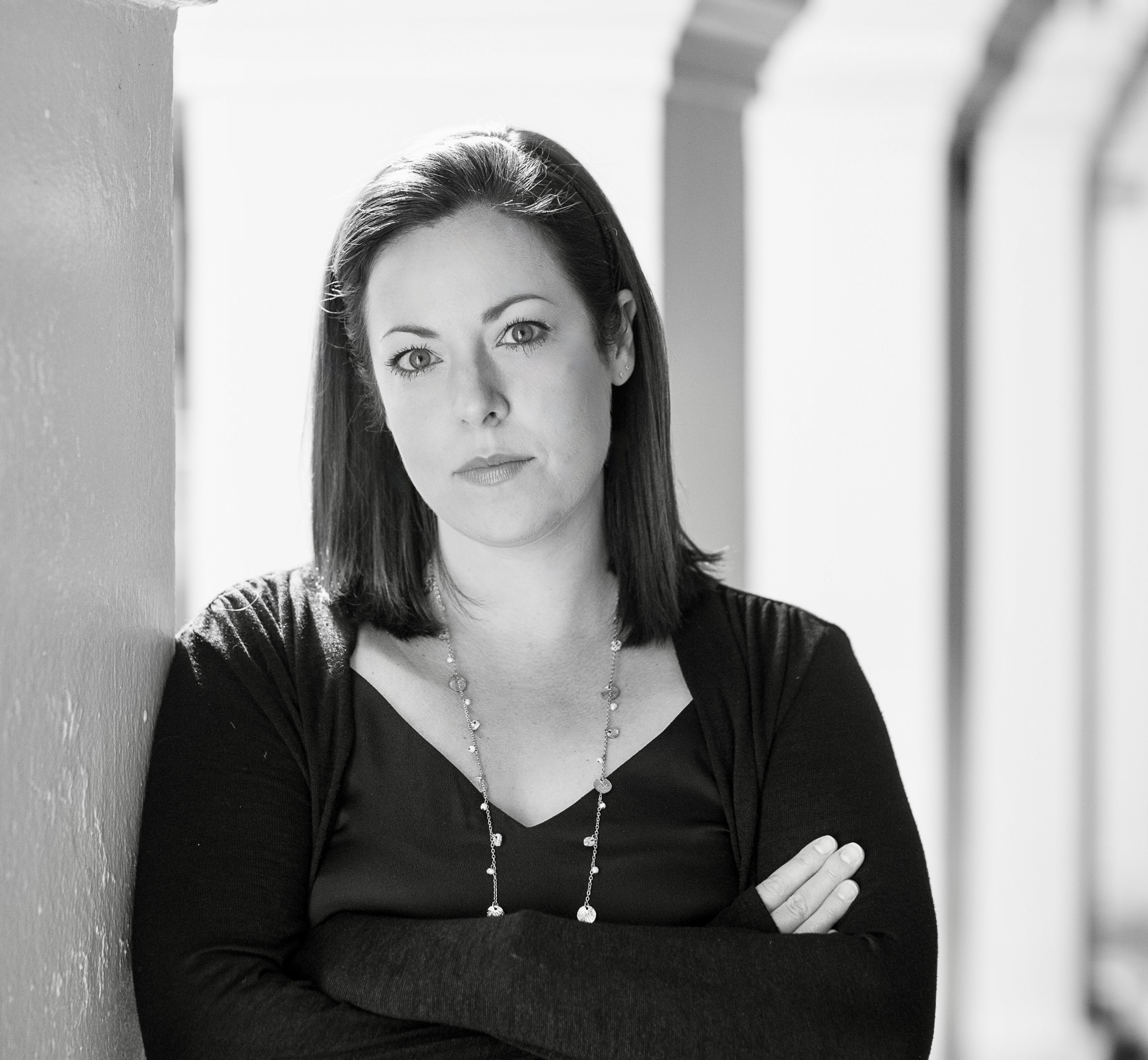
Timbre is an elusive sonic attribute. UVA professor Leah Reid has devoted her career to pinning it down.
Reid, who’ll host a meet-the-composer event at the Staunton Music Festival, says timbre is “the combination of how sounds are built up … and how they evolve and interact over time.” But as she notes in a research literature review, “there is no simple, objective, or single-dimensional scale that describes” timbre.
Reid’s response? Design a multi-dimensional timbre model using three cubes—one focused on frequency, another to account for noise-to-pitch ratio, and a third to understand a sound’s “brightness and darkness.”
It’s all spelled out in what is known as Reid’s Compositional Timbre Space, which the researcher first introduced in her doctoral thesis at Stanford University in 2013. “My admiration for many different composers and perceptual studies kind of led into my creating this model,” she says. “I’m deeply inspired by the sounds that surround us in our everyday life.”
Reid’s work is far from strictly academic. As an active composer, every piece she creates is intended to explore timbre. In “La Ballata,” she draws on the acoustic rhythms of a poem. In “Reverie,” she slowly cobbles together simple music box sounds over the course of 10 minutes, building to a melodic crescendo. And in “Crossed Wires,” which recently won the 2026 LunART Festival Call for Scores and was a finalist in the Society for Electroacoustic Music of the Czech Republic’s Musica Nova Competition, Reid explores sounds associated with telephones in a composition commissioned by Piedmont Duo.
The Duo, comprising Ayn Baliya and I-Jen Fang, will perform “Crossed Wires” as part of Reid’s Staunton Music Festival engagement. Listeners will hear amplified viola, percussion, and other electronic music elements as the work explores communication media past and present through telephonic clicks and beeps, dial tones, smartphone haptics, busy signals, fax machine bleeps, and even customer service interactions and hold music.
Reid, who grew up in the home of artists before being classically trained as a string performer and opera singer, does most of her performing in the studio these days. But she will hold forth in a conversation during the music festival, discussing her recent work, the science of merging acoustic and electronic sounds, and more.
“It will be a little bit about my background, my process,” Reid says. “Growing up, I was constantly finding inspiration in the sound around me. Those moments, those everyday sounds and how things combine—that is what I really enjoy digging into. There’s so much sound that surrounds us in this world.”
As an assistant professor in the University of Virginia’s Department of Music, Reid teaches acoustic and electronic music composition to students ranging from undergrads to Ph.D. candidates. She also helps organize a concert each year for students, bringing in professional musicians to flesh out their compositions.
At the Staunton Music Festival, Reid’s work will be featured in two other sessions along with the meet-the-composer event—a micro-opera and the other to be performed by a percussion quartet.
“I’m more of a traditional composer in that I love the relationship of handing my work to other performers and seeing them bring it to life,” she says.
Composer, sound artist, researcher, and educator, Leah Reid appears at Staunton Music Festival’s summer event, which runs from August 14–23, beginning on August 19. A schedule of her performances can be found at stauntonmusicfestival.org.