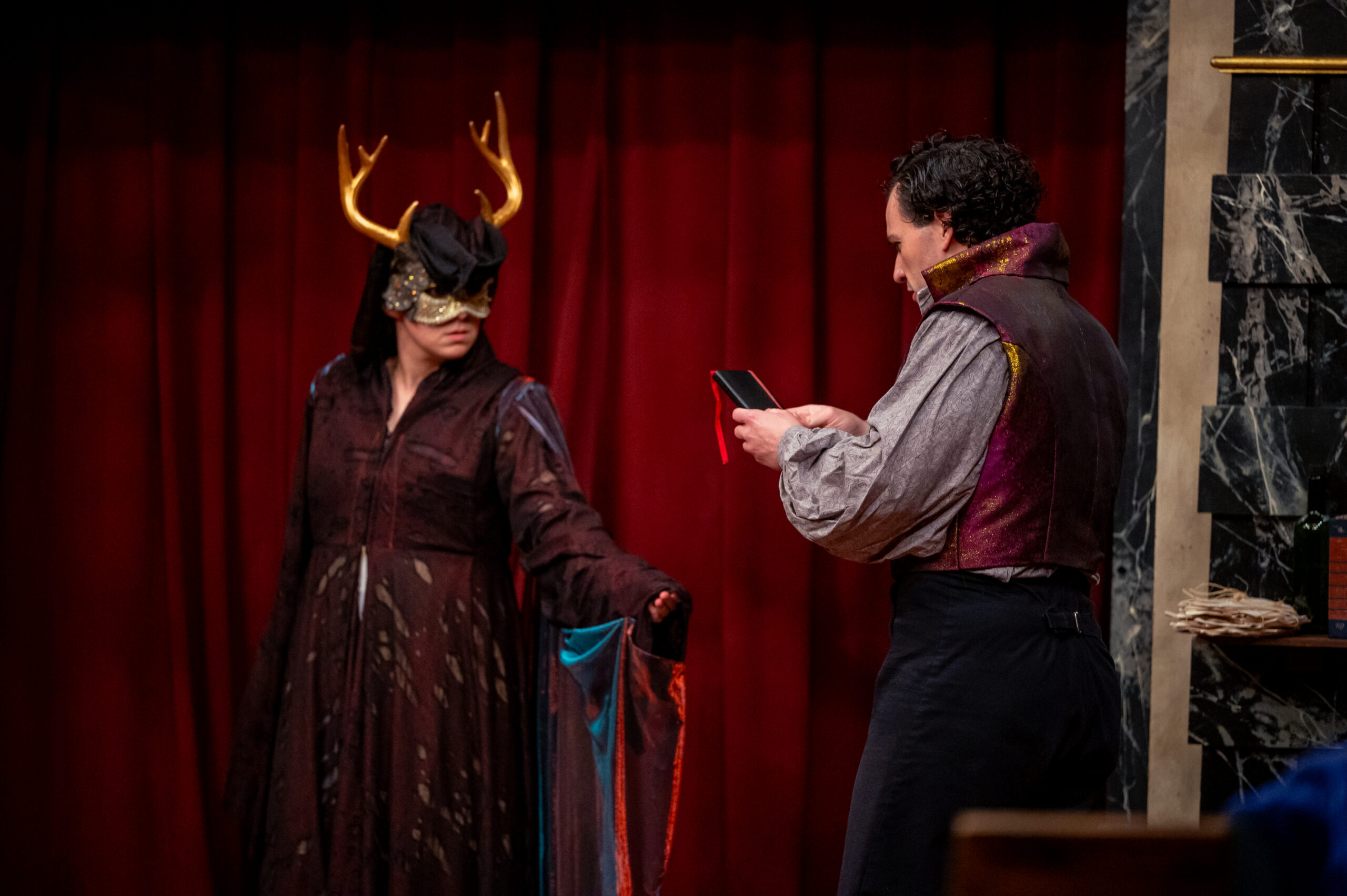
As an art form, theater holds the potential to do something that cinema or television cannot: connect with people in the flesh. Given that inherent possibility for eliciting close emotional ties with an audience, I was excited for what I hoped would transpire at the American Shakespeare Center, knowing that a 2019 retelling of Mary Shelley’s 1818 classic Frankenstein would be in the usually more-than-capable talents of high-caliber actors.
Unfortunately, the task of effectively capturing the fraught relationships, the multilayered pathos, and the nascent science proved to be too epic an aim for this sparse cast, and a beloved theater too tied Elizabethan standards, to do justice to Shelley’s horror tale.
For better or worse, playwright David Catlin’s version of the story harkens back to the literary origins of Shelley’s novel. Mirroring the opening scene of the very different Universal film sequel Bride of Frankenstein (1935), this production begins with Mary Wollstonecraft Godwin (Shelley’s birth name), herself involved in an hours-long ghost story competition with lover and eventual husband Percy Bysshe Shelley, Lord Byron, his pregnant wife, Claire Clairmont, and Dr. John Polidori.
While the others bicker over who had the scariest yarn, young Mary steps up with her own entry, the doozy we all know and love about the ill-fated, mad scientist and the doomed monster he makes. But Catlin’s early structural decision to put the story within the story renders the narrative muddled for those of us trying to follow the plot through the first half of this play.
Mary takes on the role of the abandoned love interest of her novel, Elizabeth Lavenza, while the rest of the partygoers jump at the chance to help her tell it. The English friends trade costumes and countenances to become an assortment of characters including Victor Frankenstein, the Creature, and a gaggle of sailors, villagers, supernatural figures. The difficulties that Victor and Elizabeth grapple with (due to the former’s extended absence in Germany where he obsesses about bringing his dead amalgamation of body parts back to life, while she’s left to raise their infant son) continually cut back and forth with the issues cropping up in Percy and Mary’s relationship; he’s still married to someone else and she’s clearly not okay with being his side piece. Fine.
But when they’re supposed to be bickering within Mary’s story and when they’re hashing it out in the play itself as writers is not clear—and maybe it’s not supposed to be. That artistic decision does have consequences, though, including confusion for those of us propped against wooden benches in a very bright theater watching a sparse cast attempt to give us a reason for being there on a rainy midweek night.
The switching between stories makes for some messy plot points to follow, but the bones of this play form only part of the problem. Another culprit? A lack of nuance.
Beyond ASC standout Angela Iannone, who performs a quartet of secondary characters and can do no wrong, the performances are, by and large, way too heavy-handed to be convincing. Ronald Román-Meléndez as Percy/Victor spends a sizable chunk of the show literally strutting and fretting across the stage, writhing on his back and gasping for air, or beseeching Mary/Elizabeth to believe his aim is true. For her part, Isabel Sanchez has a perpetually furrowed brow and delivers the bulk of her lines in a beleaguered yowl and on the verge of tears.
When you add Daniel DeYoung as the ridiculously saucy Byron parody or constantly enraged Creature to the two voices of his fellow actors, it amounts to an aural assault and ham-fisted vaudeville that is truly beneath this company. Loud does not equal emotiveness. Screaming lines at the top of one’s lungs does not necessarily equate to fine acting. Watching these three going full volume at each other for the better part of a couple of hours delivered a one-dimensional brutality that couldn’t be salvaged. By the second half, I found myself wishing for the Creature to push Victor and Elizabeth off stage and force them in a chase down Staunton’s South Market Street.
Admittedly, that’s a harsh take. But the actor’s shortcomings were exacerbated by both the Blackfriars’ lack of ambience for horror (the cranked up electric-lit chandeliers and spotlights at the back of the room would far outshine Shakespeare and company’s best candle haul) and the staging decisions made by director Aidan O’Reilly.
The line between horror and comedy was blurred often in execution and in the crowd’s response. No one was sure which was which. Sadly, the monster, with his bedazzled tatters and the guts of red fabrics thrown from Victor’s work bench elicited more laughs than gasps. I don’t want to insult the intelligence of the cast, crew, or my fellow audience members, but I think it’s safe to say that we ought to know a joke from a gruesome act, or a zippy rejoinder from a soul-bearing plea. We didn’t.