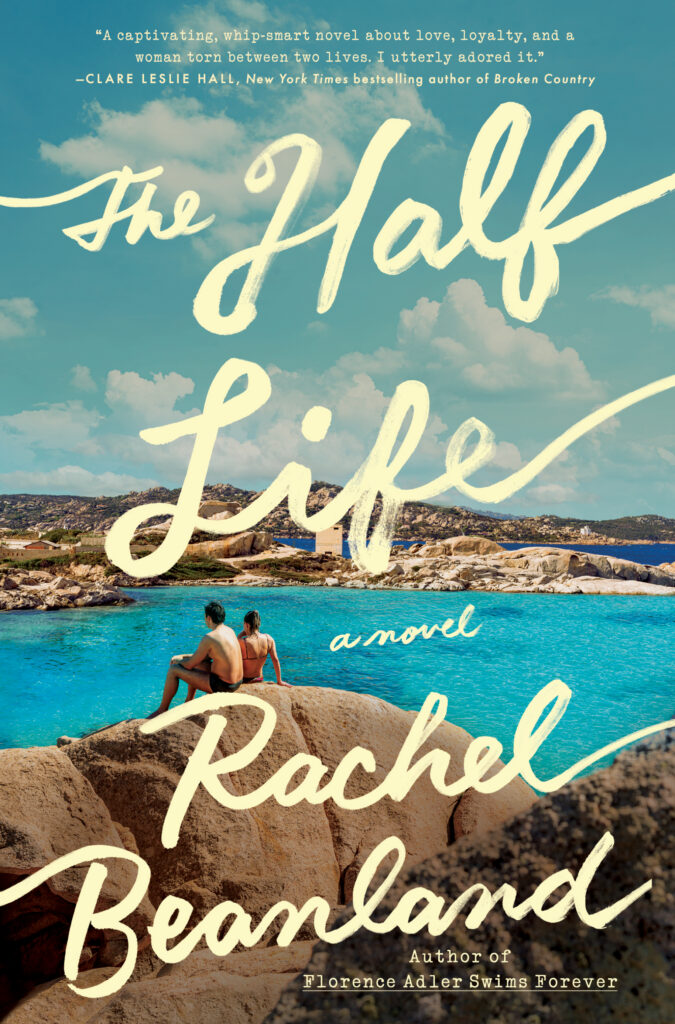
Framed by one woman’s story of self-discovery amidst geopolitical tensions between the U.S. and Italy in the 1970s, The Half Life is the latest historical fiction novel by Richmond-based author Rachel Beanland. Beanland is also the author of The House Is on Fire and Florence Adler Swims Forever, which won the National Jewish Book Award for Debut Fiction. She earned her MFA in creative writing from Virginia Commonwealth University and recently shared a few thoughts about her new book.
C-VILLE: The Half Life largely takes place on La Maddalena, an island in Sardinia, where you lived with your family in the 1980s, when your father was a U.S. Navy officer stationed there. Did the research for this book influence your understanding of childhood experiences?
Rachel Beanland: Definitely. My experiences living in La Maddalena as a kid were all positive. I ate a lot of focaccia and gelato, played in the piazzas, learned to swim in crystal clear water, and helped my mom make homemade pesto with pine nuts we’d gathered on the nearby island of Caprera.
I returned to La Maddalena for the first time in 2019, and it was after that visit that I began reading more about the island and the U.S. Navy’s presence there. The first U.S. submarine tender arrived in La Maddalena in late 1972. … A submarine tender repairs and resupplies nuclear-powered submarines, and while a case could be made for La Maddalena being a central location to conduct this work, it was also strategically advantageous to have Americans in Sardinia because there was real concern that Sardinia—not to mention all of Italy—would go communist in the next election.
Many Sardinians, particularly those who were members of the Italian Communist Party, were outraged to be living alongside Americans and their nuclear-powered submarines, and this led to a period of unrest. As I read more about the protests and political maneuvering that followed, I came to understand that life on the island during the Cold War had actually been a lot more layered than I realized, and that the landscape of my childhood would make the setting for a great novel.
Your debut novel, Florence Adler Swims Forever, was also deeply rooted in your own family history. How did that research compare to your process for The Half Life?
Every book is so different. Florence Adler Swims Forever was set in Atlantic City in the 1930s, which meant there were very few people I could talk to who remembered life as it was then. I interviewed my grandparents about their own childhoods (and the story of the real Florence Lowenthal’s drowning) shortly before they died, but much of my research had to be through other means. With my second novel, The House Is on Fire, which is set in 1811, there was absolutely no one I could talk to, so I spent a lot of time in the archives. But with The Half Life, I benefited from being able to call up people who had been stationed in La Maddalena in the 1970s. Some of their stories were wild, and … I really tried to write a novel that authentically spoke to the experience of serving in La Maddalena at that time. I also read a ton and traveled to La Maddalena on two separate occasions. Both those trips helped me better understand the island and its culture.
Set in the 1970s, The Half Life engages with political history in a way that is accessible for readers while still grappling with complex questions related to U.S. imperialism, environmental impacts of
the military-industrial complex, and intersections of faith and gender equity. Why was it important to you to include these themes in ways that highlight the issues without necessarily pointing to a tidy resolution?
As a novelist, I never want to preach. I want to give you a story, populated with characters you come to care about, and then let you think through the repercussions of their actions and the actions of those around them. One of the reasons historical fiction is such a pleasure to read is because history repeats itself. Nothing’s really new. So, without laying anything on too thick, I can write about the proliferation of U.S. military bases abroad or politics or environmental pollution in the 1970s, and readers will inevitably make connections to the here and now.
In the acknowledgments of The Half Life, you write, “I have felt my father’s absence with each book I’ve written, but never more so than with this one.” What role do you see grief playing in your work?
My father has been gone for 16 years now, which is still hard for me to believe. His death changed me in so many ways, but one of the most important things it did was open my eyes to the nature of grief. Before his death I might have foolishly assumed that grief was something to be gotten over, but now I realize that it’s with you all the time and that it changes how you think about big stuff like the passage of time, the self, and the world around you. All these years later, I can acknowledge that I’m grateful his death allowed me to better understand people’s suffering. When I write, it’s that understanding that allows me to get at my characters’ humanity.