Virginians are weighing three constitutional amendments this November. If adopted, Amendment 3 would change how the Commonwealth restores former felons’ voting rights.
On the ballot, Question 3 reads:
“Should the Constitution of Virginia be amended (i) to provide for the fundamental right to vote in the Commonwealth, (ii) to revise the qualifications of voters so that a person convicted of a felony is not entitled to vote during his period of incarceration but is automatically invested with the right to vote upon release from incarceration, and (iii) to update the existing prohibition on voting by persons found to be mentally incompetent to instead apply to persons who have been found to lack the capacity to understand the act of voting?”
Currently, people convicted of certain felonies in Virginia permanently lose their right to vote unless the governor restores it. The proposed amendment would automatically restore voting rights upon release from incarceration. The amendment would also make voting a “fundamental right” in Virginia for qualified people, and create a new system for determining capacity.
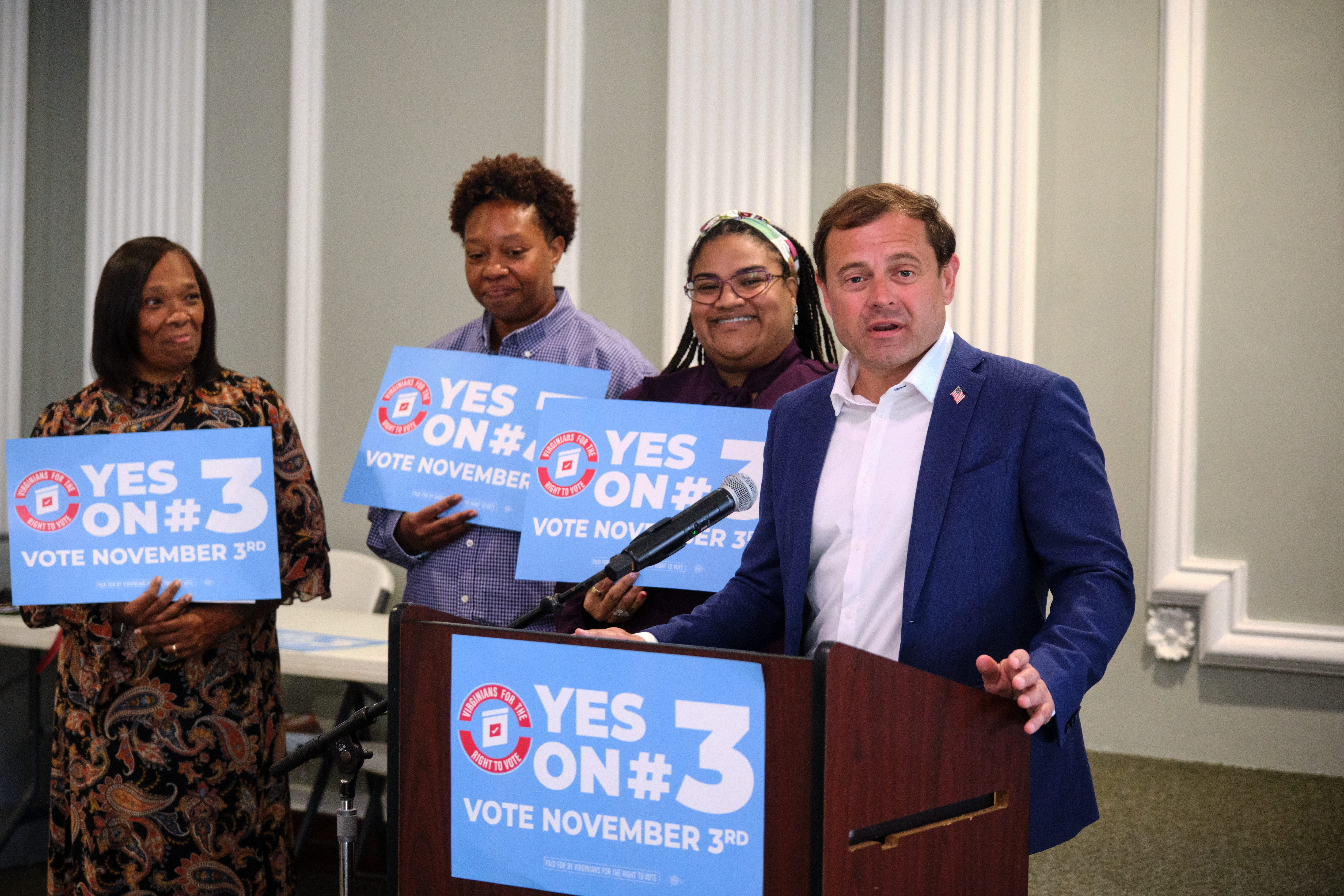
Virginians for the Right to Vote, the coalition organizing in favor of the amendment, includes the ACLU of Virginia, NAACP Virginia State Conference, New Virginia Majority, Nolef Turns, and Virginia Interfaith Advocacy.
“Virginia’s constitution currently allows for the permanent disenfranchisement of people with felony convictions. This provision is a holdover from the 1902 Constitution, and its designers explicitly said this provision was intended to deny Black people the right to vote,” says state Sen. Mamie Locke, chair of Virginians for the Right to Vote.
In a 2021 analysis, the Prison Policy Initiative found that Black Virginians represent roughly 19 percent of the state’s population, but 54 percent of its prison population. A recent estimate found that at the beginning of 2026, more than 230,000 people in Virginia were unable to vote despite no longer being incarcerated.
Defend Virginia’s Sons and Daughters, the largest group fundraising against Amendment 3, claims on its website that Amendment 3’s provision making voting a “fundamental right” does not contain “limits or safeguards,” and implies that the state would not be “able to challenge fraudulent voting procedures.”
Nothing about Amendment 3 would change Virginia’s voting process, or its identification requirements. It would not supersede federal election law.
Current law in Virginia also revokes the right to vote when someone is placed under guardianship or found “mentally incompetent,” “regardless of the kind of incapacity.” If Ballot Question 3 passes, a person would only lose the right to vote if a court finds they “lack the capacity to understand the act of voting.”
“Question 3 is about creating a fair pathway to getting voting rights back that politicians can no longer interfere with.”“ says Locke. “We all deserve protection from political interference in our ability to vote, no matter which party is in power.”