Todd Murphy’s “Bird Room” at Les Yeux du Monde highlights a fascination with birds, but it also draws attention to a love of beauty, a vast knowledge of challenging cerebral concepts, and a holistic approach to photography. The artist, who lived in Charlottesville in the ’90s, and lost his life to cancer in 2020, left us with works grandiose in concept, effort, and scale—art that is provocative and haunting, with portent that seems both significant and ambiguous.
In a process more akin to painting or sculpting than to photography, Murphy builds his works using images he took in the studio, or on location, or when he was just out and about, producing composite photographs from hundreds and sometimes thousands of images. He plays with reality, capturing it, deconstructing it, and then reorganizing it into something entirely new and captivating.
Dominating the show, “The Courage of Margaret Mead” is “of this place,” says LYDM Director Hagan Tampellini, begun when Murphy was living here. Margaret Mead was a heroic figure to Murphy, who admired her scientific research and her questioning of established theories.
In the piece, Mead is seen from the rear, which adds a mysterious, almost voyeuristic quality to the work. The hidden face piques our curiosity, while directing our focus to what she’s looking at, fostering a shared experience between subject and viewer. Mead wears, somewhat improbably, a white pouffy evening gown, and is standing within what seems like a fantastical Wunderkammer (cabinet of curiosities) containing ornithological specimens along with prowling tigers, leopards, and cheetahs. Is she in a natural history museum? Have the cats escaped their dioramas? It’s a wild and unsettling scene with the coherency of a dream.
The white dress is a recurring symbol for Murphy. He invites preconceived ideas associated with the garment into the experience, adding layers of emotion. Murphy’s use of the dress changed over time. Eventually, he employed it without a figure, making it more anonymous, relatable, and poignant. He repeatedly used the skirt as a blank canvas to embellish. Viewers see this in “Regatta,” from the “Murmurations” series, where plexiglass shards bearing images of sailboats adorn the skirt, their billowing sails echo its fullness, while the sharp pieces of plexiglass disrupt its softness.
“The Courage of Margaret Mead” shares the same qualities of grandeur, drama, and the theatrical handling of light and shadow (known as chiaroscuro) as the great paintings of the Baroque era. Murphy unapologetically embraced beauty—which had become a bad word in contemporary art. He made it work by tempering it with subject matter and rigorous process, and the enigmatic atmosphere he creates.
Murphy placed transparent sheets of plastic overtop the piece, making it feel more removed and dreamlike. At LYDM, the sheet’s been removed from the center section so that area appears clearer. The plastic sheets are printed with the same image that they cover and, because they don’t align perfectly, things appear subtly blurred, softening them and creating hints of movement. Murphy began the piece in 1998, returning to work on it in 2009, 2014, and 2017.
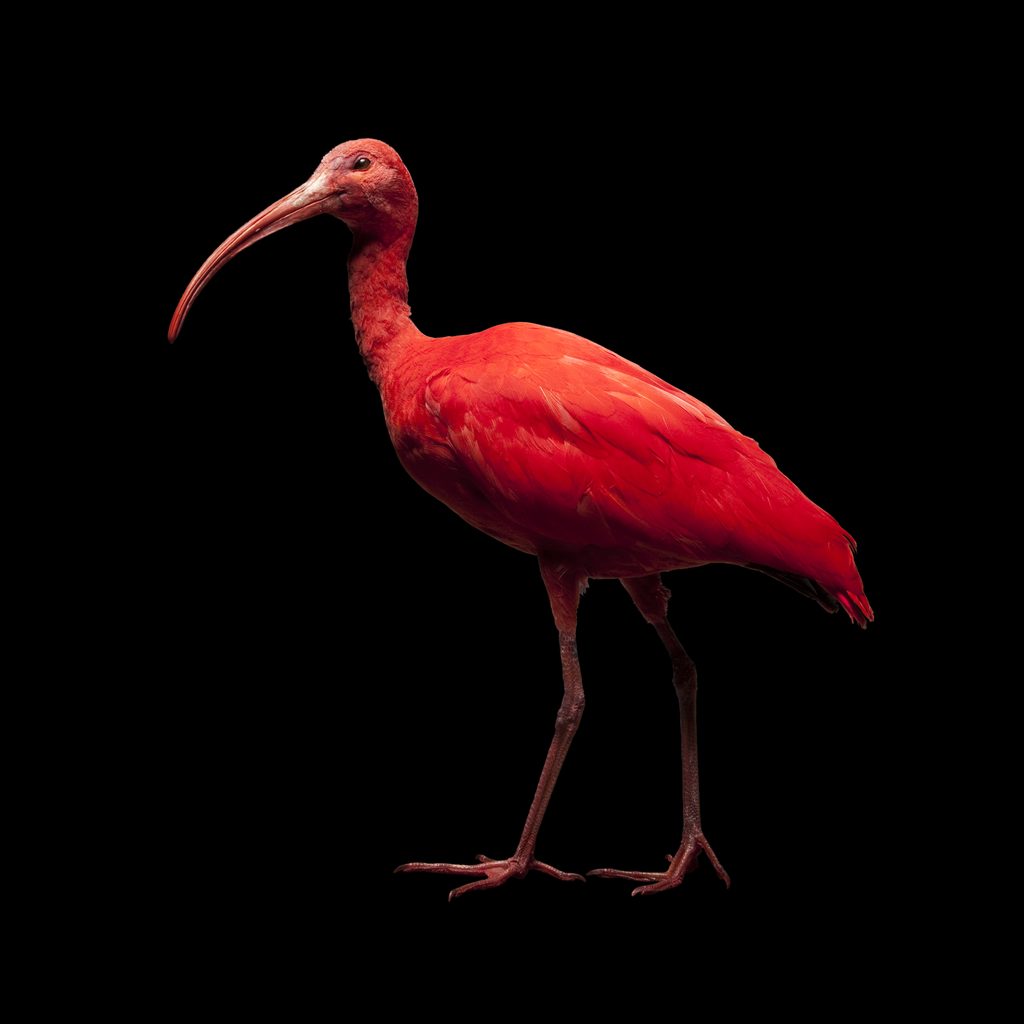
“Scarlet Ibis” and “Brown Pelican,” two of Murphy’s “Bird Portraits” series, are face-mounted, meaning the image is printed directly onto the surface of the plexiglass. Murphy used a combination of a pigment print, laid down first, followed by successive UV print layers, in a process that produces such astonishing clarity and detail that the subjects verge on mythical.
There’s a small sculpture in the show that seems to encapsulate Murphy’s approach. But the fusion of camera and paintbrush only tells part of the story. It doesn’t convey the enormous amount of thought and effort that he poured into his work.
Murphy immersed himself in all aspects of his practice, from taking the photos, which sometimes involved staging photo shoots, or photographing countless individual birds at museums in Washington, D.C., and New York, to processing and printing.
“Todd’s studio print lab was integral to his work,” says Murphy’s widow Liane Murphy. “He constructed and printed everything to scale in his studio first. If scale was beyond the studio printer capacity, he patched the work together to match scale before going to a lab to collaborate on production.”
Murphy also acquired large collections of taxidermy birds and animals with whom he surrounded himself. This was by necessity, but it was also by choice. In a very real sense he lived within his work. “To Todd everything he did was art. His whole life was,” says Liane Murphy. “And we were almost objects within it. The home was the studio and the studio was the home.”
While beauty remained at the forefront of Murphy’s oeuvre, from the beginning it was also highly conceptual. In addition to his technical expertise, Murphy was a deep thinker who possessed extensive reserves of scientific and art historical knowledge.
It’s an impressive legacy for someone whose career was cut so short. But perhaps Murphy would be satisfied with what he’d wrought in his professional life, having sent out an abundance of “signals,” both compelling and profound, that are part of a larger continuum. “We have our time,” Murphy told writer Brenna Sanchez in 1997. “We send out our signals and then we move on. And that becomes part of a bigger pattern.”