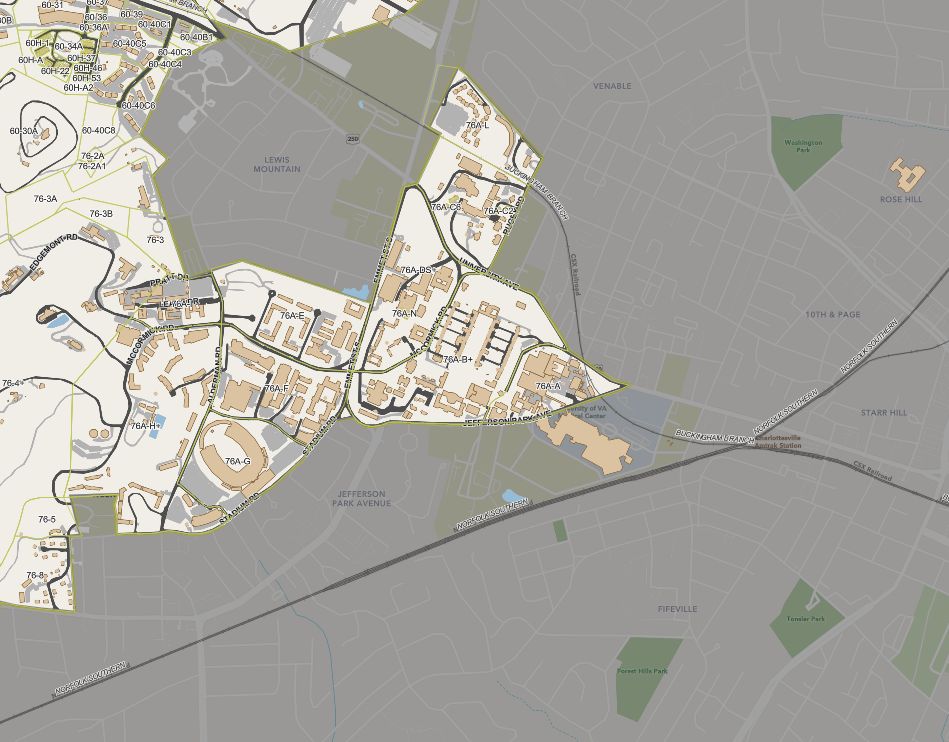
This view from Albemarle GIS shows that the western corner of JPA and West Main is part of a large parcel owned by the UVA Board of Visitors, a key definition of “Grounds” dating back to the 1939 city charter.
Aproposal from LCD Acquisitions to construct The Mark, a seven-story apartment building along the railroad tracks in Fifeville, can proceed under the city’s affordable housing fund rules, which allow the firm to pay less money into the fund.
Charlottesville’s zoning code, adopted in December 2023, says projects designated as student housing are not required to build affordable units on site. Instead, they must pay a fee into the city’s housing fund, but at a lower rate from those outside the half mile.
“The … [zoning code] states that in order for a project to be student housing, bedrooms must be leased individually and the project must be within one half mile of the University of Virginia campus,” said Genevieve Keller, the chair of the Board of Zoning Appeals, at a March 19 public hearing.
Council adopted the new code as a way of encouraging the construction of housing across the entire city by removing the role elected officials play in decision-making. LCD Acquisitions has a contract to buy five properties off of Seventh Street, all zoned Residential-Mixed Use 5, and filed plans for The Mark last June.
Under the code, the BZA hears challenges from those who formally question determinations made by city staff. In this case, a neighbor of the proposed building appealed the interpretation that the project qualifies as student housing.
Paul Reeder, who filed the appeal, has lived in a cottage across the street from the property for more than 10 years, and began voicing his opposition to the by-right project last summer.
“The zoning administrator’s erroneous determination reduces the cost of development of this proposed property,” Reeder said. “Put simply, the more expensive it is to build this property, the less likely it is to get built. So if I can increase the developers’ costs, I’m going to do it all day and all night.”
Zoning Administrator Read Brodhead made an official determination on December 11 that this project qualifies because it is within a half-mile of the intersection of Jefferson Park Avenue and West Main Street. The University of Virginia has plans to convert the space to a pocket park.
Reeder used maps created by the University of Virginia to assert that this particular corner is not considered to be Central Grounds and argued it should be seen as an outlying parcel. Several speakers agreed, but local land-use attorney Valerie Long said the city has long defined what makes up UVA.
“Using the city’s own charter is the best place to start to answer that question,” Long said. “The charter effectively says that land is part of Central Grounds because it is university land.”
Hosea Mitchell, a member of the Planning Commission who also sits on the BZA, said a lot of the implications of The Mark trouble him, but the central question is from where the half-mile would be measured.
“If the pocket park is irrelevant, is it a part of the Central Grounds?” Mitchell asked. “And if it’s a part of the Central Grounds, then is it then within a half-mile?”
Keller said she was persuaded by testimony from the hearing that offered alternative definitions. She said she thought Brodhead acted in good faith but said the situation exposes flaws in the new zoning code.
“I think it’s the ordinance and the language of the ordinance and the [affordable dwelling unit] manual that is flawed,” Keller said. “Whatever is built there will have an effect on the neighborhood. It will overwhelm it and it will bring about change.”
A motion to uphold Brodhead’s determination failed on a 2-2 vote, which means the ruling stands. Reeder has the right to appeal the decision to Charlottesville Circuit Court.