
Recently re-released in a 10th anniversary edition, Little Star is the memoir of Carmelita Estrellita, a trans poet, artist, and educator who lived in Charlottesville until her death in 2016. Edited by Lauren Catlett, the book combines Estrellita’s writing, stories, and drawings to share reflections on her life and to offer comfort, affirmation, and inspiration to others facing challenges of their own.
Catlett is a nurse, artist, and researcher at the University of Virginia School of Nursing, where they study aging and end-of-life care with a focus on older adults from historically marginalized communities. They recently discussed Little Star and their hopes for the new edition.
C-VILLE: Little Star provides a glimpse into Carmelita’s experiences as a trans woman, from institutionalization and discrimination to the joys of taking ownership of her identity. How would you describe Carmelita and what it was like to spend time with her?
Lauren Catlett: The time I spent with Carmelita was characterized by reserved quietude and expressive creativity. These qualities were ones we shared, and I think this helped to open communication between us. In the telling of her stories, she had both wisdom and humility. As I observed her interactions with others, I saw that she was not afraid of vulnerability, neither laughter nor weeping, with those close to her. I don’t know how many friendships and connections Carmelita had, but the ones I knew of had depth and authenticity.
I met Carmelita as a volunteer at the Jefferson Area Board for Aging adult day center, where we spent time helping the older adults there. Just as in Carmelita’s story of reading literature with her aging aunt Anne in Little Star, the longstanding tenderness and compassion she had for elder members of our community was evident in her service at JABA and in her later involvement with a local companionship initiative for older adults.
Carmelita told me of her strong call to service, even though some of her attempts to volunteer had been met with rejection due to discrimination based on her gender identity. … I saw Carmelita as a quiet change agent in our community.
She had frequent visitors while on hospice, and her visitors described how she became an important part of the places she frequented around town. As she said in Little Star, Carmelita’s goal was to be a force for good in the world, which she demonstrated in her attitude and actions, even from her hospice bed.
The book is also about Carmelita’s cancer journey, during which she expressed her desire to share her story with others. How has sharing the book in the past 10 years shaped your own relationship to mortality?
Sharing Little Star has shaped my relationship to mortality and meaning-making as an artist by demonstrating a poignant and viable way of prompting reflection about end-of-life through stories and artwork. The book has become a living entity though the author is no longer living. Sharing Little Star highlights the capacity of legacy-sharing to reshape perceptions of disappearance and erasure in mortality. In a sociopolitical climate that threatens the existence of transgender people, this capacity is especially important.
As a researcher, legacy-sharing through Little Star has influenced my work related to end-of-life communication and has allowed me to connect with community members from diverse backgrounds about end-of-life issues. Personally, Carmelita’s lessons on finding regrowth through suffering helped me navigate my father’s serious illness and death in April of this year, and the life-threatening health challenges of my own that I faced in the preceding decade. As Carmelita said, in the suffering, there was something bigger, and that held true every time.
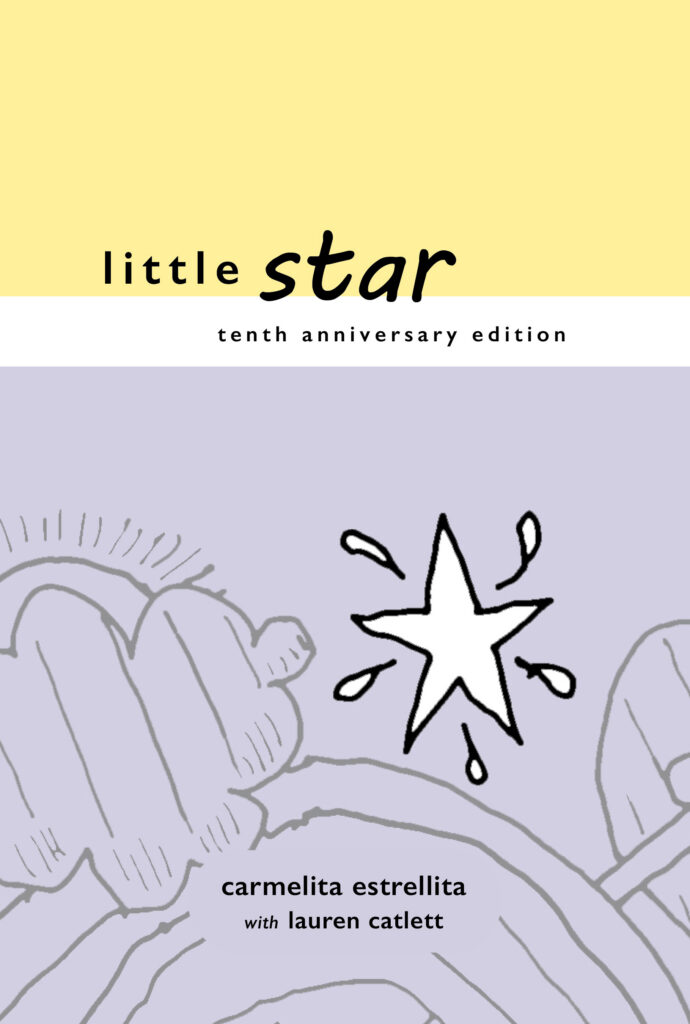
In the book’s epilogue, you describe how Carmelita’s story encouraged affirming resources for trans folks in aging and end-of-life care, and how this informed your research on health equity for transgender older adults. Has anything changed in how you hope readers will experience the book now?
When we first released Little Star, the focus was on elevating messages of forgiveness and hope in the context of anti-transgender stigma and the fear of mortality. These messages have gained even greater relevance in the sociopolitical environment of today, especially Carmelita’s emphasis on giving back and forgiving. I’m reminded of Hil Malatino’s book, Trans Care, that critiques medical and political systems of ‘care’ for trans people while urging trans people to ‘show up’ in these systems that so often ‘fail to show up’ for them. Carmelita had been doing this for decades, as have many of the trans older adults I’ve met subsequent to the publication of Little Star.
I hope that the book will continue to serve as a nuanced and meaningful account that challenges misconceptions and misinformation about transgender people perpetuated in public fora and social media. I hope that trans people reading the book will find hope for greater equity, acceptance, and equanimity in a time of significant adversity.