It took two years and four multi-day hospitalizations before Kenny Belew, 47, finally knew what left him writhing in pain, his gut raw and inflamed, his midsection almost comically distended.
“I looked like I was pregnant,” says Belew, of Palmyra, recalling the moment just before he was carted off by ambulance for a nine-day hospital stay. “I hadn’t gone to the bathroom in 10 days. I came home from work, told my wife, ‘I can’t do this no more. I’m going to go sit in the tub.’ Then I got so weak I couldn’t get out.”
The year was 2017, and, much like now, few physicians knew about alpha-gal syndrome—sometimes called the “red meat allergy” or “lone star tick disease”—which can trigger everything from crippling gastrointestinal upset to itching, hives, and swelling, to anaphylactic shock and even death in its victims, who had been unlucky enough to have been bitten by a carrier tick.
The Centers for Disease Control estimates that nearly a half-million Americans have alpha-gal syndrome, even as many clinicians still haven’t heard of it. Scientist Thomas Platts-Mills, at the University of Virginia—the first to identify the link between the allergy and the bite of a lone star tick—believes at least 5 percent of central Virginians (which includes eight counties of Albemarle, Culpeper, Fluvanna, Greene, Louisa, Madison, Nelson, and Orange) have it.
That’s more than 17,000 people. And Belew is one of them.
Many with alpha gal syndrome experience allergic reactions, like Belew, who works for the City of Charlottesville gas department. Others with alpha-gal allergy remain symptom free, and may never know they have it, though they’re still at risk of developing a reaction. But one encounter with the wrong tick, whose bite often leaves an itchy nodule, and things can change quickly—seemingly for keeps.

Developing symptoms
Rebecca Smith, 41—“a good old country girl [who eats] meat with pretty much every meal”—broke out in “red, rashy hives” after returning from a 2018 camping trip. A nurse, she knew she was having an allergic reaction, but it took some doing before she had a diagnosis.
“Alpha what?” Smith remembers asking.
After a couple of inconclusive blood tests, the allergist who hesitantly confirmed Smith had alpha-gal syndrome also noted that she had mast cell activation syndrome—when the body’s immune system inexplicably and mistakenly amplifies an allergic reaction. Told to avoid red meat and dairy, Smith adapted to eating fish, turkey, and chicken. If she wanted ice cream, she knew she’d have to rush home before the violent pain in her stomach started. Social meals became a headache.
“At cookouts, when people cook a steak on a grill, you have to ask them to cook a chicken on a different part of the grill, to avoid contamination,” Smith says. “So I became that person. It kind of sucked.”
People with alpha-gal syndrome most often react hours after eating mammals—beef, lamb, pork, venison—or animal products, like milk, cheese, or gelatin. Carrageenan, a thickening agent (made out of red algae that contains the alpha-gal epitope and is used in everything from whipped cream to toothpaste, and air fresheners to cosmetics) may also spur allergic reactions.
Typical alpha-gal reactions range from mild—such as the bloating, stomach upset, and mild hives Smith got, which she tried to remedy with Benadryl and bedrest—to seismic: debilitating gastrointestinal distress, diarrhea, hives, and swelling of the extremities, or, in the most dangerous cases, full-on anaphylaxis, such as what happened to Belew.
It can also, rarely, be a killer. The first-known death due to the alpha-gal allergy was documented by Platts-Mills and colleagues late last year.
Pins and needles
In 2011, when Travis Brown first got shooting stomach pains on his way home from work, he began tracking what he’d eaten for lunch.
“A feel-bad day was when I had a burger,” explains Brown, now 40, a site manager and former pipe-layer who lives in Culpeper. “A feel-good day was when I had a chicken sandwich.”
A couple of times he rushed to the ER with a “face that looked like it went a round or two with Mike Tyson: nose swollen, head-to-tail in hives.” It wasn’t long before Brown realized his episodes happened four or five hours after he’d eaten lunch, about the time when he was headed home from work.
That delay—characteristic of people with alpha-gal syndrome—was key. “Compared to shellfish or peanuts, which are pretty instant,” Brown says, “alpha-gal is like a ticking time bomb; it takes hours. For me, [an allergic reaction] took four or five.”
But it took eight months, several doctors, and two allergists for Brown to get a diagnosis in 2012—pretty quick, when compared to other symptomatic patients at that time who waited more than five years to be diagnosed with alpha-gal syndrome. After that, Brown quit red meat, had “awkward conversations at cookouts,” and generally avoided restaurants where the risk of cross-contamination—his grilled chicken getting cooked on the same spot as a piece of steak, or pork, or lamb was grilled, for example—made him anxious.
Ten years after his diagnosis, though, a tiny pinprick changed everything.
“I’d hear of acupuncture being a potential cure for the condition,” recalls Brown, “but I was naive, like, ‘No way.’ When a friend of mine told me he was going to try it for his alpha-gal, at the back of my brain, I was like, ‘Impossible.’ Then he sent me a picture of himself eating a steak. That changed it. I said, ‘Sign me up. I’m in.’”
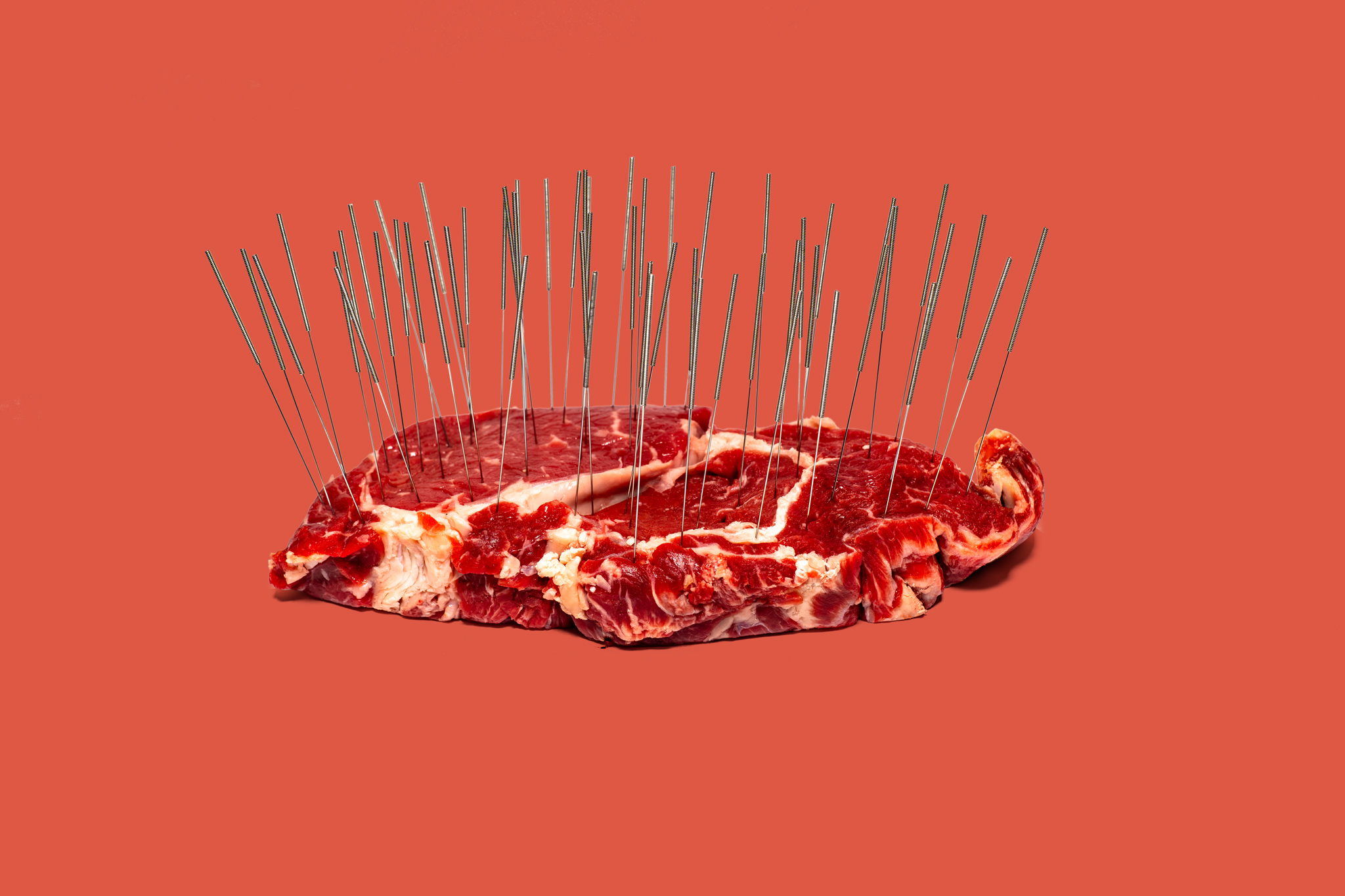
A month later, Brown met with Charlottesville acupuncturist Michael Jabalee, who practices integrative medicine in a small office on Hillsdale Road. After an exam, Jabalee inserted an eyelash-sized needle with a round hook at its head into Brown’s right ear and covered it in a round bandage. Jabalee—who, a dozen years before, had been trained in a procedure called the Soliman Auricular Allergy Treatment, or SAAT—told Brown to continue to avoid eating red meat, keep his ear dry, and come back in four weeks.
A month later, once the needle was removed, Brown headed home, immediately grilled a T-bone steak, cut off a fist-sized piece, and stared at it.
“It was the scariest meal of my life,” he recalls. “I was like, ‘I’m either cured, or I’m going to the hospital.’ I had a fork in one hand and an EpiPen in the other. That day, I ate only the fist-sized portion, and waited. It was 2pm, and I knew if I was okay between 6 and 8pm, I’d be fine.”
Nothing happened that day. And nothing happened the next—or the next. Brown says he’s eaten red meat every single day in the two years since Jabalee removed the needle from his ear. He considers himself “cured.”
“It’s mind-blowing because, when you think of acupuncture, you might see, like I did, that it could work for muscles and tendons,” says Brown, “but, like, a chemical reaction within your body? I just couldn’t understand that.
“I went and saw Jabalee. It took a month for him to cure me—a month after over a decade of trouble.”
The skinny on alpha gal
Initially, scientists thought alpha-gal syndrome was an allergic reaction triggered only after the bite of the lone star tick, an arachnid prevalent throughout a growing portion of the United States, including in Virginia. But alpha-gal cases occur worldwide, so it’s now thought that other kinds of ticks also carry and transmit the disease, too. It’s also likely that the tiny creatures both create and transmit the triggering carbohydrate, conveyed in their saliva, entirely on their own, rather than acting as a vector carrying the disease between, say, an infected deer or mouse.
There’s evidence that those with alpha-gal syndrome are at higher risk of heart disease and heart attacks. There’s also evidence that people with alpha-gal syndrome who have certain blood types (including A and O) may be less vulnerable to allergic reactions.
What’s less clear, though, are solutions.
Medicine is often siloed. That means research done by, say, allergy scientists may not percolate to those in other specialties who are caring for people with alpha-gal: emergency room clinicians, cardiologists, neurologists, gastroenterologists, and oncologists, among others. And while there’s evidence that the length of time to an alpha-gal diagnosis is improving, two-fifths of medical professionals say they’ve never heard of it. One-third lack the confidence to diagnose it and help their patients manage the condition.
While there is no known cure except to avoid its triggers, and stories about desensitization and remission are anecdotal, there is evidence that acupuncture may help relieve alpha-gal symptoms.
A 2021 study involving a retrospective chart review of subjects treated for alpha-gal syndrome using auricular (in the ear) acupuncture found that 96 percent of subjects said their symptoms went into remission. While the study had several limitations, including its retrospective approach, absence of lab values, and the fact that it didn’t include a control group, some with the allergy, like Belew, Smith, and Brown, are convinced.
While he doesn’t recommend acupuncture for alpha-gal, Platts-Mills also doesn’t dismiss those who say it works.
“The only people who are going to get treated with acupuncture are patients with alpha-gal, and they’re only going to go if they’ve got symptoms,” he says. “They’re a select group. I don’t know of any evidence that indicates that the antibodies go away; all I’ve heard is that their symptoms go away. Which is perfectly possible. There’s no reason why it shouldn’t happen; we just don’t know the mechanism.”
Platts-Mills has a couple of theories—including one that acupuncture triggers “a spray of exosomes, some of which have an effect on mast cells” and another related to acupuncture’s possible “indirect effect on the autonomous nervous system”—but says “it’s too far outside [his] world.”
But “if you can be changed from being in the symptomatic class to the non-symptomatic class, I think that’s great. I’m in favor of that. I don’t recommend it, because we’re trained so thoroughly not to recommend alternative medicine, but the truth is, some alternative medicine works.
“But how it works?” Platts-Mills chuckles. “I haven’t got a clue.”

Ticks bite
Belew is constantly outside—in addition to working for the City of Charlottesville gas department, he likes to camp and fish—and gets bitten by ticks all the time. He thought nothing of the bites, including the one that appeared on his ankle in 2017 that left a tiny, itchy nodule just before he started having symptoms. Neither did he consider how a steak birthday dinner out and, several days later, a hamburger and hot dog at a cookout might’ve triggered his body’s massive allergic reaction. At the time, it seemed to come out of nowhere.
Hospital scans revealed Belew’s wildly inflamed colon and small intestine and a full bowel obstruction. During the first of his four hospital stays, doctors snaked a tube through his nose into his stomach and digestive tract to pump out its contents. They repeatedly wondered aloud whether he had Crohn’s disease. Others thought portions of his intestines might need to be surgically removed.
Belew and his wife, Stefani—he calls her “Stevie”—were terrified. They had young children and spent two Easters in the hospital. The mystery continued, on and off, for nearly two years.
Doctors confirmed “he was having an allergic reaction, but couldn’t figure out where it was coming from,” Stevie recalls. It wasn’t until three hospital admissions later, and a transfer to UVA, that Belew met gastroenterologist Brian Behm, who tested him for alpha-gal. It came back positive.

Poke the (b)ear
Jabalee got interested in using acupuncture to relieve allergies when “observing patients’ adverse reactions to medications, or foods, and how their pulse would respond.” He learned the SAAT method and, today, uses it to treat the roughly one-third of his clients who’re seeking allergy relief. About half of those clients have been diagnosed with alpha-gal, Jabalee says.
Acupuncturists are careful to say they don’t offer cures, though.
With alpha-gal syndrome, acupuncture offers “more of a remission than a cure,” explains Charlottesville acupuncturist Mila Zimmerman, who just became SAAT-certified and calls tick-borne illnesses among clients “massive.”
“I cannot as a practitioner guarantee a cure,” she says. “But I can say, hopefully, ‘You might get 90 percent clearing of these symptoms.’”
“We’re not treating diseases,” adds Jabalee. “We look for what’s out of balance. We’re just saying, ‘Hey, we find when we needle this point in this way that people are getting relief.’ If someone is amenable to that, then we do it. Since I’ve been doing the SAAT, it’s been very reliable and helpful for people. Maybe even life-changing.”
Platts-Mills says he has “very little anger about people doing alternative medicine.” Acupuncturists “have a treatment that works—it doesn’t work permanently, and doesn’t work for everybody—but then that’s true of every other medicine we’ve got,” he says. “Hopelessly true.”

Sitting for SAAT
Acupuncturist Jessica Dodds—who’s been treating clients with alpha-gal syndrome for the last year—kept getting the calls.
“‘Do you treat alpha-gal?’ they’d ask me, or, ‘Do you do the ear thing?’” Dodds recalls.
She’d heard of alpha-gal, but didn’t anticipate just how many clients would be interested. She got SAAT-certified one year ago and now estimates people with an alpha-gal syndrome make up one-third of her business. She doesn’t advertise, but has a sign on the road in front of her Kents Store office that says, simply, “alpha-gal.”
After sending lengthy introductory emails, Dodds begins every 90-minute visit asking about alpha-gal clients’ goals (“I’d love to not have diarrhea,” or, “I want to eat burgers again,” or, “I’d love to go to a restaurant and not fear contamination”). Though it varies by practitioner, acupuncturists often test clients’ reactions to “filters,” small vials that contain allergens that are brought close to but never touch their body. Then acupuncturists observe what happens: perhaps a quickening of a client’s pulse, or an observed weakness during a muscle task.
Dodds has clients close their eyes and hold a metal rod in one hand that’s tethered by wire to a metal base. She “exposes” clients to a variety of allergens by placing the small vials in the metal base (containing everything from alpha-gal to lactose, ragweed, cat dander, venison, and more). Then she asks clients to do a series of strength tests with their fingers or arm, noting any weaknesses when the vials come close.

Depending on what she observes, Dodds then places as many as six needles into the client’s concha—the depression in the central ear that leads to its opening—and then covers each with a bandage. Clients are advised not to wash their treated ear, to continue avoiding contact with triggers, and to return in three to five weeks.
Belew got four needles in his right ear.
“I was skeptical at first, because I’d read there is no cure, and from what I’d heard about acupuncture, there wasn’t a lot saying that it worked,” Belew said. “I remember thinking, though, ‘It might be the best money I’ve ever spent,’ because I really missed meat, and really missed living a normal life, and having a normal diet.”
Dodds took the needles out of Belew’s ear last October. After a couple of days, he ate a few bites of hamburger. Nothing happened. A week later, he texted Stevie to meet him at Outback Steakhouse, where he ordered steak.
“I sat and stared at it for a long time, because I couldn’t wait,” Belew recalls. “I was so excited. I sat and ate that, and let a week go by, and I had no issues at all.”
It’s been five months. Belew says he’s eating whatever he wants. He’s also back to cooking bacon—“real bacon, not turkey”—for his kids when the family goes camping.
“This changed my life,” Belew says. “There are still people that say to me, ‘There’s no way. There’s no way that works.’ I’m like, ‘Hey, let’s go get a burger and I’ll show you.’ I won’t end up in the hospital. I’m totally fine.”
Smith enjoyed her first bit of ham last Thanksgiving after having acupuncture for her alpha-gal. While the roast-beef-and-cheddar sandwiches she recalled loving eight years ago aren’t as tasty as she remembered, she’s grateful she can “eat what I want to eat for dinner. That’s really nice.”
“When the guy comes back, and says, ‘I’m eating the meat again!’ or, ‘My son’s not losing the weight, he can play the sports again,’ it’s stuff like that, where, holy smokes, I realized I really like this,” says Dodds. “I didn’t up front think that I’d love it so much. In one treatment, you can seriously change people’s lives.”
The main thing, says Jabalee? “Keeping an open mind.”
“It’s the bird watchers’ proverb,” he chuckles, hands clasped. “When the bird and the book disagree, always believe the bird. Don’t dismiss your experience.”