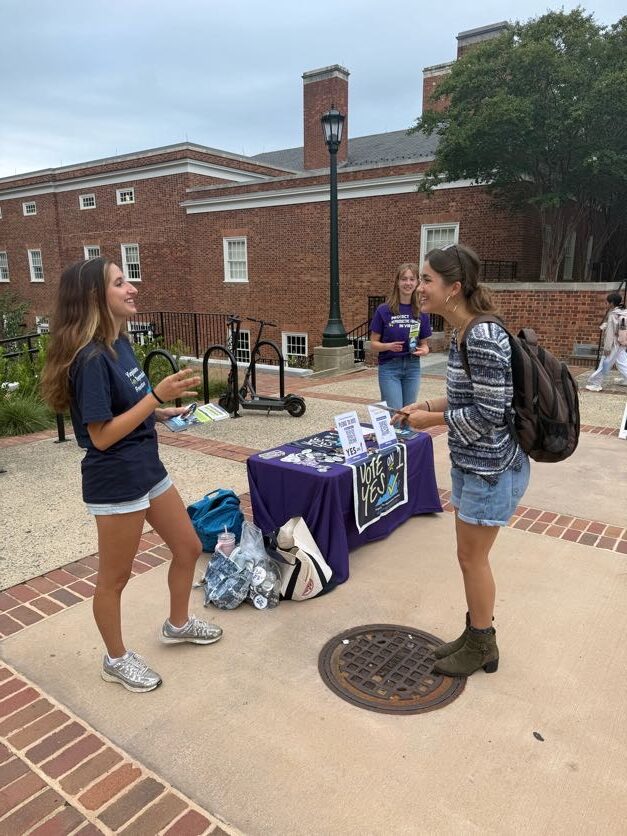
Virginians for Reproductive Freedom campaigned across the state on September 19 and 20, including on Grounds at the University of Virginia.
There is a lot on the ballot this November. On top of several contests that could decide which party controls Congress, Virginia is weighing three proposed amendments. The first, Ballot Question 1, reads:
“Should the Constitution of Virginia be amended to (i) protect the freedom to make personal decisions about prenatal care, childbirth, postpartum care, birth control, abortion, miscarriage management, and fertility care; (ii) protect doctors, nurses, and patients from being punished for these decisions; and (iii) allow for restrictions on access to abortion during the third trimester of pregnancy except when the patient’s health is at risk or the pregnancy cannot survive?”
The proposed amendm ent would make reproductive care a right protected by the state constitution—and consequently much harder to revoke by future Virginia lawmakers.
Since the 2022 Dobbs v. Jackson Women’s Health Organization decision that eliminated the constitutional right to abortion, states have been able to set their own abortion laws, which can have far-reaching effects on access to reproductive care. Virginia is the only state in the South that does not have an abortion ban or heavily restrict access to the procedure.
Nationwide support for legal abortion access has continued post-Roe, with 60 percent of Americans telling Pew Research Center in a January 2026 survey that the procedure should be legal in “all” or “most cases.” A study that asked the same question across 34 states and Washington, D.C., between 2023 and 2024 found that 63 percent of Virginians were in favor of legal abortion access.
Fundraising by committees for and against the amendment reflects this trend, with Virginians for Reproductive Freedom reporting more than $2.8 million in contributions as of August 31, per the Virginia Public Access Project. VPAP found contributions opposed to the amendment totaling $444,820, with the largest committee (No Safeguards, No Deal) raising $263,887.
Groups backing the amendment include: the American Congress of Obstetricians and Gynecologists, the American Civil Liberties Union of Virginia, Birth in Color, Equality Virginia Planned Parenthood Advocates of Virginia, Catholics for Choice, The League of Women Voters, and Women of Reform Judaism. Organizations opposed include: AAPLOG (American Association of Pro-Life Obstetricians and Gynecologists) Action, the Frederick Douglass Freedom Alliance of Virginia, Live Action, The Family Foundation of Virginia, and the Virginia Society for Human Life.
No Safeguards, No Deal argues the proposed amendment is “vague” and would remove “safeguards for women,” take away parental rights to be involved when “a minor is considering an abortion,” and be “locked into the Constitution.”
The committee organizing in support of the amendment, Virginians for Reproductive Freedom, says it would ensure the right to reproductive care for future generations.
“It would protect both the patients seeking this care and also the doctors and nurses that give this care. … This really puts health care decisions into the hands of patients and their doctors,” says Maymie Burris, VRF’s regional organizer for Harrisonburg and Charlottesville.
According to Burris, VRF has knocked on more than 5,000 doors this election season, and she personally tries to knock at least 100 doors a weekend. A lot of the people she’s talked to have been excited to vote on the measure, but not everyone knows it’s on the ballot. “Especially with ballot initiatives, it’s a little bit harder to get the word out,” she says.
Deborah “Dee Dee” Denaud is one of the volunteers working with VRF in Charlottesville. She hasn’t gone door-to-door locally yet, but the 21-year-old has chalked on Grounds and handed out materials between classes at the University of Virginia.
“This amendment is important to me because I’ve personally experienced how reproductive health care can improve someone’s quality of life. During my first year of college, my periods were extremely heavy and irregular. I was constantly going through menstrual products and often bled through my clothes and sheets,” says Denaud. She was diagnosed with PMOS, formerly known as PCOS, and prescribed birth control. “I want my experience to show people that birth control does much more than preventing pregnancy; it can aid in managing reproductive issues due to metabolic concerns. I am advocating for this amendment and reproductive freedom because I hope to become an OB/GYN one day.”
Before shifting into voter outreach in 2026, VRF worked with legislators to draft the language of the proposed amendment. Getting it to the ballot has been a lengthy process, and one the group says shouldn’t be taken for granted.
“To even get a constitutional amendment to voters, it has to go through the General Assembly twice, there needs to be an intervening election, and the language of the amendment can’t change even by a comma, or it has to start the process all over again. So, this isn’t something where it can be overturned lightly or easily in the future. But it’s also not something that we will have another opportunity to vote on in the near future if we don’t vote ‘yes’ on it this time around,” says VRF Communications Director Mary Olivia Rentner. “This is a historic opportunity.”
The full text of the ballot question, as well as a voter explanation, can be found at elections.virginia.gov.