On the fifth anniversary of the removal of the Robert E. Lee statue, Swords Into Plowshares announced the design concept for the next stage of the project: ROOTED, by Model of Architecture Serving Society and Dana King. The former monument’s melted-down bronze will be transformed into a new public artwork at the center of a redesigned Market Street Park.
“For more than a decade, Charlottesville has stood at the center of national debates about Confederate monuments, racial violence, historical memory, and the future of public space,” reads an excerpt from the July 10 announcement. “Swords Into Plowshares asks what comes after removal: how a community might transform a symbol of white supremacy into something that reflects shared values, public accountability, and the possibility of repair.”
Reflecting on the more than 10-year-long journey, Zyahna Bryant—whose petition, written when she was in high school, kicked off conversations about removing the Lee statue and other Confederate monuments in Charlottesville—is excited about what’s to come with ROOTED.
“I never thought when I originally introduced that petition that it might actually happen,” says Bryant. “To have the vote to remove those statues years and years ago … and then to have them actually removed, and then to have Swords Into Plowshares … It’s kind of hard to find the words to express how excited I am for our community, and for the healing and reconciliation that is ongoing and that will continue to take place in our community.”
The design concept from artist King and MASS was selected via a ranked-choice survey of almost 1,000 community members. ROOTED was the first-choice design for 64 percent of respondents.
“The project is so important historically, socially for the people of Charlottesville, and the state of Virginia, for the country,” says King. “I’m just so grateful and thrilled that people love [ROOTED] too, and that I get a sense that it fits Charlottesville, that it’s something that the people would be proud to have in the city.”
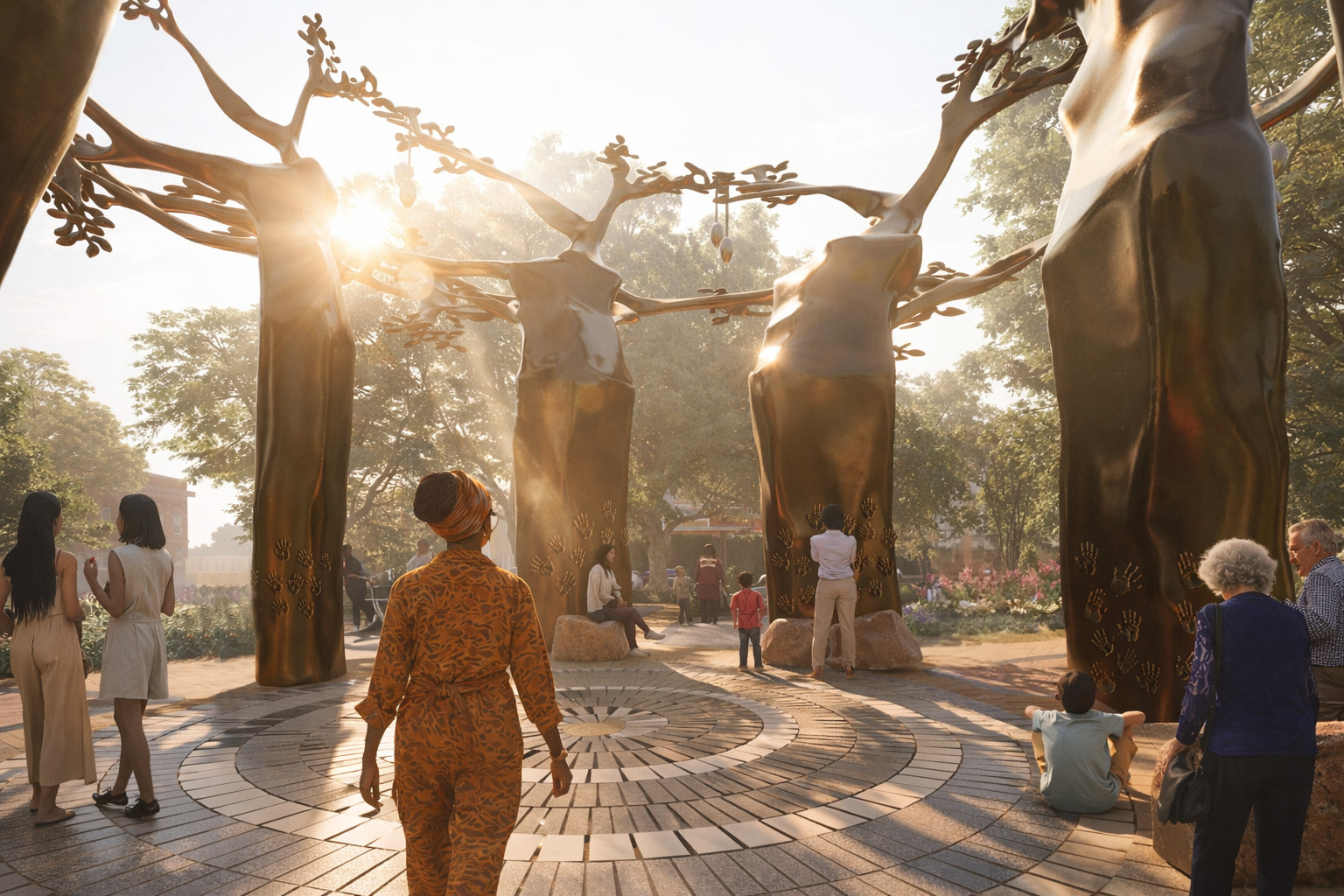
At the center of the design is a baobab tree, chosen for its “pan-African symbolism for wisdom, longevity, and interconnection,” with seasonal gardens and brick niches also highlighted in the project proposal. New pathways will web across the park, connecting gathering spaces and gardens. The interior of the baobab tree is imagined with handprints of community members, and the possibility of extending the sculpture’s message to other spaces across the city with installations of baobab fruit sculptures and imagery in the future.
While the concept is fleshed out, SIP’s announcement emphasized plans for continued community engagement in the project.
“We believe that the most impactful art emerges from genuine collaboration,” said Andrea Douglas, SIP co-founder and Jefferson School African American Heritage Center executive director. “The extensive community engagement we’ve undertaken—with input from so many diverse voices—has been absolutely vital to this project. We’re thrilled to be working alongside such an accomplished and thoughtful design team. I am confident that we will create something lasting and meaningful.”
Both King and MASS have previously worked on projects transforming spaces and architecture, examining the history of people and environments.
King, who describes herself as a “classical figurative sculptor who creates public monuments of Black bodies in bronze,” has a portfolio of work spanning the United States. Highlights from King’s portfolio include Monumental Reckoning Golden Gate Park (San Francisco, California, 2021), King William Lanson (New Haven, Connecticut, 2020), and a sculpture of Black Panther Party for Self Defense co-founder Dr. Huey P. Newton, commissioned by his widow in 2021 and permanently installed in Oakland, California.
“I think for me, the goal of this is … very simple. It’s to take up space with ROOTED and your neighbors, and find a level of acceptance—not just welcoming and belonging, but acceptance—of people that don’t look like you, that may not speak the language you speak … just different people, and that you all enjoy the space in the space together,” says King. “On some level, the outcome is simple. But getting there is going to take intention.”
Among MASS’s most notable undertakings is The National Memorial for Peace and Justice in Montgomery, Alabama, designed in collaboration with Bryan Stevenson and the Equal Justice Initiative. A Charlottesville delegation led by JSAAHC visited the museum and the national lynching memorial in 2018.
“We experienced firsthand the powerful healing work of this design firm,” said Jalane Schmidt, SIP co-founder, in the
July 10 announcement. “The Swords Into Plowshares project looks forward to collaborating with MASS in the community engagement process to transform Charlottesville’s public space to support our striving for multiracial democracy.”
“Their designs invite passive onlookers to become active participants in this act of reflection,” says Bryant. “Whether we’re thinking about the work they did at the National Memorial for Peace and Justice in Montgomery, to even this design for Charlottesville, it is this invitation to come in to reflect, to connect with others, to have a moment to kind of just pause. I think that that’s really powerful.”
With the ninth anniversary of the August 11 and 12 Unite the Right white supremacist rally on the horizon, SIP hopes to complete its plans for the new monument in time for the 10th anniversary next summer.
“As we approach the 10th anniversary of the 2017 what I will call terrorist attack … as we mark that occasion next year, I’m just really proud of our community for doing the hard work. I’m proud of the people who have put themselves on the front lines,” says Bryant. “The sacrifice and the dedication of people like [Douglas], [Schmidt], Jordy Yager, the entire Jefferson School African American Heritage Center team, and all of the organizers, the Blue Ribbon Commission. All of their work has been so important to bring us to this place, and we couldn’t have done it without them.”
There’s still a long way to go for King, who has a list of to-dos that spans from meeting with a local foundry about logistics to finding a studio space large enough to create 8- to 10-foot models of the baobab tree. But the prospect of working with MASS and the Charlottesville community to create the end product is a beacon for the sculptor.
“I think once we get there and succeed at creating a welcoming, accepting space, it will be the model for the world,” says King. “That sounds pretty lofty, I know. But, you know, we’re in a challenging space as Americans, and I do believe that art can close the gap on where we’re at.”