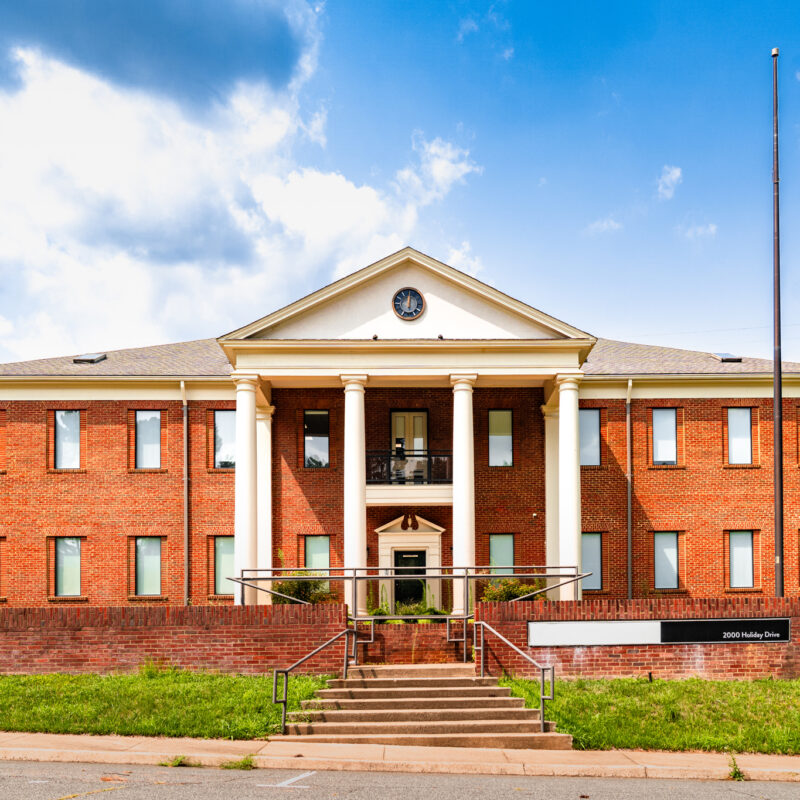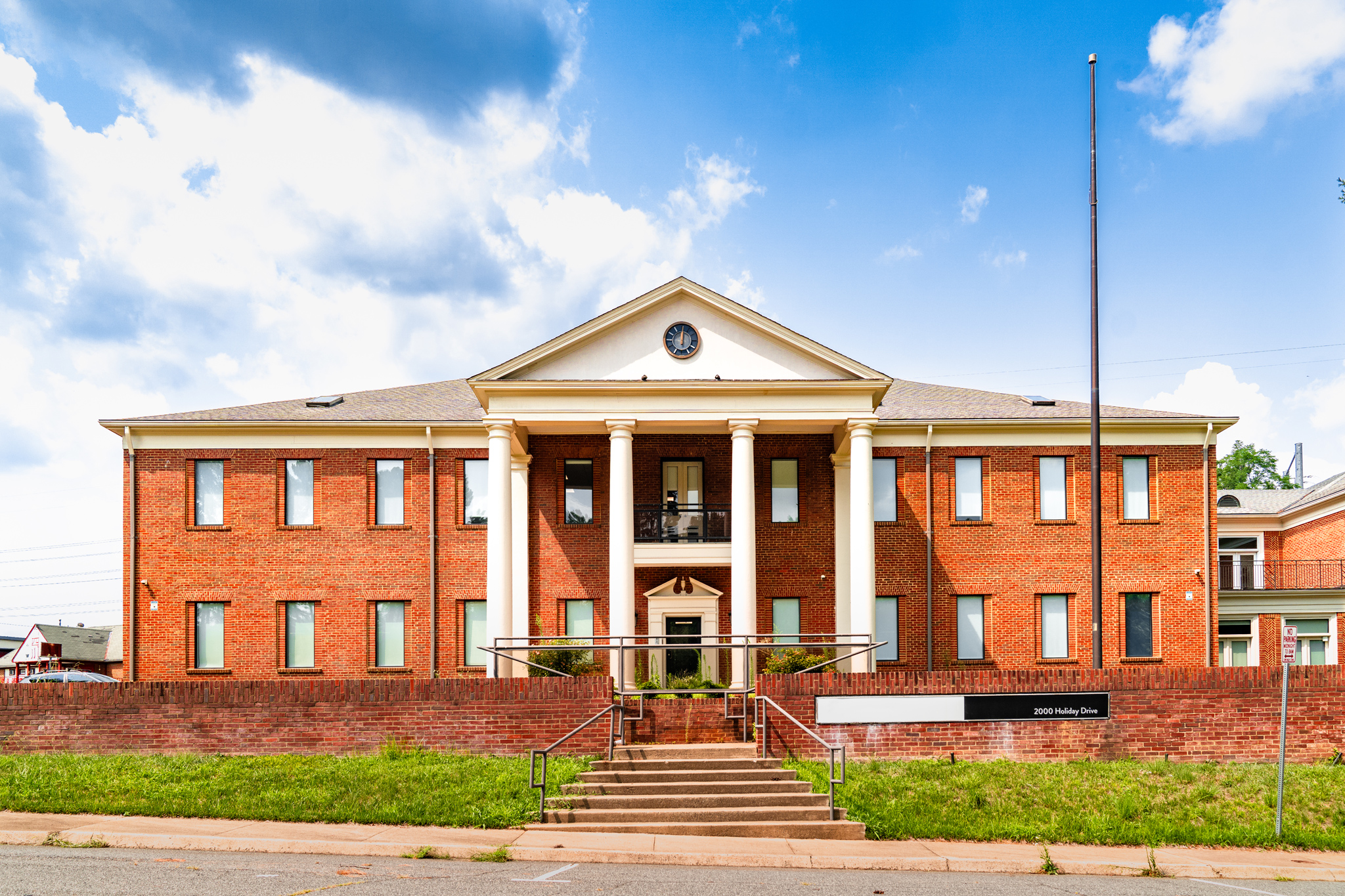
It’s been more than a month since Charlottesville closed two encampments dozens of people called home, and opened its emergency shelter at 2000 Holiday Dr. Dozens of people are utilizing the space every day, including those previously living along the Rivanna River.
Everyone C-VILLE spoke to said the emergency shelter is a work in progress—but some staying there say the city is falling short of its promises. Former encampment residents are also opting to stay elsewhere, including outside, after trying the Holiday Drive site. Others are unable to get a bed.
On Holiday
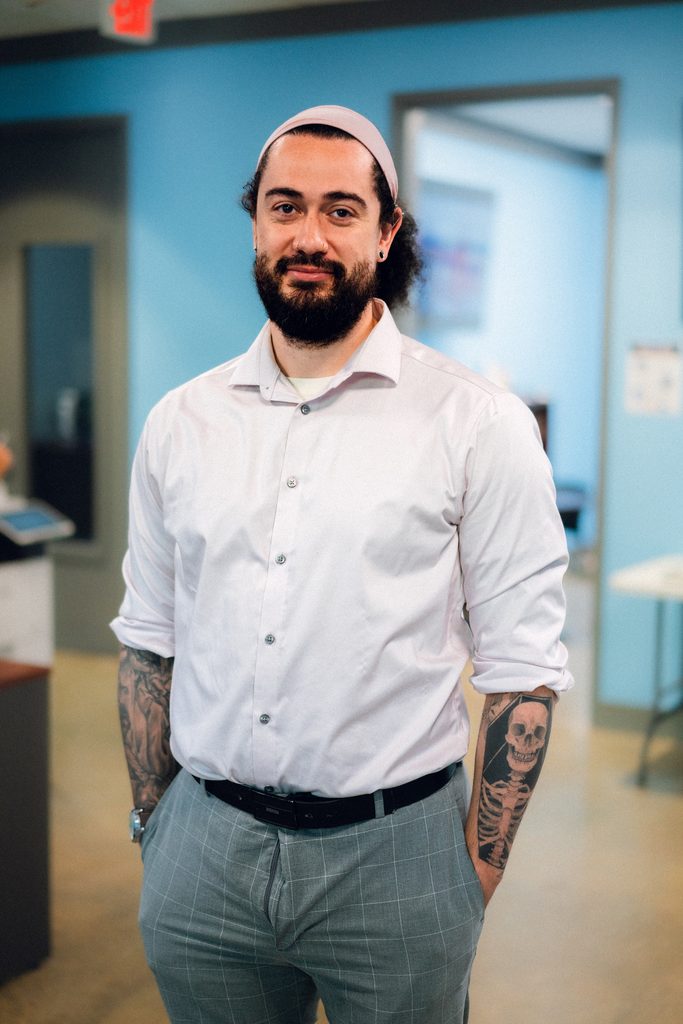
Richard Southee, regional executive director for Central Arizona Shelter Services, didn’t come to Charlottesville to run the emergency shelter—he moved to town last year with his fiancé, who is a student at the University of Virginia.
“I moved out here purely by chance,” says Southee. “I was working remotely, and learned about what was going on and started meeting with people. … That is how CASS got pulled in.”
While CASS has decades of experience running its primary Arizona shelter, launching the Charlottesville emergency shelter on short notice has been a learning experience.
“I think we started sort of with this expectation that it was going to be a slow roll, and it was not a slow roll at all,” Southee says. “Within four days, we were at capacity and have been slowly adding beds since then. I think things are going well.”
Southee estimates that roughly 50 to 60 percent of the shelter’s clients previously lived at one of the Rivanna encampments.
“Someone could have stayed at the encampment for three weeks two months ago, and then they went elsewhere,” he says. “A lot of the clients are familiar with each other, reporting to us that they were staying at the encampment at the Rivanna at some point.”
When C-VILLE visited on October 1, the shelter’s capacity was 75 beds. According to data provided by Southee, the shelter served 112 people in September, with 47 departures. Among those who left, 14 percent went to “permanent housing solutions,” and 68 percent to “known destinations.”
Beds for shelter clients will eventually be relocated to the second floor of the building once a fire suppression system is installed.
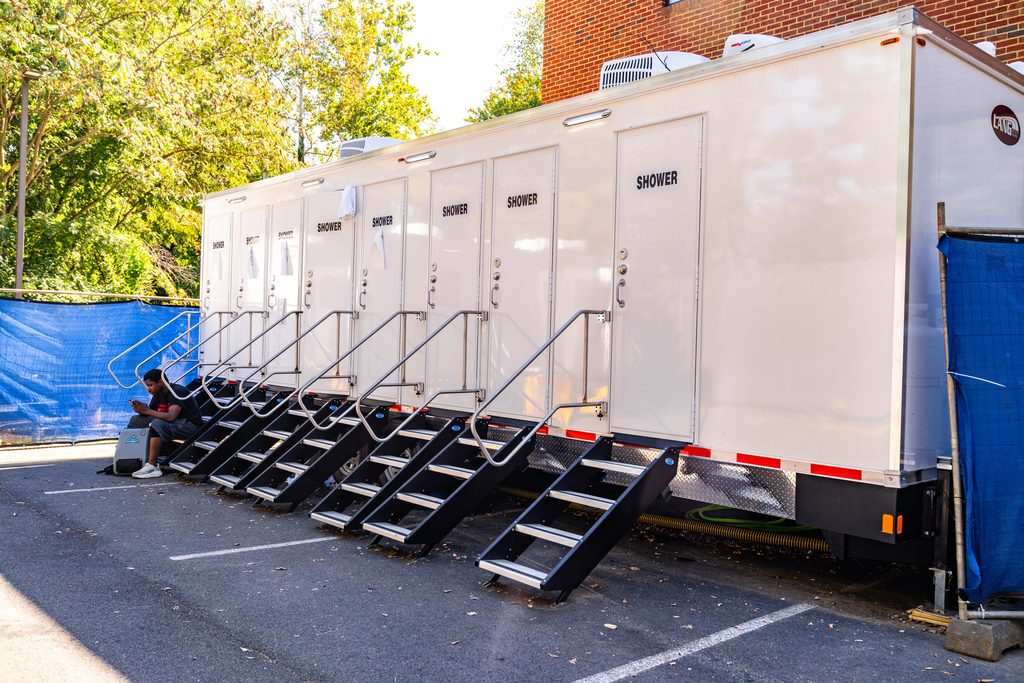
The building currently lacks indoor restrooms, with the exception of one ADA accessible half bathroom. Bathroom and shower trailers sit to the left of the main entrance, plumbed into the building’s sewage system.
Southee says the plan is to create a base of 80 beds with space to temporarily house up to 120 people. An exact bed count for the permanent low-barrier shelter has not been set.
“Our operation is through the renovation of this building,” Southee says. “We’re here to get this building up to where it needs to be, so that it can be a permanent shelter. To set policies and procedures, so that the community understands how 24/7 year-round shelter works, and then sort of hand it off.”
“24/7 shelter removes one of the largest barriers to homelessness, which is shelter, and allows you to decompress just a little bit,” he adds. “I don’t think anyone goes. ‘Yeah, I love congregant shelter,’ but I’ve got 75 beds in here; 75 people that were sleeping outside that are now sleeping inside and have access to whatever they need while they’re here, so that we can help get them housed.”
Settling in
While the city originally considered other, more local organizations to operate the shelter, it selected CASS based on the accelerated timeline it set for opening 2000 Holiday Dr.
“The city initially explored options with local providers, including PACEM [People and Congregations Engaged in Ministry], but the urgency of the need required an operator capable of moving quickly. CASS brought the experience and capacity to establish and manage a shelter on an accelerated timeline,” says Afton Schneider, Charlottesville’s director of communications and public engagement. “Our goal has always been to complement, not replace, local service providers, and we continue working to integrate CASS into the existing network, including its partnership with PACEM.”
Blue Ridge Area Coalition for the Homeless has been part of the city’s years-long effort to launch a permanent low-barrier shelter. Executive Director Shayla Washington says the city and CASS “have really taken ownership of this project for the initial 12 to 18 months,” while BRACH “is really looking at the long-term planning for how operations will go at Holiday Drive moving forward.”
Washington says local providers were unable to meet the city’s rapid timeline because of capacity, not capability. At the moment, BRACH is focused on funding more outreach positions within the continuum of care.
Washington isn’t hearing a lot from the people currently staying at the emergency shelter, but has received feedback from those who left.
“We have relationships with them. They’ve been around, and we’ve been around them for years,” says Washington. “Some of the reasons I’ve heard that folks are not staying in the shelter is because … the restrooms and showers are outside in a trailer in the parking lot, and some folks don’t feel safe trying to access that at night. There have been other folks who have reported that their abuser is staying in the shelter, and they have some kind of restraining order or protective order against that person, and don’t feel comfortable trying to access the shelter themselves.”
“We do not require any specific conditions to be met to get shelter,” says Southee. “You don’t need to be sober. You don’t have to have a job. We allow sex offenders to be here. If you have any barriers to shelter elsewhere, we’re not going to have those barriers. … That does not mean people are out here shooting up, doing whatever they want here. We do check bags. You’re not allowed to have weapons.”
Promises made
Pulling up to 2000 Holiday Dr., it’s not immediately clear where the front entrance is, and the building is similarly labyrinthine inside. Some current and former residents say that’s not where the confusion ends.
Megan Hope lived along the Rivanna Trail for more than two years before the city cleared the sites on September 1. She went to the emergency shelter the day it opened, but decided to leave the same night.
“I got there right before the cutoff hour,” says Hope. “I literally only stayed, I think it was til 3 o’clock in the morning, and then I got an Uber out. … It was just very awkward because we have to use the bathrooms outside, the showers outside. I understand they wanted to make sure everybody’s safe in a way, but at the same time … I’ve been incarcerated. It was literally like a jail cell.”
Throughout the intake process, Hope says staff seemed unprepared for the amount of people coming to the shelter and kept emphasizing it was not a permanent housing site.
“There really were no resources,” says Hope. “Honestly, the shelter is no different from the trails. Like it’s the exact same thing. You still have people literally stealing from each other, doing weird things. The only difference is we’re not outside, but at the same time we still use the bathroom and everything outside.”
Hope is still homeless, and is currently staying outdoors, unsheltered.
“If they wanted to open up a shelter, they should not have closed the encampment down so soon. I understand why they did it, in ways, but at the same time, they weren’t prepared. They weren’t ready for us. They just did this on a whim,” she adds. “People are getting turned down. Like either way, people are still outside.”
Dee, who also was displaced by the city’s clearance of the Rivanna encampments, is currently staying at the shelter.
“I was actually in the public workspace group when they put the rules down, when they said, ‘This place is gonna be this.’ … A lot of stuff they said in the meeting, it’s not true. There’s no transportation there. There’s no caseworkers there,” says Dee. “You gave this man a building and beds, and just said have at it.”
Dee also has concerns about the outdoor showers and bathrooms, and alleges that shelter staff have explicitly told people not to call the police to report incidents ranging from a stolen scooter to sexual assault.
“There was a guy exposing himself to women, which the police should have been called, but [weren’t],” says Dee. “You see this report by the police: ‘There’s been low crime rates at 2000 Holiday Dr.’ … Because a lot of stuff that’s going on, they’re not reporting it.”
According to Dee, the man who exposed himself eventually threatened a woman, and was kicked out of the shelter for 30 days. Staff allegedly told the man to leave when he returned to the site, but did not escort him off the property.
“He’s out there, traumatizing the women that he already has, saying stuff—
rude, rude and irregular stuff—to women that he shouldn’t be, because you didn’t escort him off the property, and that’s where it gets other people there in trouble,” Dee says.
With the lack of frequent transportation close to the shelter, Dee and other residents have been getting rides from the C’ville Care Bears—a volunteer organizing, advocacy, and outreach group. Residents have found accessing the service complicated by the shelter’s lack of WiFi and inconsistent policies.
“[The shelter is] hard to work with and it definitely limits our capacity,” says Isis, a Care Bears volunteer who drove Dee to his interview with C-VILLE. “Sometimes we’ll pick people up and they’ll let people know we’re there,” she says. “And sometimes they’re like, ‘You can’t even wait on the premises for them.’ … ‘Unless they’ve already pre-signed out a form, we aren’t even gonna tell them that you’re here.’”
While some people staying at Holiday Drive have cell phones, many of them rely on WiFi. According to Dee, there is currently a single computer available for resident use.
“If you need something you can’t really communicate with the outside world without Wi-Fi, because most people’s phones are not on,” says Isis. “How are we blowing this much money and you can’t get Wi-Fi? … We would spend less money if we just housed everyone.”
The city purchased 2000 Holiday Dr. for $6.2 million in October 2025. According to Schneider, start-up costs for the emergency shelter were $243,398.20, and operations for the first month were $181,693.13. At its current 75-bed capacity, the city is spending roughly $2,422 monthly per shelter resident. The average rent in Charlottesville is $2,100, according to zillow.com.
“I feel like this is very on par for [Charlottesville] to blow a bunch of money and hurt a bunch of people in the process,” says Isis.
Southee highlighted CASS’s use of the social determinants of health to help people get housing, saying nine people had exited the emergency shelter to either “housing or positive housing destinations.” Schneider told C-VILLE that three people had transitioned into “permanent housing.”
“I’m like, ‘Who are these people?’ Because the same people are still here,” says Dee. “There’s only one person I know that got housing, but he already had that before he came in there. He was just waiting for it to open up.”
C-VILLE asked the city about the response to the shelter. Schneider says, “feedback from individuals staying at the shelter has been largely positive.”