In 2025, filmmaker Chrisa Giorgi drove across Virginia, visiting wineries and vineyards to answer a simple question: What is Virginia wine? The result is We the Wine People, a 96-minute documentary released on Apple TV in September.
Wine was part of Giorgi’s life long before she made films about it. Growing up in Crete, she and her siblings would harvest grapes from her grandfathers’ vineyards. On Sundays, when the family gathered for lunch, her maternal grandfather would share small sips of wine and ask her to name the grape, the vineyard, or even the specific barrel. She recalls performing well enough that her grandfather thought she had a gift. To her, it was always just a game. Today, she realizes her grandfather was teaching her to pay attention, remember aromas, and understand how the same grape could change depending on where it was grown or how it was made.
A more formal wine education started after she moved to the United States. Giorgi previously worked in journalism, political analysis, and marketing. Looking back, she sees a common thread in all of these: trying to understand the choices people make and using different methods to tell their stories. While wine offered her a way to combine agriculture, history, science, geography, and culture, Giorgi found she was not very interested in telling people what to drink. She was more interested in the who and why behind the making of the wine.
Giorgi’s exposure to Virginia wine was a gradual process. Virginia wines that instructors shared after class at Capital Wine School first caught her attention. Then a Glen Manor Meritage poured at a friend’s dinner made her wonder how much she had overlooked. “How did I not know this was happening in Virginia?” she remembers thinking.
Attending the Virginia Wine Benefit’s annual auction in 2023 was a turning point for Giorgi, who remembers the wines being beautiful, but says she was struck even more by the community around them. “After that, I was hooked,” she says. Her enthusiasm led her to write a film grant proposal that received support from the Virginia Wine Board.
Filming began in June 2025 and continued through November that year. The work included about 40 shooting days and more than 50 interviews and scenes, with the goal of including smaller producers and covering every region of the state.
Giorgi already knew Virginia was making high-quality wines. What she learned quickly was that Virginia wine is not simply a single thing. The Shenandoah Valley is not the Eastern Shore. Northern Virginia is not Central Virginia. Elevation, soils, climate, disease pressure, and other challenges vary from region to region.
She also found a throughline of research, experimentation, and collaboration aimed not just at making better wine now, but at answering larger questions about Virginia’s future. What grape varieties should be planted? Which will thrive decades from now? Can vineyards be farmed more sustainably in Virginia’s humid climate?
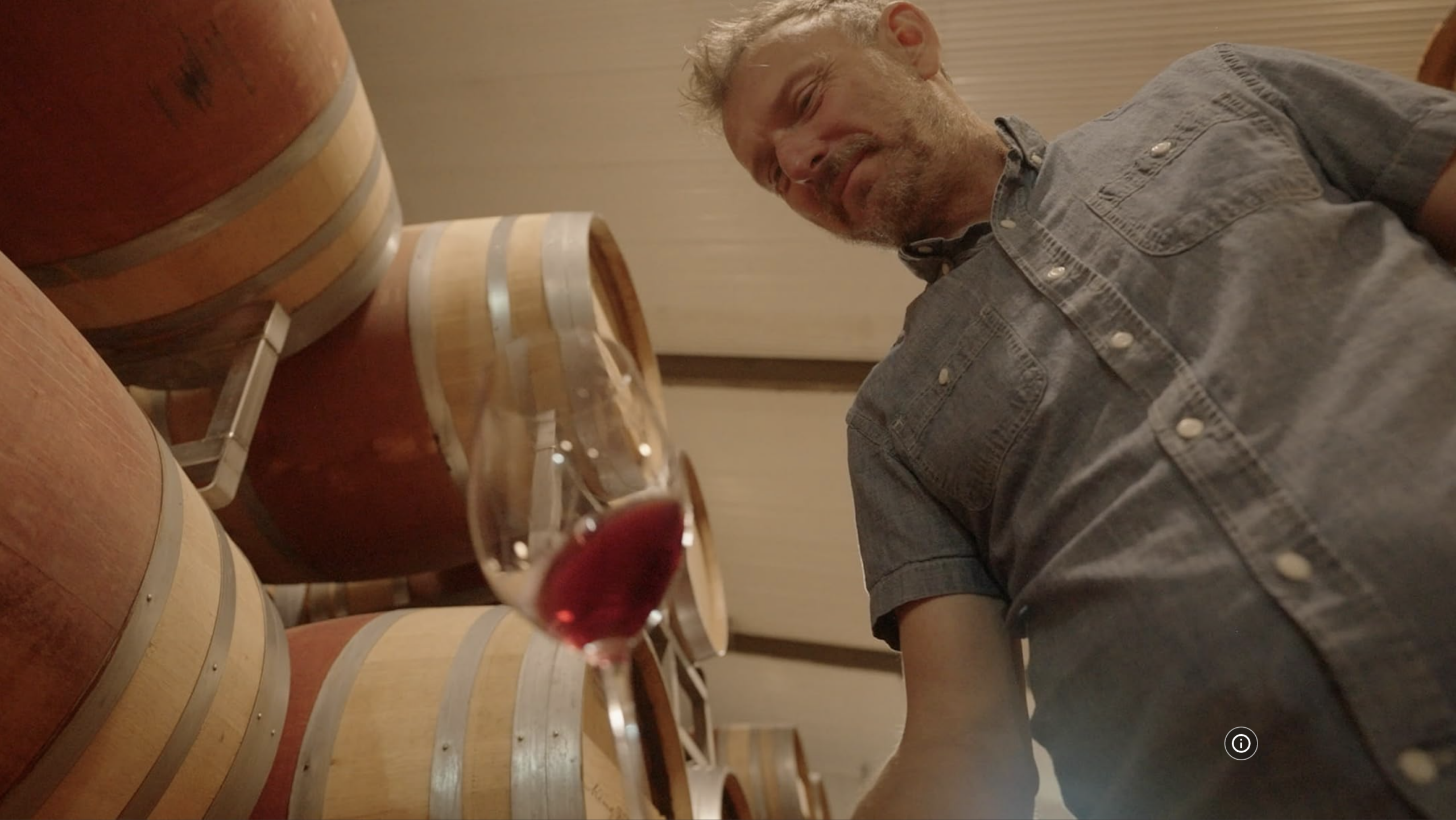
Virginia Tech is working on answers to some of these questions. The Virginia Wine Board supports research in this area as well. Giorgi found herself particularly fascinated by the Winemakers Research Exchange. “You have winemakers conducting real-world trials in their own cellars and vineyards and then sharing the results with everyone else,” she explains. “No gatekeeping.”
“I thought I was coming in to make a film about a wine region,” Giorgi says. “I ended up making a film about a whole ecosystem.”
The filmmaker describes Virginia wine as “comfortable with uncertainty.” She means it as a compliment. How will climate affect grape growing? What role will hybrids play? What will varieties such as cabernet franc and petit manseng become? The desire to experiment is paired with a desire to share. Giorgi said she gradually came to realize that “collaboration wasn’t simply a beautiful subplot in the story. It was part of the infrastructure of Virginia wine.”
That observation became unexpectedly personal when Giorgi hit a deer and totaled her car during production. Winemaker Matthieu Finot happened to drive by and stopped to help. After Giorgi posted about the accident, messages came from across the Virginia wine community, offering rides and assistance. “The people I had been documenting stopped being simply the protagonists of my film,” she says. “They became the people taking care of me.”
That emphasis on community runs throughout We the Wine People. Winemakers, growers, researchers, educators, hospitality professionals, and consumers all contribute to the story and the identity of Virginia wine.
Giorgi sees the challenge ahead as less about quality than visibility. People who visit Virginia and taste the wines are increasingly convinced, but what happens outside the state? She asks, “Can someone find Virginia wine on a restaurant list in D.C., New York, or Chicago? Can they find it in an out-of-state wine shop? Does a sommelier know enough about Virginia to recommend it confidently?”
For now, Virginia wine’s story is that it continues to ask bigger questions. What Giorgi found is an industry, perhaps better described as a community, that is unusually willing to search for answers together.