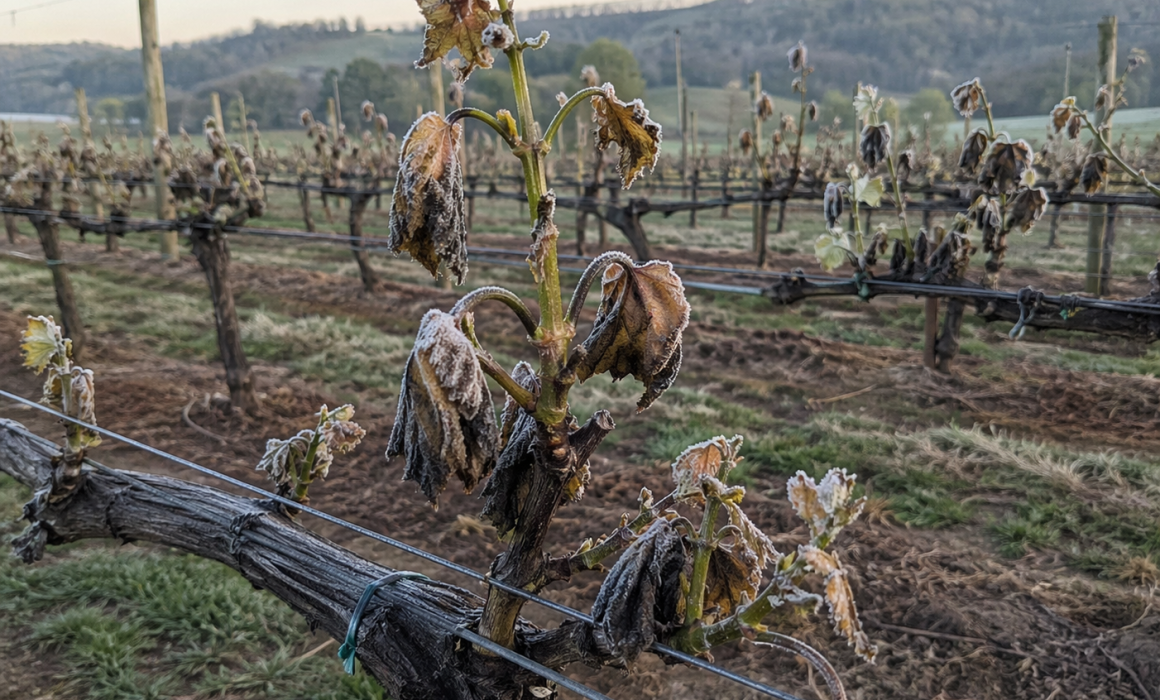
For five days in mid-April, Charlottesville simmered unseasonably, with highs reaching a record 92 degrees on April 15. But as April 20 rolled into the 21st, the temperature plunged to an equally unprecedented 28 degrees, catching plants at a vulnerable part of their growth cycle, and adding another burden to a tough season for local farmers.
At King Family Vineyards in Crozet, an estimated 15 to 20 of the farm’s roughly 45 acres of grapevines took serious damage. “We have all of our primary shoots out, and our cluster formations were formed,” says Eric Clouse, King Family’s vineyard manager. The frost “was enough to harm those growing shoots, and then also, in serious cases, damage the fruit clusters entirely. We’re going to see a big setback on this year’s fruit production on those primary shoots.”
Grapevines can produce secondary shoots if the primary ones die, but Clouse says they tend to produce fewer, if any, fruit clusters. Even though he could lose up to 20 percent of the year’s crop, Clouse is optimistic. “Things are already bouncing back,” he says. “Good thing about grapevines, they’re pretty resilient.”
Crown Orchards wasn’t so lucky. “This time of year in our orchards the trees are blooming and the young fruits that we’re hoping to harvest for this year are very, very delicate, as flowers or as very, very small fruit,” says Henry Chiles, the youngest of three generations of Chiles by that name working for Crown. “At this stage we’re very susceptible to cold weather and to frost. Any sort of freeze damage will kill the fruit. And unfortunately, the crops that we have, apples and peaches, they only flower one time per year.”
The company’s Carter Mountain and Chiles Peach Orchards were largely spared. “We’ll still have fruit for the local community,” Chiles says. Crown Orchards’ other fields, which grow wholesale to grocery stores, took harder hits.
Chiles estimates Crown lost half the year’s total crop, and with it, crucial market share. “When somebody calls you and asks you for a tractor trailer-load of peaches and you don’t have it, they’re going to find the next guy that does,” he says. “And next year, they’re going to call that guy, and they’re not going to call you again.”
At Bellair Farm, manager Michelle McKenzie’s crops mostly made it through. She’s more concerned about fuel costs, a labor shortage that she blames on government staffing cuts, the region’s ongoing drought, and a changing climate in which this year’s extremes become the new normal.
“I can’t even tell you how bad the damage is,” she says. “Once the ball is rolling, we are just on this freight train that we don’t have control of all the levers of. And this spring is really throwing us for a doozy with the drought [and] the worker delay.”
“We had a challenging year last year with the wet weather, and then the introduction of the spotted lanternfly insects into our farming systems, and then a hard winter, and then that week of 90 degrees in early April, followed by a 28-degree day,” Clouse says. “All these things seem to work together and make things more drastic than it typically would be on one-off events.”
Chiles says insurance will cover Crown’s crop losses. Clouse, in his second year at King Family, wasn’t sure whether the vineyard had a policy for its crops.
“It’s kind of one of those things, farming. You’ve got to roll with the punches,” Clouse says. “We do everything we can to protect our crop, but sometimes Mother Nature just gets the best of you.”
The 28-degree frost that hit area farms April 21 damaged grapevines, apple and peach trees, and other crops just as they were starting to grow flowers and fruit.