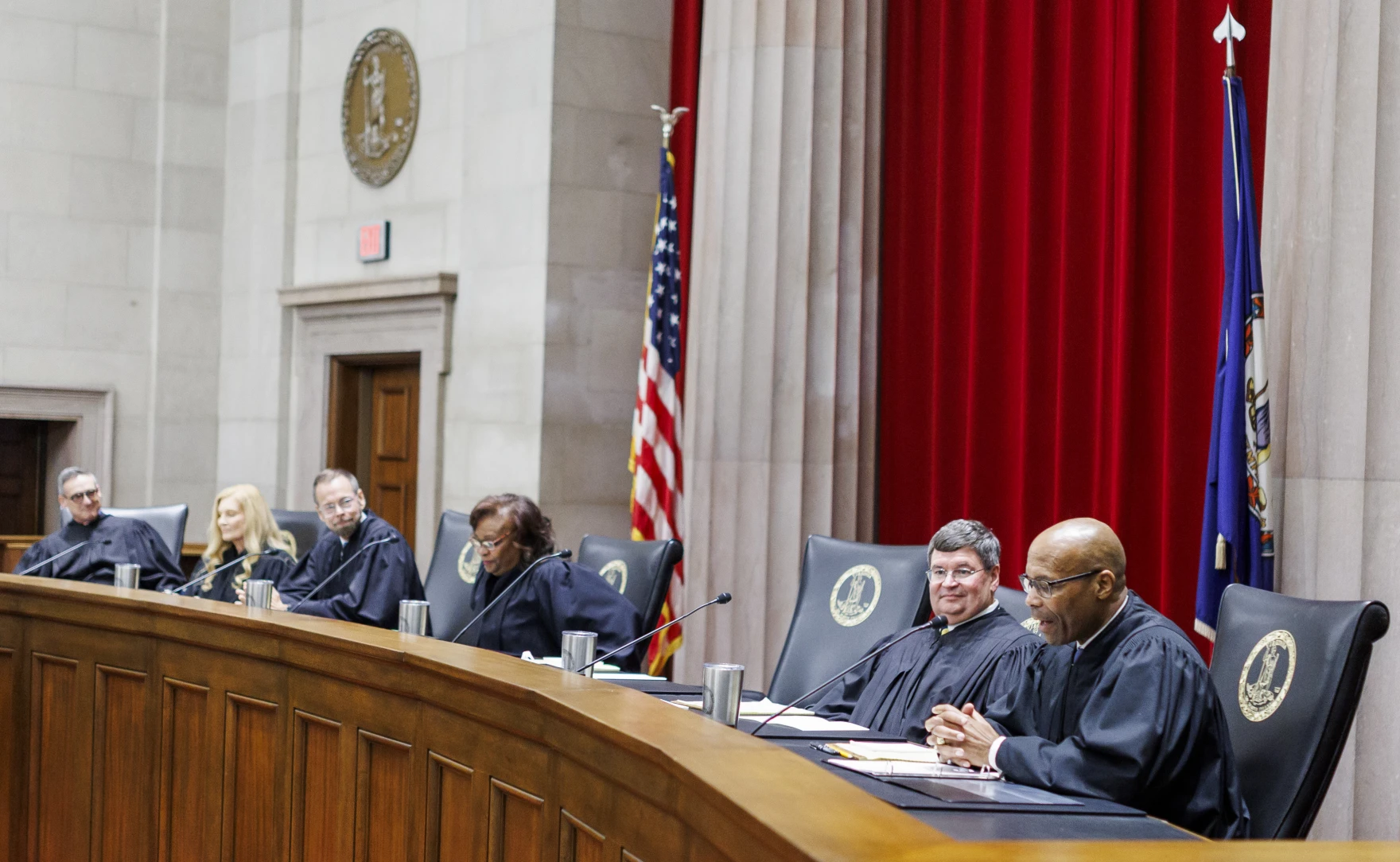
In a 4-3 ruling, the Supreme Court of Virginia sided with the Tazewell County Circuit Court on May 8, tossing out voter-approved maps ahead of the 2026 midterm election. With the decision, Charlottesville will remain in the 5th Congressional District.
Both the majority opinion and dissent grapple with the definition of “election” as it pertains to early voting and the state’s constitutional requirements for amendments.
In the majority opinion, Justice D. Arthur Kelsey argues that the state’s constitutional amendment process is intentionally designed to guard against “hasty changes to the Commonwealth’s organic law.”
The requirement that the General Assembly must vote twice, separated by an election, before sending an amendment to the voters gives Virginians multiple opportunities to weigh in on amendments. Since the first General Assembly vote on the amendment took place after the start of early voting for the 2025 House of Delegates election, the majority asserts that voters who cast their ballots early did not have equal opportunity to consider the redistricting amendment when selecting the candidate of their choice.
“Voters can support or defeat candidates for the House of Delegates who either endorse or oppose the proposed amendment. If the General Assembly votes against it at the next legislative session, the process ends there. If the General Assembly votes in favor of the proposal, voters get a second direct opportunity to vote the proposed amendment up or down at the ballot box,” writes Kelsey.
Given his interpretation that the Commonwealth “violated the intervening-election requirement,” Kelsey concludes that the special election results are “null and void. For this reason, the congressional district maps issued by this Court in 2021 … remain the governing maps for the upcoming 2026 congressional elections.”
Justices Stephen R. McCullough, Teresa M. Chafin, and Wesley G. Russell Jr. joined Kelsey in the majority opinion.
Chief Justice Cleo E. Powell wrote the dissent, and was joined by Justices Thomas P. Mann and Junius P. Fulton, III.
Powell argues that the majority’s consideration of the definition of “election” fails to weigh the language of the state constitution and state law itself. Under Virginia code, Powell writes, “the General Assembly has specifically defined a ‘[g]eneral election’ as ‘an election held in the Commonwealth on the Tuesday after the first Monday in November.’”
Furthermore, she asserts that the potential violation of posting requirements by the General Assembly does not rise to the level of overturning “an amendment that otherwise meets the requirements.”
While most politicos see the Virginia Supreme Court ruling as a death sentence for the 10-1 redistricting map this election cycle, state Democrats filed a longshot appeal to the Supreme Court of the United States on May 11.
“For our purposes, in terms of rating these races, … the Virginia State Supreme Court was always going to be the final word,” says J. Miles Coleman, associate editor of Sabato’s Crystal Ball at the University of Virginia Center for Politics. “As we saw in the ruling with the Voting Rights Act, the U.S. Supreme Court is not really a court that is sympathetic to Democrats. … Generally speaking, when it comes to these issues of gerrymandering, this U.S. Supreme Court has given a lot of deference to the state supreme courts.”
Despite the setback in Virginia, and the growing number of states redistricting in favor of Republicans, Coleman still forecasts Democrats gaining a majority in the House of Representatives.
In addition to the six congressional seats currently held by Democrats in Virginia, the party has an opportunity to pick up currently red districts, even with the 2021 map in place. VA-2 in the Virginia Beach area is looking like a toss up this cycle, and Republican incumbent Rob Wittman will face a tough challenge from Henrico County Commonwealth’s Attorney (and 2025 lieutenant governor candidate) Shannon Taylor in VA-1.
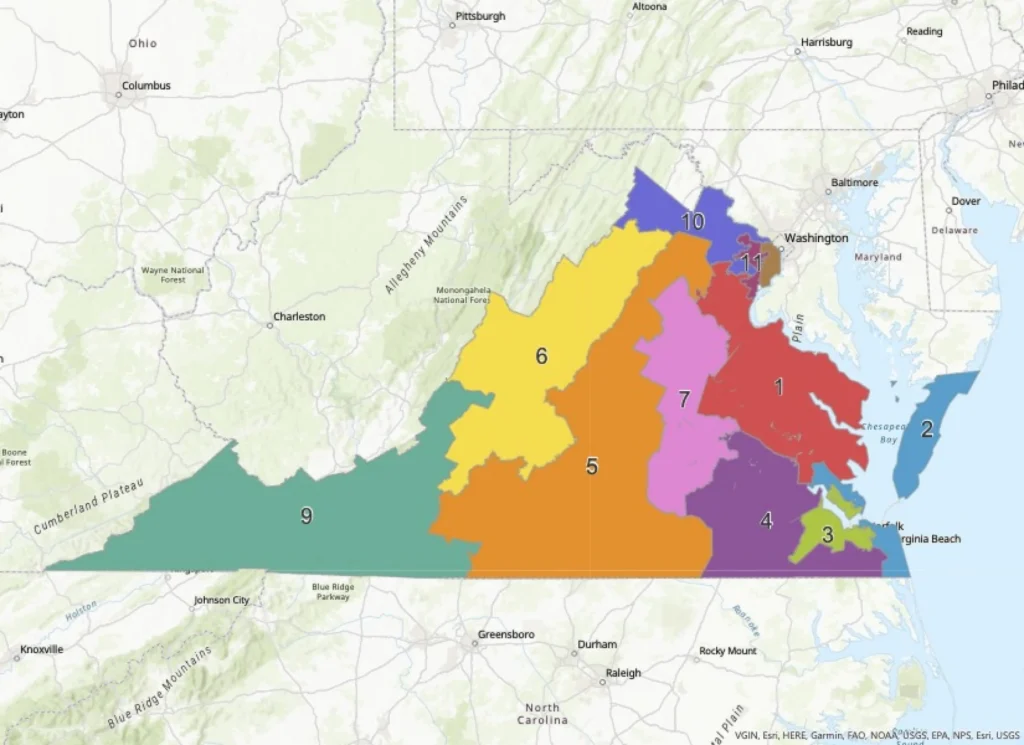
Charlottesville’s district, VA-5, is much more difficult for Democrats, according to Coleman. Despite winning the race by 15 points statewide, Gov. Abigail Spanberger lost VA-5 by roughly 7.6 points, according to the Virginia Public Access Project.
“District 5 is just a tough seat for Democrats,” says Coleman. “I think if Perriello could match what Spanberger got here, or … even keep it within 10 points, that would be a decent showing for a Democrat here.”
“You can see why Democrats are really frustrated, because in some of these states, like Tennessee [and] Florida, the Republicans get to ram through these favorable maps within a matter of days,” Coleman says. “In a state like Virginia, which the Democrats were really counting on, the state supreme court holds them to a very high standard. They have to do everything exactly right. They have to jump through all the hoops and still get struck down. So that’s been one of the interesting dynamics between the red states and blue states.”
One element working in Perriello’s and Democrats’ favor this year is the steady decline in President Donald Trump’s approval rating—one of the best predictors of midterm results.
“The president’s approval rating seems to be going lower and lower. I think Democrats are probably still favored to take the House, maybe not as much as they would be if the Virginia 10-1 map had been okay,” Coleman says. “In terms of the Senate, I would probably favor the Republicans there, but … it’s not looking like as heavy of a lift for Democrats as it was maybe this time last year. … If the Democrats flip the Senate, that, to me, is the bar about whether 2026 is a true blue wave year.”
Even as he’s focused on projections for the midterms, Coleman expects that Virginia’s redistricting conversation is here to stay.
“After the ’26 elections, there is going to be massive pressure on Democrats everywhere, in states like Virginia or Colorado … to redraw where they can. So I would not be surprised at all if maybe a year from now, we’re in another position where Democrats are trying to do another referendum,” he says.
To read the full text of the majority opinion and the dissent, visit vacourts.gov.