Transgender Americans have seen big changes to their health care in the last 18 months. While medical and surgical interventions for young trans patients under age 19 are now banned by the federal government, leading to policy shifts at health systems across the Commonwealth, more subtle changes to adult transgender care are surfacing, too, including narrowed coverage and denied claims for care related to gender dysphoria.
Amid the changes, here’s a glimpse at how one Charlottesville-area physician continues to advocate for LGBTQ+ patients across Virginia.
C-VILLE Weekly: Let’s start with what you do.
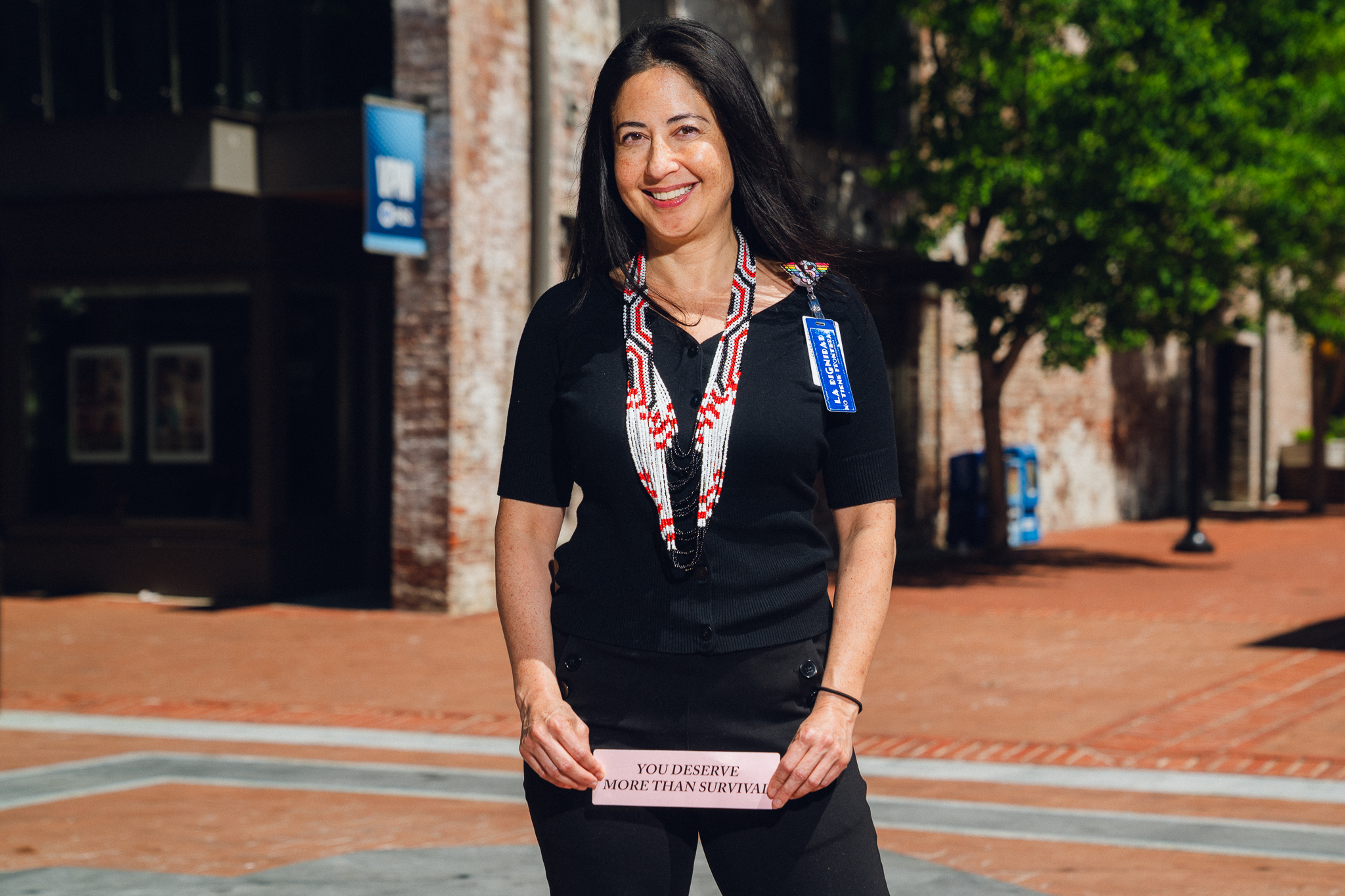
Catherine Casey: I’m a medical doctor, and family medicine physician in Crozet.
Talk about how you became interested in LGBTQ+ patients in particular.
In medical school, I had a couple of LGBTQ friends who had to go to the infectious disease clinic in order to get primary care because doctors were not trained appropriately to screen for sexually transmitted infections in gay men. This was completely wild to me, seeing as they were just regular healthy 22-year-olds looking for a checkup.
I always had a feeling that I wanted to do something later on as a physician about that. Fast forward to about 2015, when I had about five trans patients ranging in ages from 15 to 75, and it became apparent that there was no specialist who I could refer them to who could take comprehensive care of their health. I got some mentorship, and developed what eventually became a clinic specializing in LGBTQ health and trans care.
What should people know about the kind of care LGBTQ+ patients need?
It’s important to understand trauma-informed care because many patients in this population have had really negative health care experiences, which helps us use less traumatizing language and physical exam techniques.
And trauma-informed care is…?
It’s a way of treating patients so that we first do no harm. I’ve had patients tell me about providers who walked them out of offices, or got a phone call from an eye doctor’s office saying they couldn’t be seen because they’re gender diverse. Some of my patients have been inappropriately examined, including one who went to the ED for a seizure and woke up with her pants removed. They had seen her chart, and that she had had gender affirming surgery, and were curious.
So my work really focuses on providing care for these patients directly but also teaching other providers how to do it. We create a thread of information, rather than segregate it, which inadvertently pathologizes it, and teach medical and nurse practitioner students to ask about people’s pronouns, ask sexual history questions that are inclusive of partners of different genders, ask permission before touching somebody during physical exams, and never assume patients are comfortable having their shirt off.
The approach pays dividends for cisgender populations who might need trauma-informed care, too.

You helped organize UVA Health’s first transgender clinic back in 2019. Why’d you decide to make a separate space for these patients?
The vision was to provide the care that wasn’t available and a distinct space where all the people patients would interact with—from the front desk to the nurses to the therapists and lawyers providing name change and other legal services—would be supportive and fluent in using LGBTQ terminology.
Today, we have multiple full-time staff and more patients than we can take on: probably about 1,000 LGBTQ patients who see us on a regular basis, if not more. We have a certified nurse-midwife who sees patients by telehealth with transportation or access issues, and a constant stream of medical students, providers, and residents from around the state who come to learn with us.
LGBTQ health and trans care specifically is truly interdisciplinary, overlapping with primary care, OBGYN, and surgical. It’s the entire life cycle. And that’s absolutely how it should be. LGBTQ health should be a routine part of primary care, and all primary care doctors should be familiar with it, the same way they’re familiar treating diabetes, hypertension, low back pain, sinus infections, and the rest of it.
Take us back to President Donald Trump’s executive order in January 2025 that declared gender was binary, that there were only men and women.
As a medical doctor, and the child of scientists, it was about the most scientifically ignorant thing I’d ever heard. There are so many ways in which sex is a spectrum, as far as male and female—whether it’s at the hormonal level, the chromosomal level, what internal organs a patient may have, what external organs they have. It was heartbreaking to see this population targeted in such an irrational, arbitrary way.
It was very frightening, too. They’re just trying to live their lives. They’re not trying to hurt anybody. They have no agenda except to survive.
As a provider seeing patients self-actualize, and improve their overall happiness and function through affirmation, it’s just like, you can’t go back. You can’t pretend like our care wasn’t an effective treatment. Gender affirming care is supported by 30 major medical associations: the American Medical Association, the American Academy of Pediatrics, the American Psychological Association.
For me and others working in this area, it was a call to action. It was personal. It wasn’t an abstract attack on a population; these were people we knew and cared about deeply. It definitely raised the mama bear hackles in me, and others, and led to multiple meetings, including one at my kitchen table that proved very fruitful.
At your house? What did that meeting look like?
It was with other providers in the area—public policy and legal experts, people in our political system. We were able to pool our knowledge, think broadly about what community and political assets we had, and try to do whatever we could to ensure these patients had continuity of care.
There are real medical consequences for somebody who stops their medications, just as there’d be for those who stop taking medications for high blood pressure or diabetes. If somebody stops medicines for gender affirmation, particularly if they don’t have ovaries or testes anymore, they can develop osteoporosis very suddenly. So ensuring our patients had continuity of care to keep them psychologically and medically safe was our priority.
I bet there was a big text chain.
Yeah, that was instrumental in making progress, too.
UVA Health first banned, then reinstated with changes (admitting no new young trans patients and offering care that’s “consistent and compliant with existing law”), gender-affirming care. What impact did those shifts have?
It was absolutely devastating. The phones were ringing off the hook, providers were staying until midnight to take patients’ phone calls, we were talking to parents in tears. There was literally no plan in place about how care was going to be delivered and continued for these patients and their families.
It went on for weeks. I had never seen my pediatric colleagues break down and cry like that before, and that was honestly what made me feel like I had to double down even harder, and make sure this work was done for them, too. It was utterly unfair that some of my colleagues were never going to see patients again who they’d been caring for for years based on something so cruel and arbitrary.
A lot of these families came long distances to get this care, and saw their [trans] loved ones become psychologically healthy, non-suicidal. Access to medical care has always been a crisis in the U.S., but the very arbitrariness of how it was immediately taken away for one group of people was terrifying and not something I’d anticipated ever seeing in a democracy.
What’s the status of care for young trans patients now?
There are still many unanswered questions. We’re seeing ongoing threats to institutions providing care to this patient population, and the current federal administration has proposed that Medicaid and Medicare funds be withdrawn from institutions that provide transgender care for youth. Should that happen, then all care [of trans youth] would have to come from private providers who don’t accept Medicare and Medicaid, and there’s a shrinking number of those.
This is also highly specialized care, provided, in most cases, by pediatric endocrinologists who don’t typically work in private practice. I don’t think there’s a private pediatric endocrinologist in the entire state of Virginia; they only exist within large academic medical centers. If such a ban were to go through, access to this important component of care could be completely dropped.
Are you seeing any changes for LGBTQ adult patients since trans-youth care has shifted?
I’ve definitely seen more denials from insurance companies paying for conditions related to a gender identity diagnosis. So, if I send a bill that indicates that I checked somebody’s testosterone and hematocrit, the health insurance company is supposed to pay for those lab costs that I ordered. But certain companies have stopped doing that across the board.
We’re seeing medications related to gender dysphoria diagnoses being denied by certain insurance companies, and, certainly, surgical procedures, too. Those are obviously a big-ticket item, but even medications and lab draws run into the hundreds, which for many people is not something they have to spend.
These aren’t things they’ve been forced to do by federal statute, but things they’ve chosen to do. It’s disheartening, but not completely unexpected to see for-profit health insurance companies take advantage of one of the most marginalized populations.
I worry most for my patients who, if they don’t get this care, risk running into life-threatening problems as a result of being denied.
Like osteoporosis?
Correct. From the time you’re an adolescent to the time you hit menopause, you need sex hormones in your body to maintain bone density and strength. For patients who’ve had their ovaries or their testes removed, if they’re suddenly denied estrogen or testosterone, they’ll immediately start going through osteoporosis. It’s absolutely inconceivable that we even have to ponder that somebody in their 20s might be at risk for osteoporosis and fracturing a hip.
What do you say to those who believe transgender youth have a “social contagion”?
I have this really radical belief that people usually know who they are. And it’s important to respect who people are. There’s a misconception that all youth who identify as trans or non-binary even want to take medical or surgical steps to transition. Surveys suggest it’s more like one out of 11, so a very small percentage are even interested in exploring medical or surgical therapies before 18. As society becomes more open to discussing these issues, however, more people feel empowered to come out, and that’s why there’s greater visibility.
Something that gets overlooked is that a very large percentage of the trans population is in their 60s, 70s, and 80s. My oldest trans patient is 90. These are patients who, when I asked how long they’ve known they’re transgender, answer something to the effect of, “1952.”
Clearly this is something that didn’t just happen as a social contagion or overnight.
I’m really touched and honored that patients approaching the end of their life would have the bravery to come out, and seek a doctor’s care that makes them feel affirmed and authentic.
So hospice and palliative care for older transgender patients is probably important, too.
Yes, 100 percent. I teach students that you cannot make assumptions based on how somebody looks, especially not with somebody who’s older. Learners often think older people are naturally more conservative. I warn them that if you “sir” and “ma’am” somebody, without knowing what their gender identity is, you may hurt them.
Also, a lot of older people have trans children or grandchildren or spouses whom they love deeply. I will walk into a room with an 80-year-old patient who will see my badge and break down in tears, then say, “I have a trans grandchild and I’m glad to know there’s a doctor out there who won’t judge them.”
Wow.
Yeah. I tell my learners that just those small indicators, like the badges we wear, that are nonverbal make a big difference in someone’s comfort, which impacts the care they’ll receive. Foucault talks about the medical gaze, and the power imbalance when somebody goes to the doctor. Doctors get to ask any intrusive or invasive question they want. Anyone is going to struggle with that vulnerability . . . for somebody who’s LGBTQ who’s had negative experiences with the health care system in the past multiply that struggle by at least five.
You used the word fluency before. Do you think kids growing up today have that, and think being LGBTQ is … ?
Absolutely. Where it’s like no big deal. When my son was in middle school, he told me about a friend he had using he/him pronouns, and he said it as casually, and made the change as easily, as talking about a different baseball team. He doesn’t come with the baggage that those of us from Generation X and up have.
What’s the deal with your ID badge?
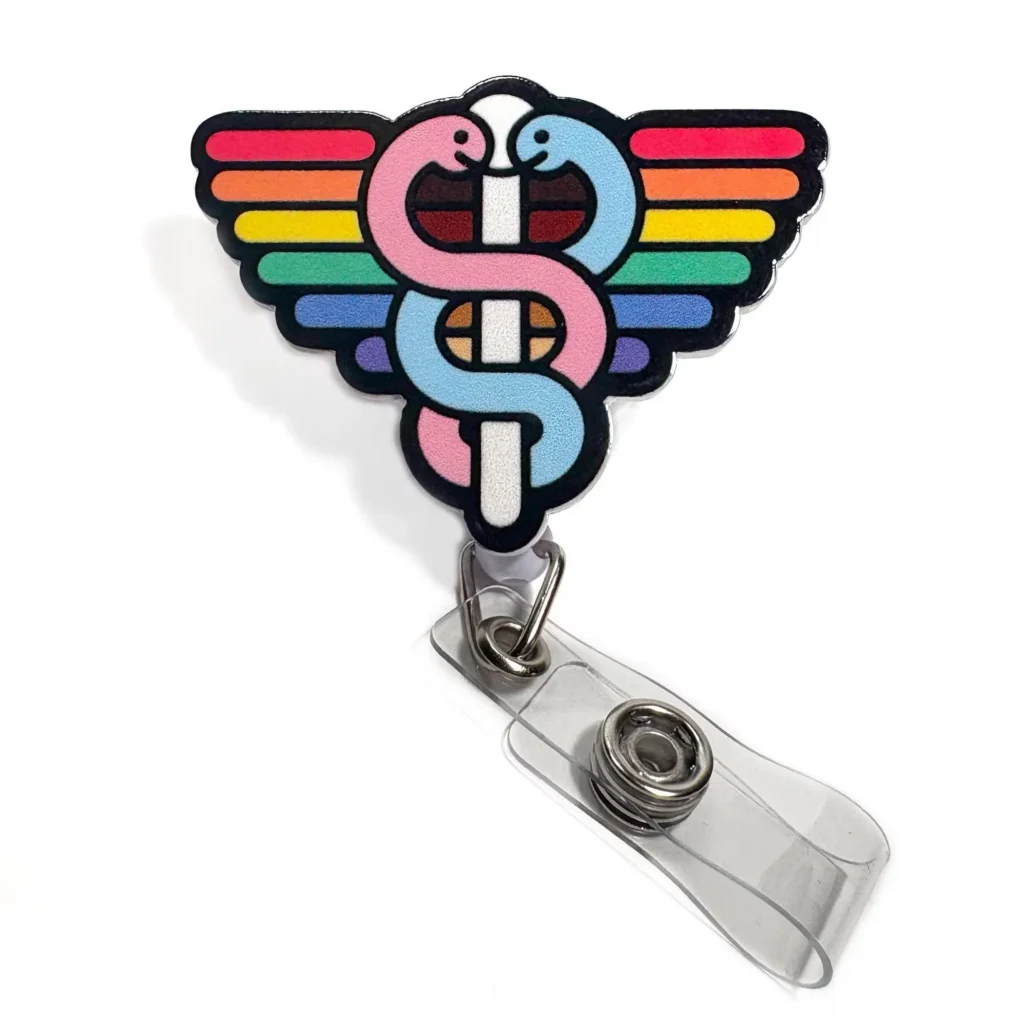
It’s the caduceus, the two snakes wrapped around the pole, an ancient Greek sign of a physician and healer. Mine has blue and pink snakes, for my trans patients, and a rainbow for my LGBTQ community.
I often get asked whether I get blowback from patients. Honestly, that’s only happened once, and the interaction went something like this:
She said, “Why are you wearing that rainbow?”
And I said, “I like to let my LGBTQ patients know I’m welcoming.”
And she said, “I believe in what the Bible tells me.”
Then I said, “I’m glad that’s working out for you. What can I do for you today?”