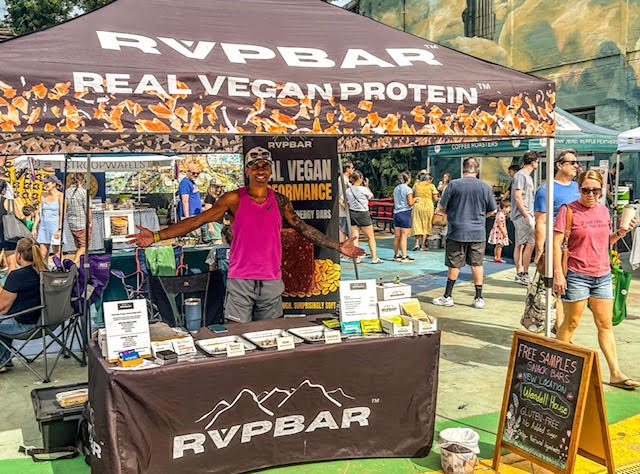
Sean Simmons digs into his lunch, the same oat bowl he’s been making for more than a decade. The bowl that inspired RVPBar, his line of plant-based energy bars. If his Instagram videos of flipping tractor tires aren’t proof enough, Simmons takes his fitness seriously. He’s cut like an ultrarunner or pro boxer, two sports that happen to be on his athletic resume.
His lunch is simple: oats, peanut butter, chia seeds, honey, and an apple. Whole foods to fuel his day, whether he’s setting up at one of three area farmers markets, installing carpet at his side job, or running a 106K (which he did in Bali in May—more on that later).
You could say a series of injuries have guided Simmons. Days before his professional boxing debut, he broke a rib while sparring. Recovering on the couch, he discovered ultrarunning and Spartan races. Later, while lifting a heavy carpet at work, he suffered a major pelvic injury, prompting him to take a closer look at his nutrition.
Simmons ate a vegan diet for about a year and a half, but today he maintains a mostly plant-based diet. “Through that healing journey and years of research, I found out the truth about real nutrition versus artificial stuff,” he says. When he couldn’t find a clean energy bar to fuel his workouts, he decided to make his own. During the pandemic, Simmons experimented with recipes until he landed on three date-based bars—peanut butter, coconut, and oats—and officially launched RVPBar in 2024.
Created and produced in Charlottesville, the Real Vegan Performance brand was built around Simmons’ belief that foods with simple, plant-based ingredients can provide quality protein and nutrients. Take the peanut butter and coconut bars, which use rosemary extract as a natural preservative. There’s no rosemary flavor, but the unexpected ingredient is an example of Simmons’ commitment to keeping the bars as close to whole foods as possible.
Soft, chewy, and tender, the snack is similar to Larabar, but contains less sugar and is conveniently sized for life on the move. The peanut butter bar has PB&J vibes and the coconut bar could pass for dessert. While the oat bar is comparatively drier and more straightforward, it’s a favorite among runners and cyclists who need high-carb, low-fat fuel for their workouts. Simmons ate nearly 15 of them during his recent 106K. “For a long run like that, your body can possibly have issues with fat, with not being able to process it,” he says.
Simmons is an athletically competitive guy, but his biggest opponent is the food industry. He’s particularly frustrated by ingredients that sound wholesome but can be difficult for consumers to understand. For example, the FDA defines natural flavors as “substances derived from animals or plants,” though these flavors are often complex mixtures that can contain more than 100 plant or animal-derived chemicals, including solvents, emulsifiers, and preservatives. “I know what they’re doing is wrong,” Simmons says. “It’s just that the majority of people don’t realize that they’re being lied to.”
He stresses the importance of knowing exactly what’s behind ingredient labels. Someone may struggle to identify the source of a health issue, Simmons says, “but it’s in their pantry with an item labeled ‘clean,’ but it contains these mysterious natural flavors.”
You can find RVPBar online, at farmers markets in Charlottesville and Harrisonburg, at UVA dining locations, and at an expanding list of vendors throughout the Blue Ridge, Richmond, and Washington, D.C., areas.