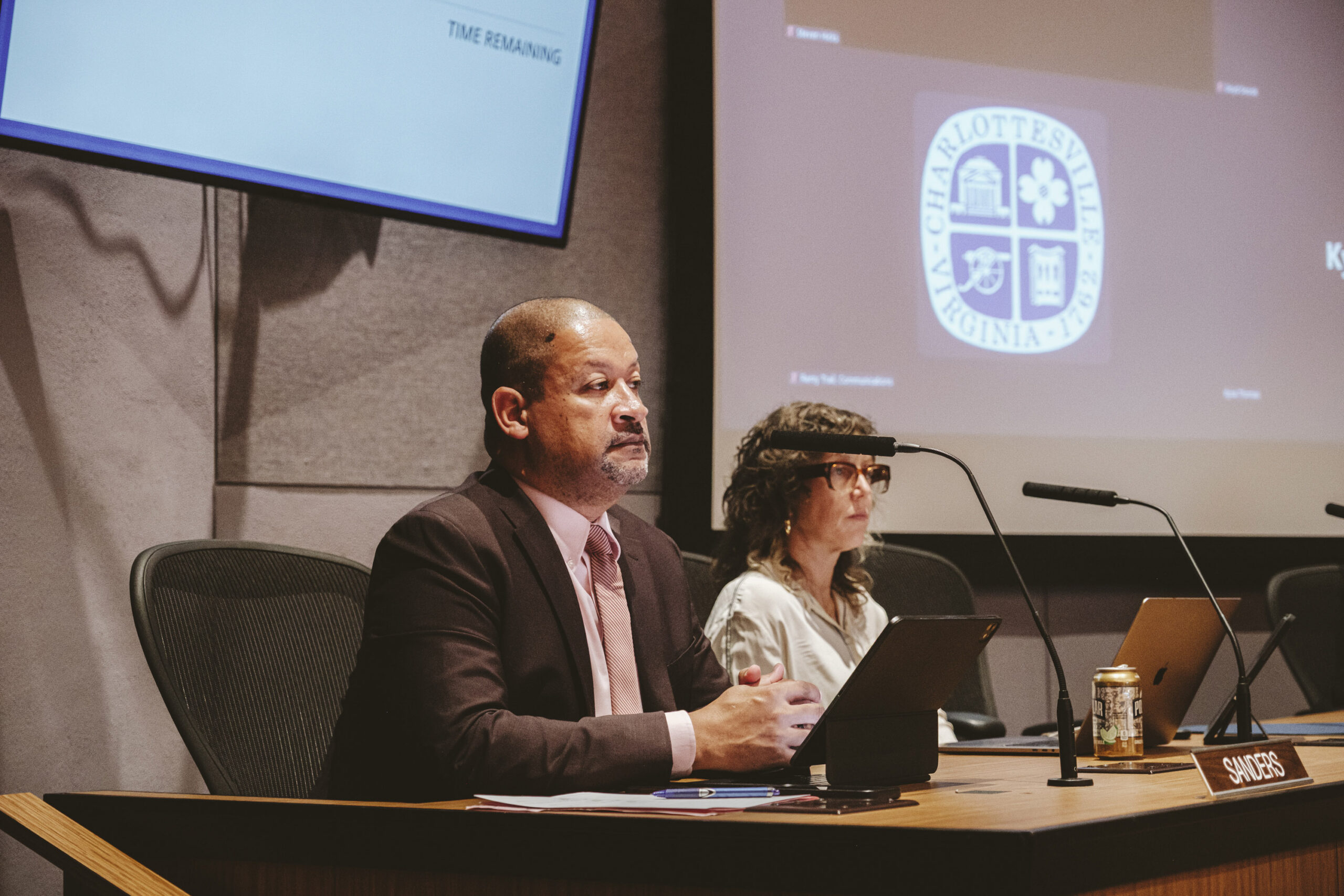
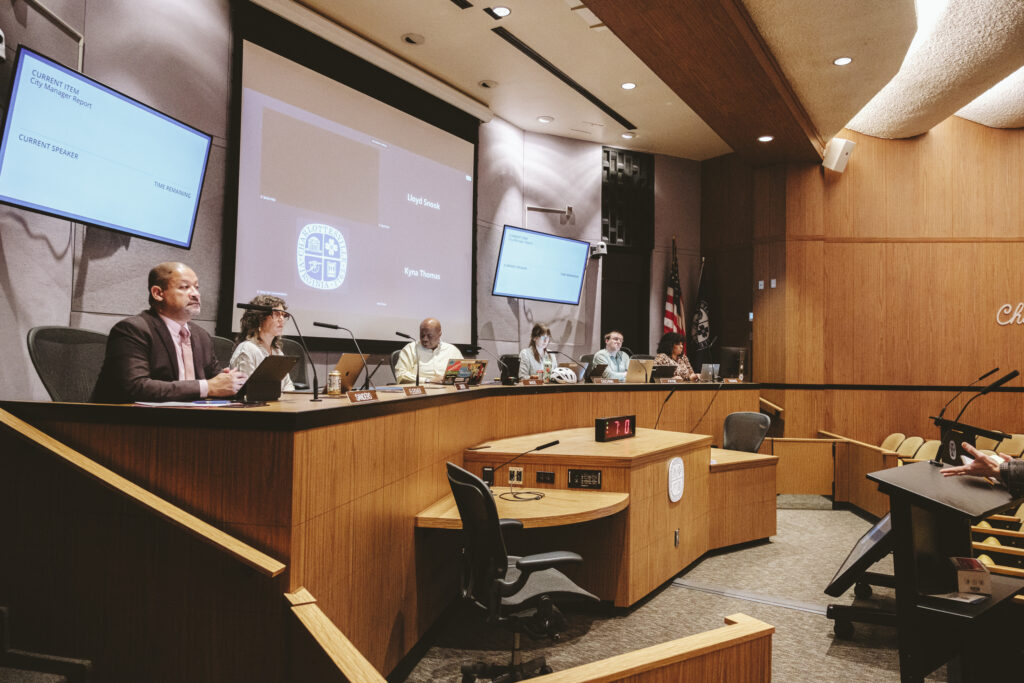
City Council weighs the cost of cutting priority expenditures against a 2-cent real estate tax rate increase. A hearing on the tax rates for FY27 will be held on April 6, prior to the budget’s adoption. Photo: Eze Amos
Work is underway on the Charlottesville city budget, with Council and leadership looking at a potential $0.02 increase to the real estate tax. The rate hike to $1 per $100 of assessed value would generate just under $2.5 million in new revenue, according to the city’s budget office.
While city councilors expressed reluctance to increase tax rates at work sessions, the proposed FY27 budget—totaling more than $327 million between the general fund and capital improvement projects—is balanced around the change.
“We did not arrive at any recommendation of a tax increase lightly. We have worked very hard trying to figure out alternatives to this point,” said City Manager Sam Sanders at Council’s March 5 budget session. “We started this budget cycle with a double-digit gap. We start with a gap every year, because we’re realizing that there are things that come forward that we then have to see if the assessment and other increases were enough to cover—it wasn’t. It was dramatically out of balance.”
Councilors pitched Sanders and budget team members on potential ways to avoid the tax hike—but the proposals were either already in the budget to reduce expenditures, or considered untenable for the city’s long-term financial health.
“I only have two choices: increase in revenue or decrease expenses. That’s it,” Sanders said. “We cut what we feel like we can get away with cutting, unless you tell us differently.”
Education, transportation, and affordable housing are all major expenditure categories in the proposed budget, while general fund cost-drivers include employee compensation and benefits, the transfer of funds to Charlottesville City Schools, and public transportation improvements.
On the collective bargaining front, FY27 funding for the city’s police, fire, transit, and labor and trades bargaining contracts totals roughly $1.4 million. An additional $2 million is allocated for a 2 percent step and 2 percent pay-scale adjustment for unaffiliated employees, and the previously approved raise for Council positions will cost the city an additional $88,814.
Health care costs for city employees are also up $1.9 million for FY27, with $1.5 million of the increase coming out of the general fund.
Education is a driving expense for both the general fund and capital improvement projects. The final agreed-upon transfer of $81.6 million to CCS, amounting to a roughly $2.57 million increase compared to FY26, came in roughly $600,000 over the originally allocated contribution because of compensation increases.
Legislation in the General Assembly, which would allow localities to vote on and self-impose a 1 percent sales tax for school construction and improvements, was also discussed by Council during its recent session. But the number of unknowns with that bill makes it difficult for the city to plan around.
“[SB607] was left in appropriations after being folded into another bill. Point being, there’s no guarantee it even passes this year,” said Councilor Michael Payne. “If we use surplus [to cover recurring expenditures], we’re going to be in that position of having done that, not knowing … the outcome of the state budget process.”
Similar legislation passed last year, but Payne remained skeptical about the bill, even though Gov. Abigail Spanberger committed to signing it if given the opportunity. Democratic lawmakers passed the bill last year, knowing that former Gov. Glenn Youngkin would likely veto the legislation. Payne’s observation that the political calculus has changed is still playing out in the legislature.
Improved public transportation also comes with a price tag. Adding 10 additional full-time transit operators and five support staff—with the goal of 30-minute service times across CAT and 15-minutes for the Downtown Trolley—will cost the city significantly, on top of an additional $883,063 in FY27 for operating expenditures.
Some of the largest expenses in the proposed budget are nestled into the FY27 Capital Improvement Plan, with millions slated for affordable housing, climate action, and public safety.
For now, City Council remains skeptical of, but committed to, the real estate tax increase. But the city’s long-term approach will need to shift, according to Vice-Mayor Natalie Oschrin.
“Our financial advisors told us we are hitting our fiscal stress level, so we can’t just keep reaching our hands into the wallets of the same people every year. We have to expand our people so that we can spread out that burden,” said Oschrin at the March 5 work session. “We have to see what those levers are to … grow the base instead of deepen the base.”
Attendance at the first public tax hearing of the budget cycle was sparse amid severe storm warnings March 16, but Charlottesville residents have a few more opportunities to weigh in on the proposed tax rate and the budget. A community budget forum will be held at 6:30pm on March 19. The final, noticed public hearing on the tax rates and budget will be held April 6, with adoption slated for April 9.