The pandemic changed directions for so many lives. For Chad Pelton and Christie Bazemore, it sent them to a new town and a new home.
“We were ready for a change after COVID,” Bazemore recalls. “My business lease was coming due, and we’d fallen in love with the Staunton area. Chad’s father lives on a farm nearby, and we’d been coming up often.”
In 2023, the couple, who was living in Nashville, began looking for traditional houses, when their realtor asked if they’d be open to living in town. “This place wasn’t even on the market,” Pelton says. Within weeks they were the new owners of a 19th-century house in Staunton’s Newtown Historic District.
The 150-year-old building had a varied history, including the community grocery store that operated on the street level for decades. Above it, in what had once been three one-room tenements, there were now two apartments, one of which had been created by enlarging the attic with a roof pop-up in the early 2000s.
Clearly, the building would need structural work—the stairs tilted noticeably, the floors weren’t quite level, and the attic apartment was definitely wonky. Because the couple wasn’t ready to move from Nashville, Pelton recruited local interior designer Thea Lane, whom he had known growing up in Knoxville, to be their project manager. Lane worked with the pair long-distance until they moved into the house in fall 2024.
As soon as work started, it became clear that “the building needed more than we thought,” says Pelton with some understatement. That included reinforcing the structure, replacing the roof and the HVAC system, and redoing all the windows. Says Bazemore, “We had no idea. We had rose-colored glasses.”
Lane immersed herself in the city’s historic guidelines, which governed what could be done to the building’s exterior. The replaced roof had to be appropriate to the time. The large single-paned sash windows needed to be restored or redone, not upgraded (“you could hear the wind leaking in,” Lane recalls), but fortunately the city’s historic guidelines do allow for storm windows to be added. She recruited and managed all the contractors, which took a while: “A lot of them were scared of the shape the place was in.” All the firms who joined the team, Lane says, brought both attention to craftsmanship and a respect for the old place, and she has submitted the project for an Historic Staunton Foundation Preservation Award.
An ongoing challenge, Lane notes, was that “there’s no right answer” when dealing with an historic property; decisions have to balance structural and systems needs with the building’s character and its surroundings—but “the house told us what was needed.”
Fortunately, the clients’ wish list didn’t call for a lot of changes. They wanted to retain the street-level business space to use or lease; they didn’t want to add much to the living area’s 1,764-square-footage (“I want to be able to clean my house in two hours or less,” says Bazemore); and they loved the house’s charm.
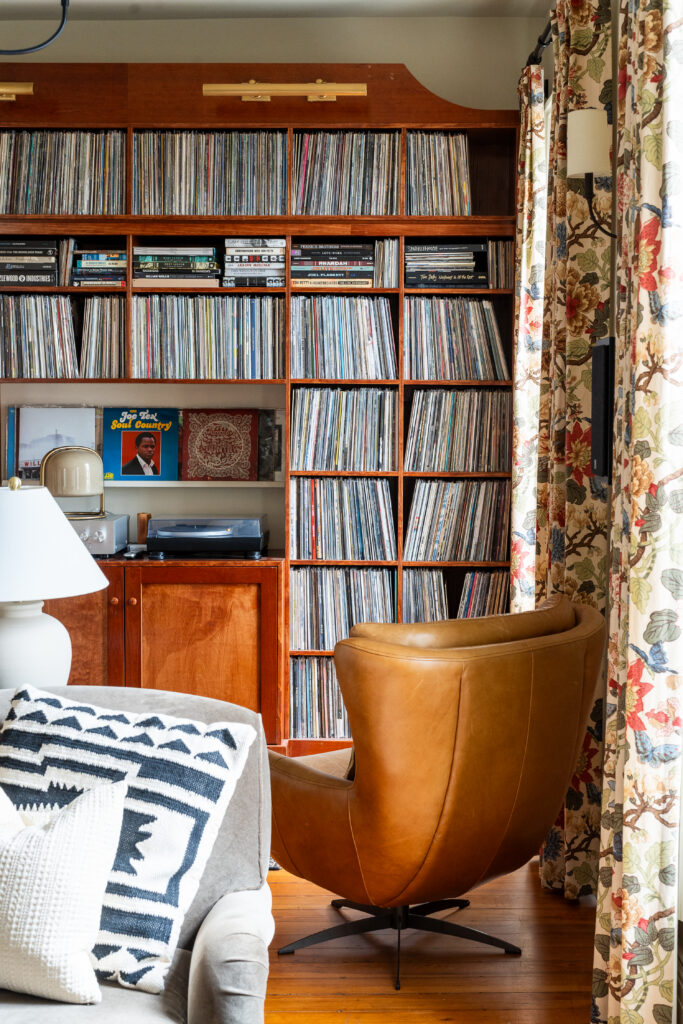
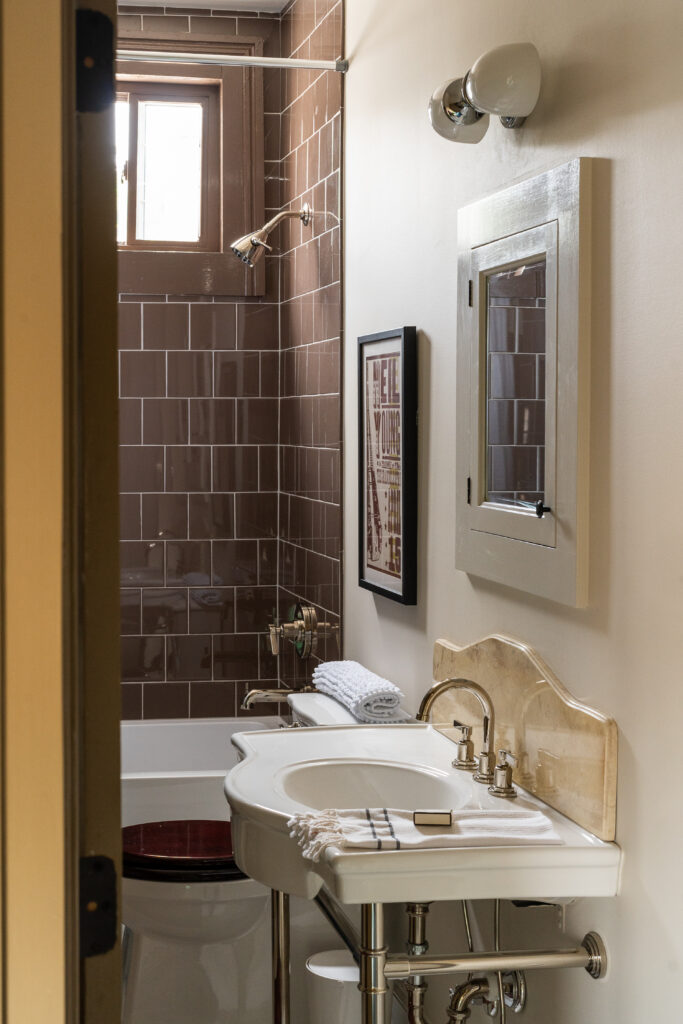
There were some non-negotiables on their list. Pelton has an extensive vinyl record collection, and its storage/display wall required additional structural support. The bathrooms had to be upgraded, and the narrow sleeping porch on the back needed to be enlarged to provide some outdoor space (the lot has no yard) and allow for a back entrance.
“The layout of the living space didn’t change dramatically,” notes Lane; the work was mostly taking pieces away to improve the flow and sightlines. In the front is the open living/kitchen space, with large windows facing south and west, and above this space is Pelton’s office/music room and the guest suite. The first floor hallway leads back to the master suite and a second- story porch lined with windows so it can be opened up in the summer. Below the porch is the back entrance-cum-mudroom; Bazemore says, “I love this space—it’s so useful for storage, which we don’t have much of, and for bringing in packages and groceries” (the front entrance at the street level has no parking, and opens right to the stairs). The rear extension added about 436 square feet.
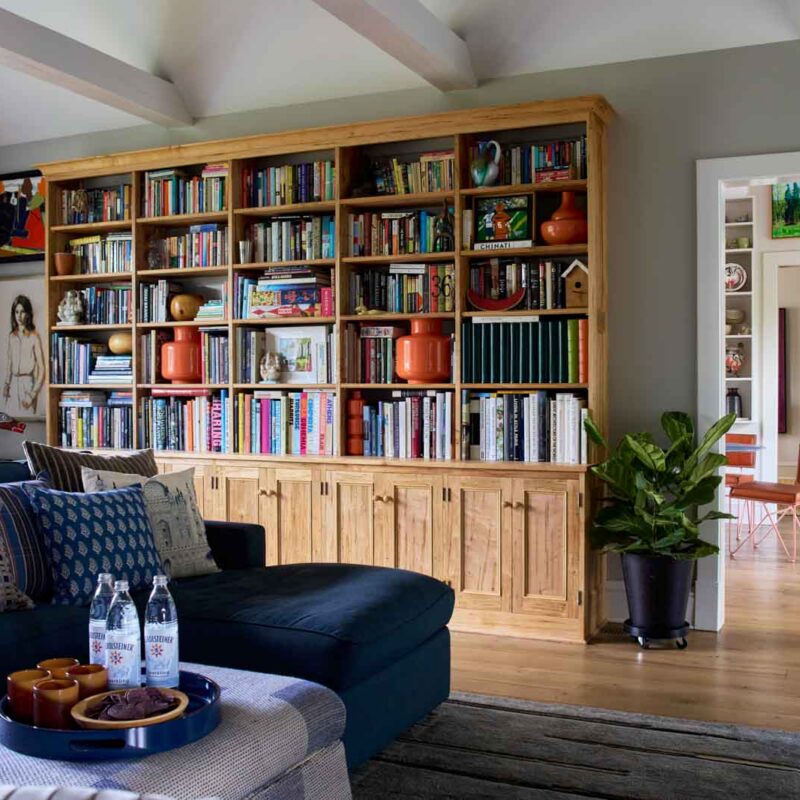
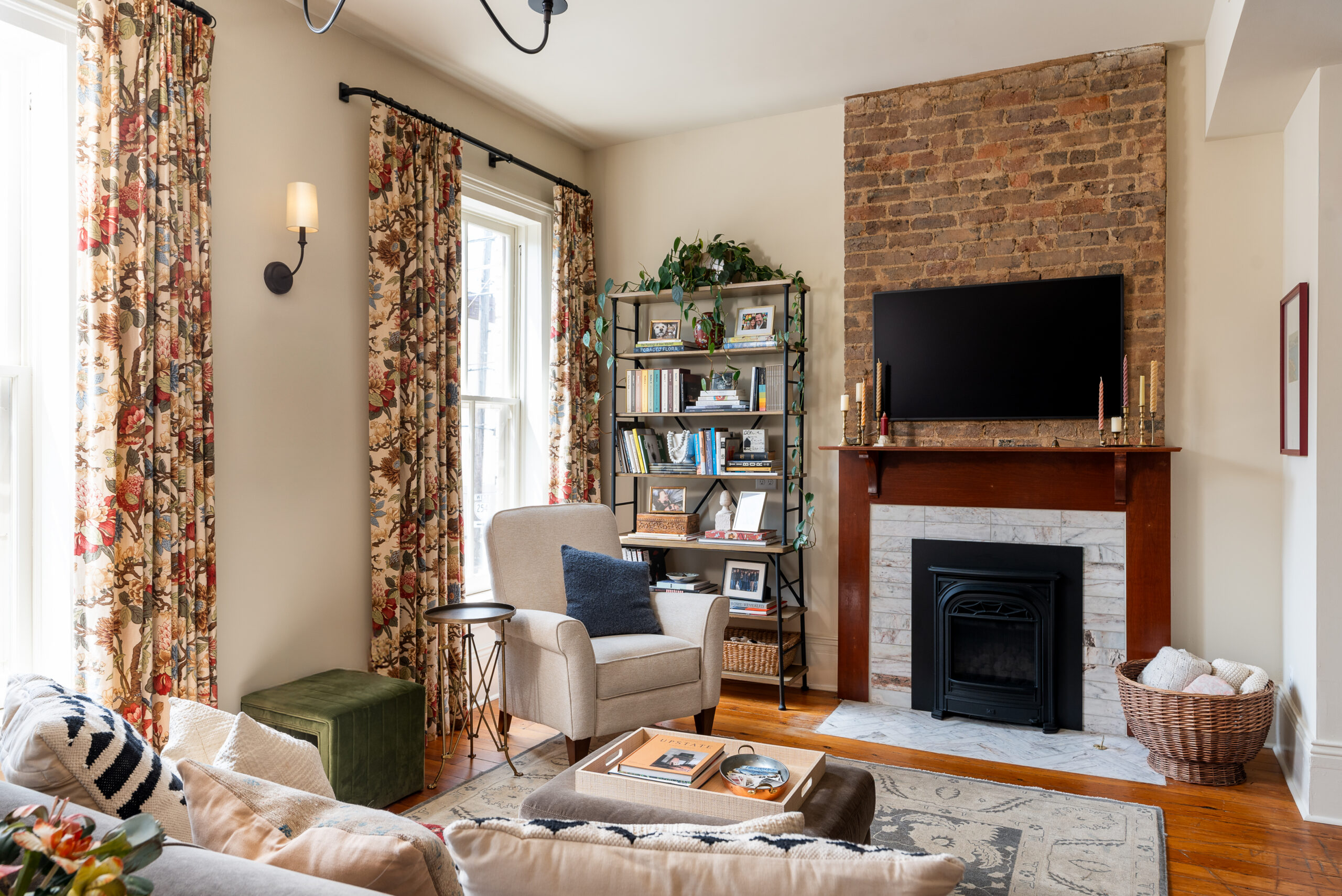
Lane worked closely with Bazemore on the interiors to create a feeling of light and calm that fits the house, and Bazemore echoes Lane’s words: “This house told us what it would be.” The walls are painted a soft white, which bounces the light around and shows off the range of colorful wall decorations, from tiles and plates to modern posters and photographs. A lot of the detailing is wood, which adds warmth and suits the historic character. The existing gas fireplace was upgraded to fit in with the cleaner look.
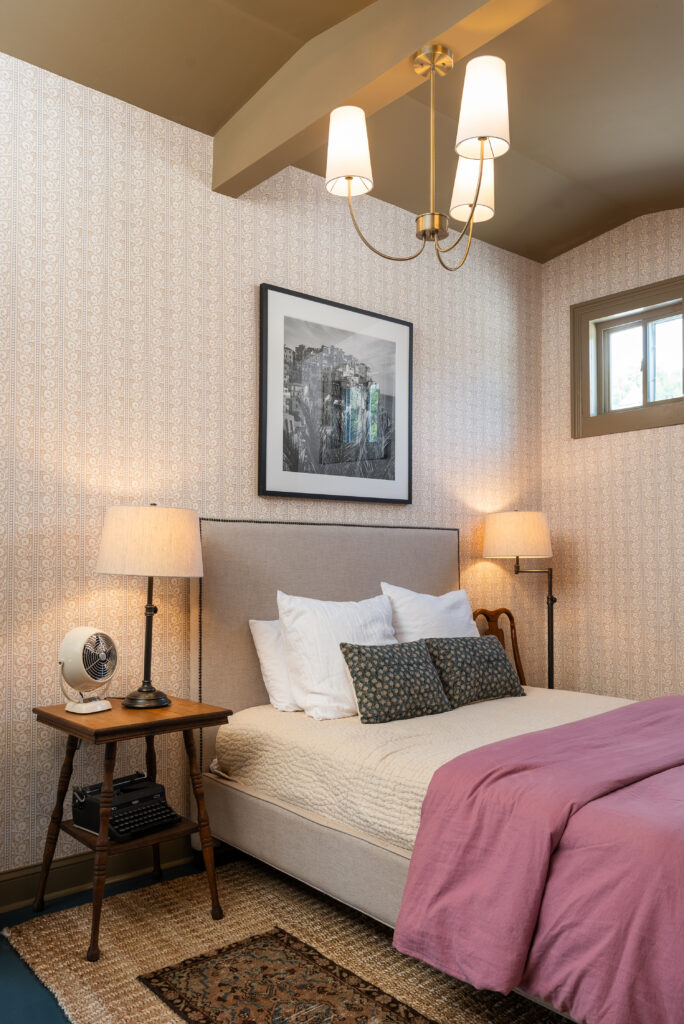
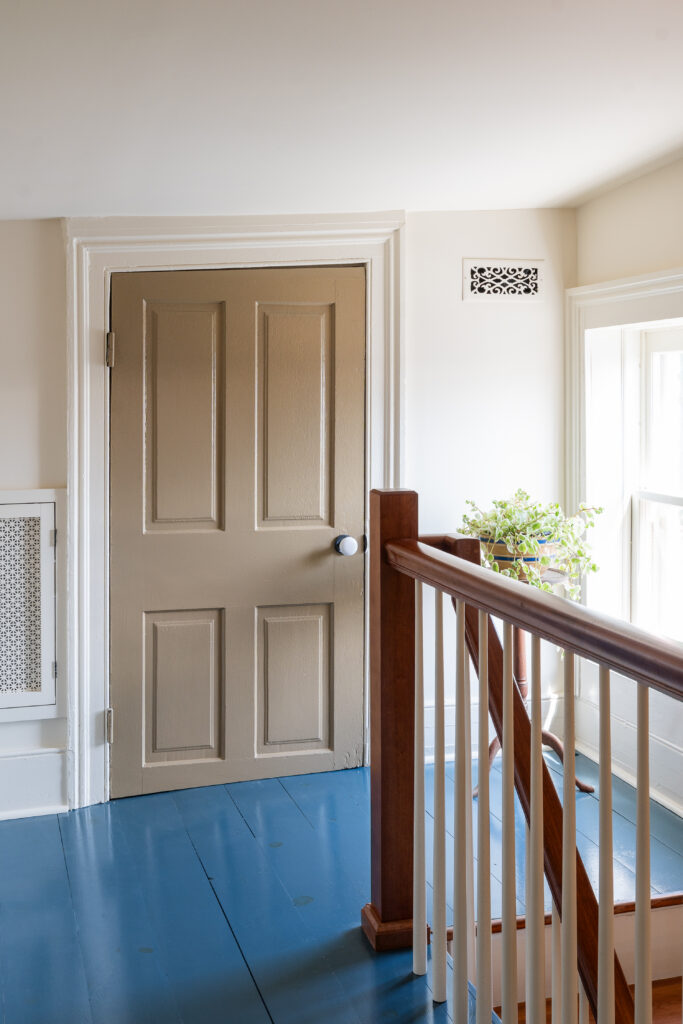
Upstairs, Pelton’s attic music room now has a beadboard ceiling. And since the flooring also had to be replaced, WRM Contracting searched out old, wider floorboards that Bazemore had painted a muted nautical blue. She also wanted a beaded look on the floor, so their carpenter stuck coins in between the boards to make a little gully (“it was unusual, but he got into it,” recalls Lane). Some quirks remain—the door to an attic closet, for example, still looks a little off-kilter, and the attic windows are knee-height.
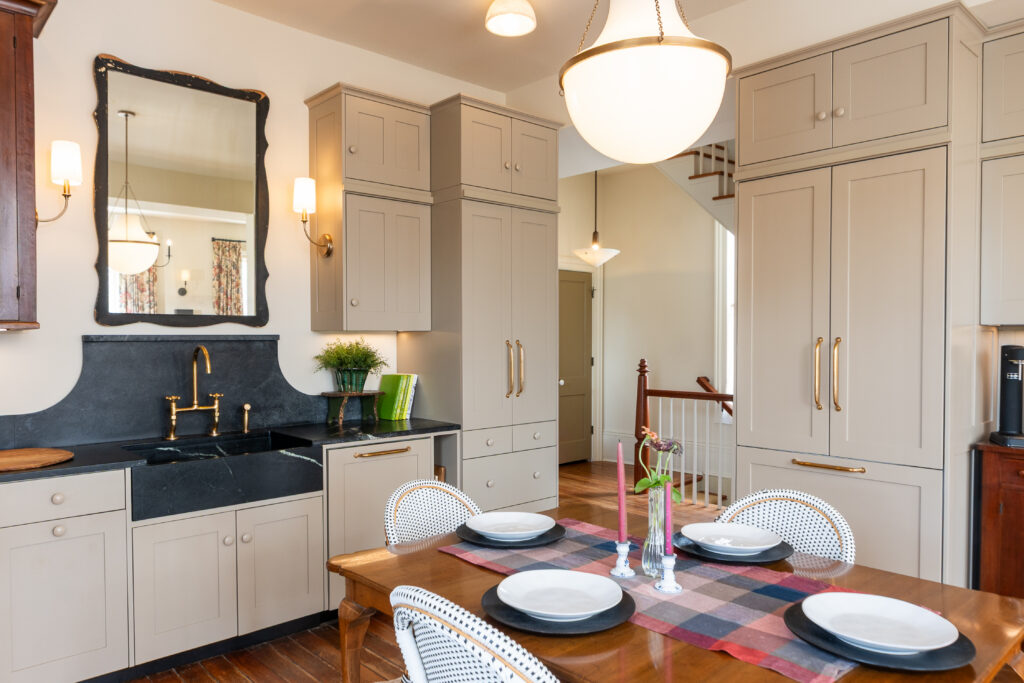
The words that keep recurring for the couple are “homey” and “cozy.” Their home in Nashville was a 1950s ranch house, but “our taste is pretty eclectic,” says Bazemore. The only living room furniture they purchased new was the sofa, bought to fit this smaller space. She loves to cruise antique and secondhand stores, and one find was a hutch cabinet, which got repurposed into a wall cupboard and a cabinet in the kitchen. The kitchen’s island was replaced with a less-bulky maple table (“I worried about losing the island’s working space,” she says, “but it only had seating for two—this way we can have guests”). Several pieces—Pelton’s desk and some peg racks with shelves for the walls in the guest suite—came from his father’s farm; others from Bazemore’s exploration of the Staunton area.
Bazemore’s vision for the kitchen was also a COVID offshoot: She and Pelton had become devoted viewers of deVOL’s “For the Love of Kitchens” show. While the kitchen layout wasn’t changed, its cabinetry was very much deVOL-inspired (the Shaker kitchen cabinets are painted in Benjamin Moore Turret; the sink, countertops, and backsplash are Alberene soapstone), and some of the cabinet hardware was actually ordered from deVOL. Bazemore and Lane worked closely on details. For example, Lane says one of her pet peeves is “sinks without a view,” but hanging a large vintage mirror over the sink (an idea Bazemore got from Pinterest) brings the living space and its view into the kitchen.
“I love interior design,” says Bazemore, whose career has been as a hairstylist, “and doing this, I got to live out my fantasy.” In fact, she plans to use the downstairs business space to open a new venture: a kitchen and pantry retail boutique, stocked with both useful kitchen items and the fruits of her secondhand store forays. She also hopes to offer some limited grocery items, in a nod to the building’s history as a local grocery store.
Bazemore has especially enjoyed the reactions of her new Staunton neighbors, who have been coming by to check on the progress of the renovation. “People are so interested—even the children of the former grocery store’s owner came by. It seems everyone knows this place as “the pink house” (the exterior was painted a beige-y pink in the 1980s).” At first Bazemore hated the color—“Miami flamingo,” she called it—but now it’s part of the house’s character. In fact, when her business opens in spring 2026, she plans to call the store Casa Rosa to connect its past to its future.
The details
Designer: Thea Lane Home (Staunton)
General contractor: WRM Contracting (Waynesboro)
Kitchen cabinets: Modern Boy Woodshop (Staunton)
Window restoration: Shenandoah Restorations (Quicksburg)
Structural design: Greenmun Engineering (Staunton)