In an effort to transform the remnants of Charlottesville’s Robert E. Lee statue into a new commemorative design, the Jefferson School African American Heritage Center has mounted “Swords into Plowshares Recast|Reclaim.” The three-pronged exhibition describes the events leading up to, and surrounding the removal of, the statue, what happened next, and what comes now.
The exhibition is “guided by this idea that Charlottesville can heal itself,” says JSAAHC Executive Director Andrea Douglas. “We can create a multiracial democratic process that grapples with the fact that something horrible happened in 2017, and then come up with a set of communal values that exist beyond that moment to produce something that articulates Charlottesville’s current social values.”
Displayed in JSAAHC’s auditorium are concept proposals (not final designs) by three semifinalists, all nationally recognized civic designers who were selected by a jury of four experts.
Hood Design Studio, which produced the 2011 Catherine “Kitty” Foster memorial on Jefferson Park Avenue, is proposing using the bronze to create “witness tree rings” around growing trees that have been privy to Charlottesville’s history.
MASS Design Group, which designed the Memorial to Peace and Justice in Montgomery, Alabama, also incorporates trees. This time, they’re baobab trees, potent symbols of resilience, longevity, and community throughout Africa.
For its concept design, PUSH Studios focuses on the land, and envisions incorporating parks to create a network of sites. “When you think about the kinds of projects they have created, they understand urbanism, they understand landscape, they understand cultural narrative, and they understand America’s racial history deeply,” says Douglas.
In the center’s Contemporary Gallery are photographs from 2020–2023 by Ezé Amos and Kristen Finn. Finn’s work records the activism that led to the passing of bills HB1537 and SB183, which allowed localities to remove the statues.
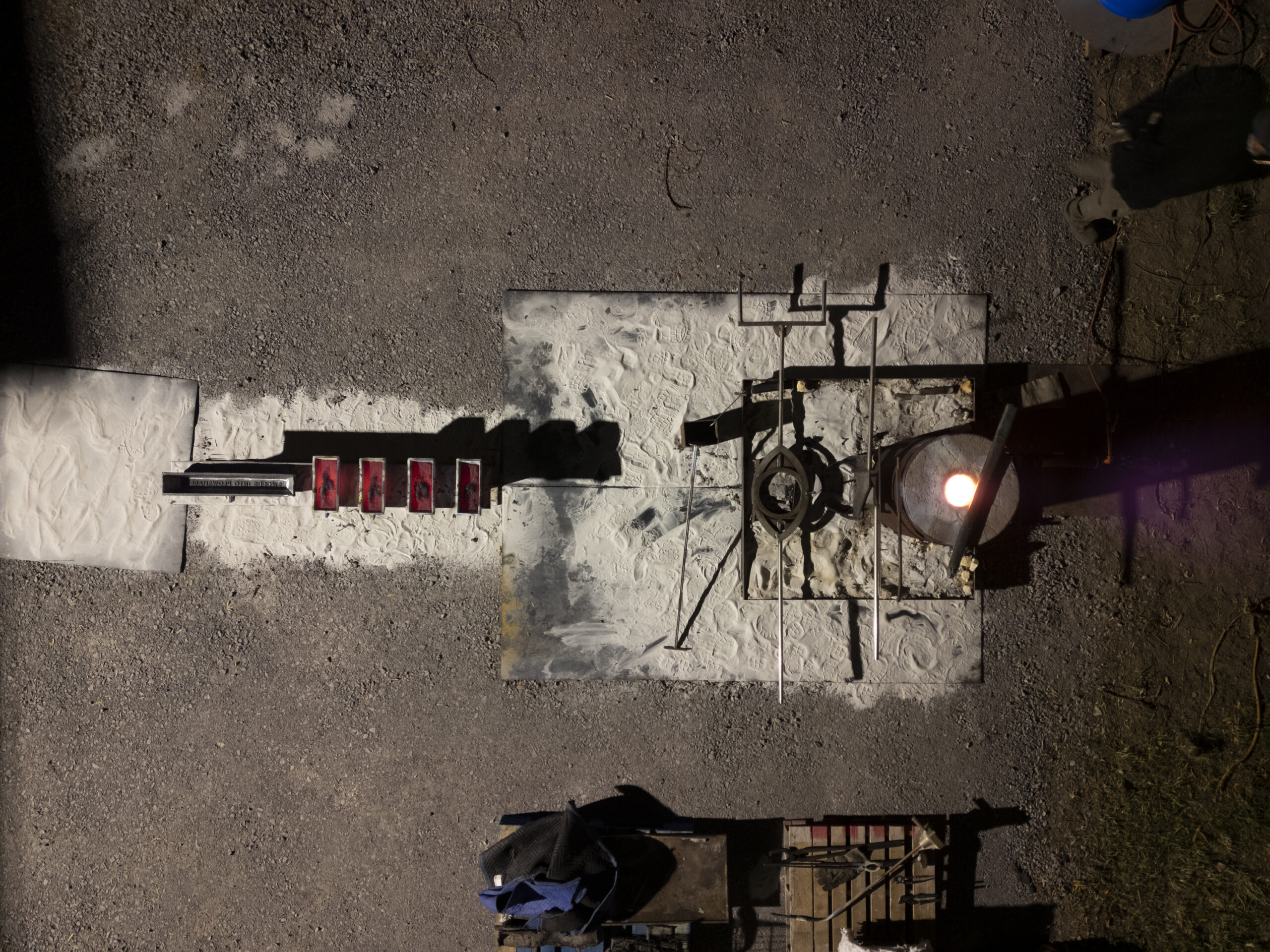
Amos’ photos tell the story of the statue’s journey, from the moment it was taken off its plinth to where it was dismantled and melted down. The process rendered about two tons of red brick bronze that will be used in the new design. Amos’ powerful final image shows the shaft of Lee’s sword resting on the crucible as molten bronze flows into ingot molds—a visual embodiment of Swords into Plowshare’s aims. Lastly, a virtual exhibition in the Foyer Learning Gallery delves into the social histories of the five Charlottesville parks under consideration for the “Recast|Reclaim” design.
“All the work and labor came as a consequence of considerable thought and planning and people who were willing to stand up for their beliefs, with a deep understanding that these objects were harmful propaganda,” Douglas says. “Allowing them to be moved from one space to a different site would have meant that our tragedies could then go on to exist in other places.”
You might assume that the new design would go where the Lee statue stood, but there are other Charlottesville landscapes that are equally charged. “When we began thinking where the object should go, we saw all this interconnected landscape,” says Douglas. “How do we understand this landscape? Can we do something that causes us to think about what creates an equitable public space?”
Working tirelessly since it was awarded the Lee statue in December 2021 to bring an equitable and inclusive resolution to fruition, the JSAAHC researched the social histories of five local parks—Market Street (formerly Lee, 1917), Court Square (formerly Jackson, 1919), Belmont (1921), McIntire (1926), and Washington (1926)—to inform the destination of the final work.
Some of these began as plantations—there were 19 within Charlottesville’s city limits. Jackson Park had been the site of McKee Row, a block of Black-owned homes and a grocery store which was razed to create the park. It’s also adjacent to a location where enslaved Black people were bought and sold. On top of all this, 14 of Charlottesville’s city parks had racial covenants on them, leaving just five—one of which was Washington Park—where Blacks were legally allowed.
It was Charlottesville native and successful stockbroker Paul Goodloe McIntire who created Charlottesville’s system of parks (159 acres of park were devoted to whites, with only 12 to Blacks). He also commissioned four statues (Lewis and Clark, William Clark, Robert E. Lee, and Thomas “Stonewall” Jackson).
Part of McIntire’s inspiration was the City Beautiful movement (1890s-1920s), which promoted urban beautification as a means to social reform. McIntire was also a proponent of the Lost Cause, and the statues were erected during the height of Jim Crow in prominent civic spaces.
“All of the objects that were in Charlottesville and elsewhere in the south were about claiming space and dictating who could or could not be there,” says Douglas. “We’re about reclaiming a narrative that no longer serves everyone and looking at a broader narrative that considers the idea of ‘public’ and what it means to be in public, how that impacts notions of belonging and citizenship. That’s really at the heart of the matter.”