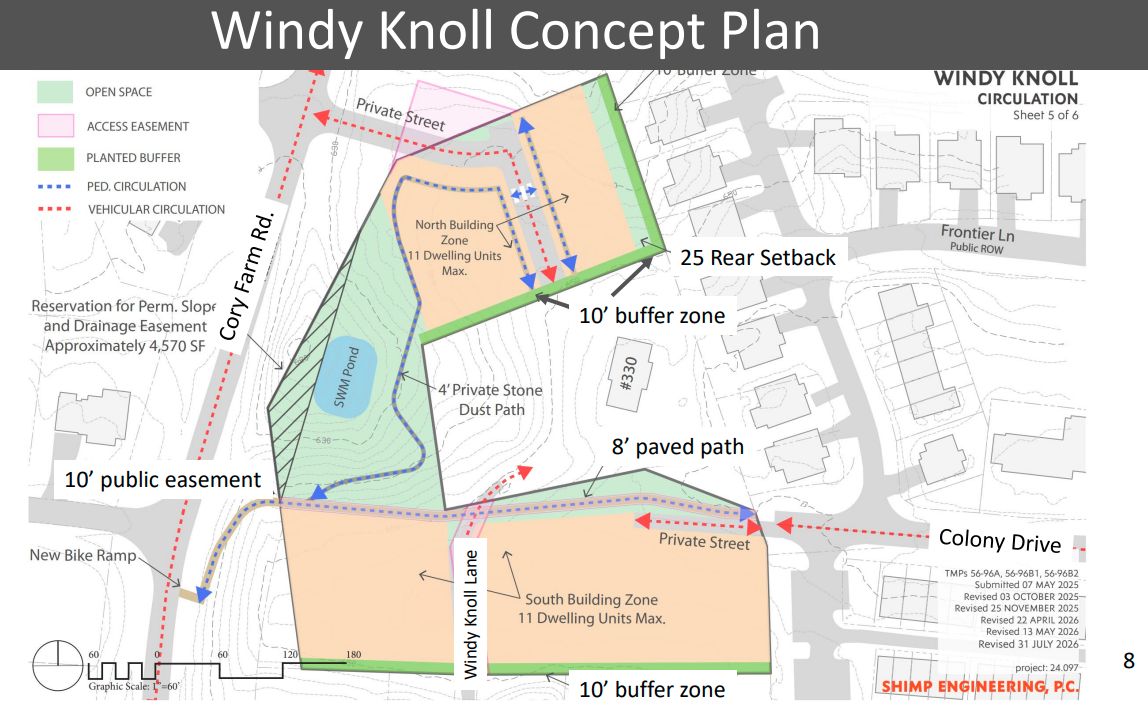
A concept plan for Windy Knoll, an 18-unit development on three acres in Crozet. Albemarle supervisors approved the rezoning 5-1 despite opposition from neighbors and a recommendation for denial from the Planning Commission. Photo: Shimp Engineering
The No. 1 objective of Albemarle County’s housing strategy is to build more units, and the county’s new Comprehensive Plan calls for projects to be as dense as possible.
On September 2, the Board of Supervisors voted 5 to 1 to approve a rezoning of three acres from R-1 to R-6 to allow for 18 units. The project known as Windy Knoll started off in mid-2025 at 22 units, but Seven Development lowered the density to satisfy the Planning Commission. That group recommended denial anyway in May.
Justin Shimp, civil engineer for the project, said the concept plan now has more clarity about a shared use path, more details on amenity space, and more detailed plans to convey stormwater from the property. He added that the project would provide much of what the county has asked for in Housing Albemarle and AC44 by providing 5.7 units per acre within range allowed under the Crozet Master Plan.
“This project will enhance the mix of units in the neighborhood, adding a higher density compared to Cory Farms and Sparrow Hill, which were developed as purely single-family dwellings,” Shimp said.
“If these post-denial changes represent a better design, why wasn’t the design returned to the Planning Commission?” asked Crozet Community Association President Bill O’Malley. More immediate neighbors of the project also expressed concern that the rezoning was allowed to proceed. One person said there will likely be a legal challenge against the shared use path. Another said 18 units on three acres is too much.
“The way to address this problem and all the problems with this design and its negative implications for the environment and the people who live around this property is to reduce the number of units to a level that is appropriate for this land and its unique constraints,” said Julianne Price.
A dozen other speakers asked the Board to deny. No one spoke in favor.
Supervisor Ann Mallek of the White Hall District was the lone vote against the project and said too many decisions would be left up to staff when the project moves to the site plan phase. She said Windy Knoll would not be compliant with the Crozet Master Plan.
“The wording which is used in master plans throughout, and AC44 as well, is that infill should be compatible in scale and scope with the surrounding neighborhoods in order to not create what we have here today, which is overwhelming houses on the east with massive buildings,” Mallek said.
One of the reasons the Planning Commission cited for denial was a lack of dialogue with neighbors. Supervisor Ned Gallaway asked for a clarification about what’s required of a developer.
“They did participate and hold a community meeting at the beginning of the process, which is required,” said Michael Barnes, Albemarle’s planning director. “As far as requirements, the ordinance doesn’t require a number or type of ordinances with adjacent properties beyond the community meeting.”
Gallaway said he understood that neighbors felt they had not been heard but was satisfied the requirement had been met.
“I find it concerning that our Planning Commission named something that’s not required as a reason for denial,” Gallaway said.
Supervisor Sally Duncan of the Jack Jouett District said she thought the county should maintain the stormwater infrastructure and not the homeowners’ association. One sticking point had been whether the households in the affordable units could make the communal HOA payments.
Duncan said the surrounding neighborhoods should have been built at higher density as called for in the Crozet Master Plan, adding that more than 18 units should be built at Windy Knoll.
“If people in the county want to stop development, they are welcome to purchase the property when it’s up for sale and not develop it,” Duncan said.