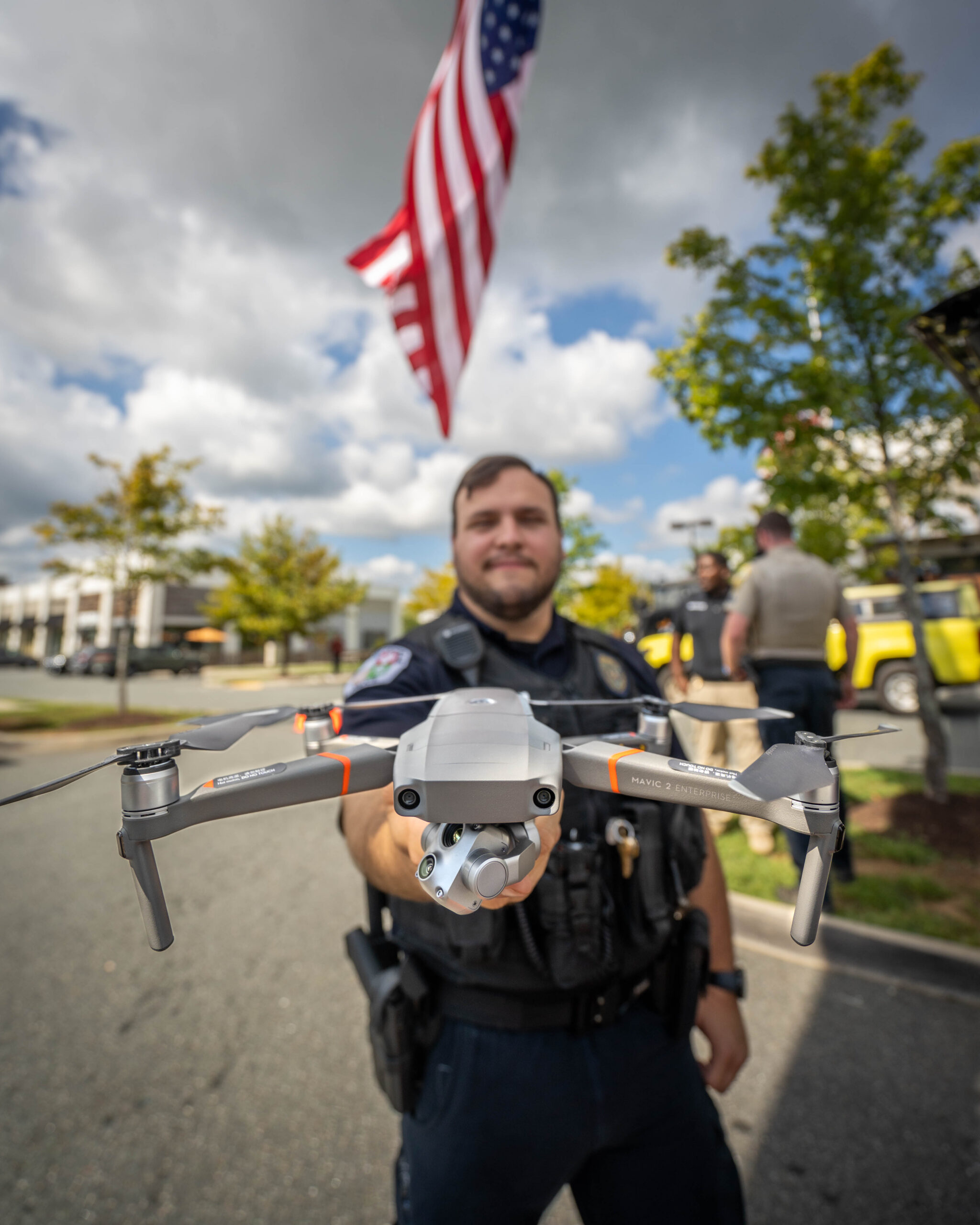
The Charlottesville Police Department wants to expand its drone program by adding a drone first-responder component, which would observe and report on more types of public safety incidents.
Sgt. Brian Curry has been tapped to oversee the proposed DFR addition to the drone team, which is part of the Emergency Services Unit.
“What we’re essentially looking to do is supplement police response and in some cases replace it altogether with a drone,” Curry says.
Charlottesville police already use drones for crowd protection at large events, such as the Tom Tom Festival, for search and rescue, and for dangerous person response work. Under DFR, the drone team would be able to respond to more routine incidents, freeing up sworn officers and better serving the city, the department contends.
Officers noted during a September 29 CPD community police academy meeting that drones might be the first eyes on a reported disabled vehicle—confirming before officer arrival whether the situation is a temporary stall or a major safety concern.
But using drones would also be “safer for first responders” by evaluating the volatility of an incident, says Sgt. Eric Thomas, CPD’s community involvement coordinator. “Do we need more units or less?”
Charlottesville’s drone first responder program would also be the first in the region.
The Virginia Beach Police Department and other departments in Northern Virginia already have DFR programs. The Fairfax County Police Department, for example, reports its drones launch in under two minutes and arrive before officers in about 70 percent of cases.
CPD’s current program, formalized in 2023, is led by Sgt. Collin Bise, who would continue to oversee existing operations.
Surveillance fears
Whatever the reason for a dispatched drone, police say they want residents to have their questions answered immediately.
“We’re all about transparency, so we’re going to be building a transparency website,” Curry said at the September 29 meeting. “And you can log on and see … the flight path we flew and what type of call we were flying to. So there’s no guesswork as to why the police are flying a drone.”
Public fears over stepped-up immigration enforcement and law enforcement overreach have turned citizens against many forms of surveillance technology. In December 2025, Charlottesville ended its use of Flock’s automated license plate reader cameras after public pushback.
The largely unseen drone program has not had that kind of pushback. James Walker, director of the Police Civilian Oversight Board, says there have been no major public complaints or formal misconduct findings specifically targeting the drone program during his tenure.
That could change with more eyes in the sky.
Curry says the program has already proved valuable to the community. For instance, a drone recently provided “overwatch” when officers arrested the individual accused of the September 12 shooting on the Downtown Mall.
He adds that drones and their operators don’t have the legal powers that a police officer on scene does. They do, however, have to operate under the strict regulations of the Federal Aviation Administration.
Partnering with fire department
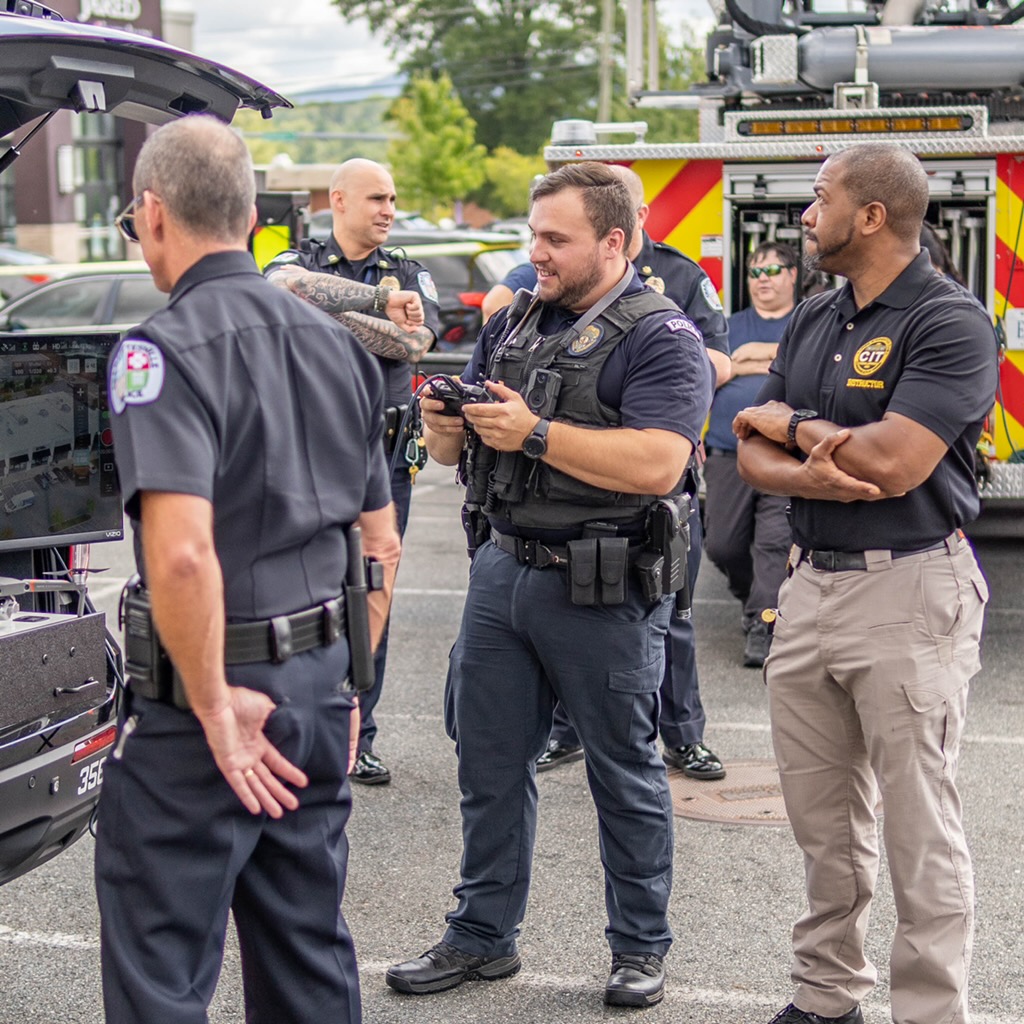
CPD plans to partner with the Charlottesville Fire Department, which has had a drone program since 2021.
So far, the police department has three Skydio X10s for first responder use, currently housed at the Ridge Street fire station drone hive, Thomas says.
Because of the expected increase in deployment, and the relatively few police drone pilots, the department plans to cross-train the fire department for the new 911 assignments.
“They have 15 pilots,” Curry says. “We don’t have that many yet. … So if I can’t spare an officer to fly a drone, I will call the fire department and say, ‘Hey, I need a drone up.’”
The drone team says the department would purchase a new multidirectional antenna to help drones avoid conflicts with other aircraft, such as UVA’s Pegasus medevac helicopter. And the new drones have parachutes if one falls from the sky.
Seeking public buy-in
The department plans for discussion before those drones go out on first responder calls.
“We as a police department have to be very careful when it comes to technology, that we are not moving faster with this stuff than our communities actually understand it,” Police Chief Michael Kochis said during an August 17 City Council technology report.
To that end, CPD will hold its first “Let’s Talk” public safety technology meeting at 6pm on November 9 in the Velocity Urgent Care Community Room at 920 E. High St. Those who can’t attend in person can livestream the meeting at albemarle-cvillenaacp.org.
Additional neighborhood meetings are scheduled for November and January.
“Residents are encouraged to attend, bring their questions, and come ready for a thoughtful exchange of ideas,” a CPD press release states.