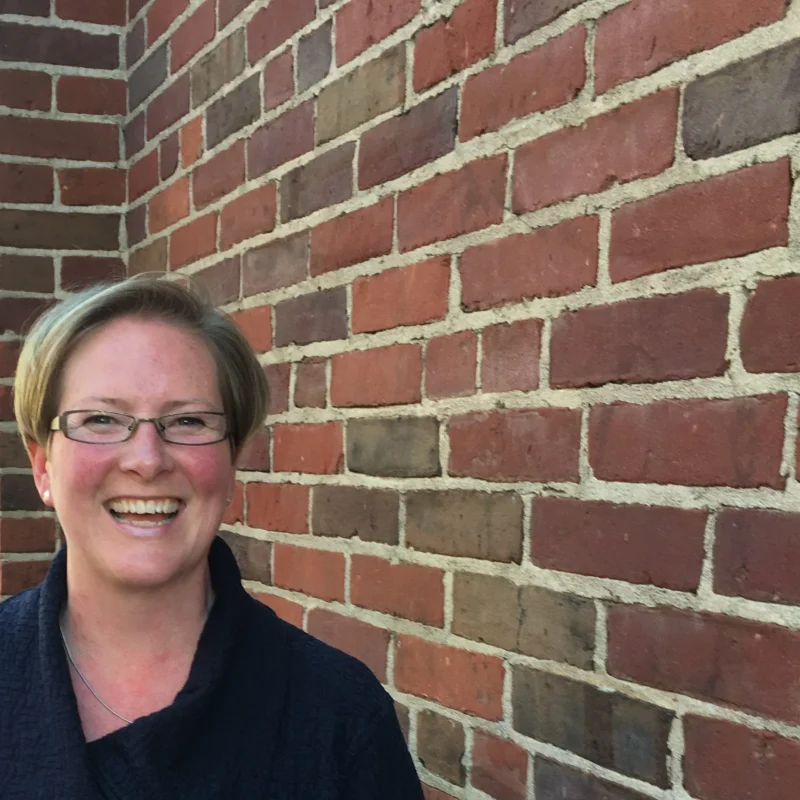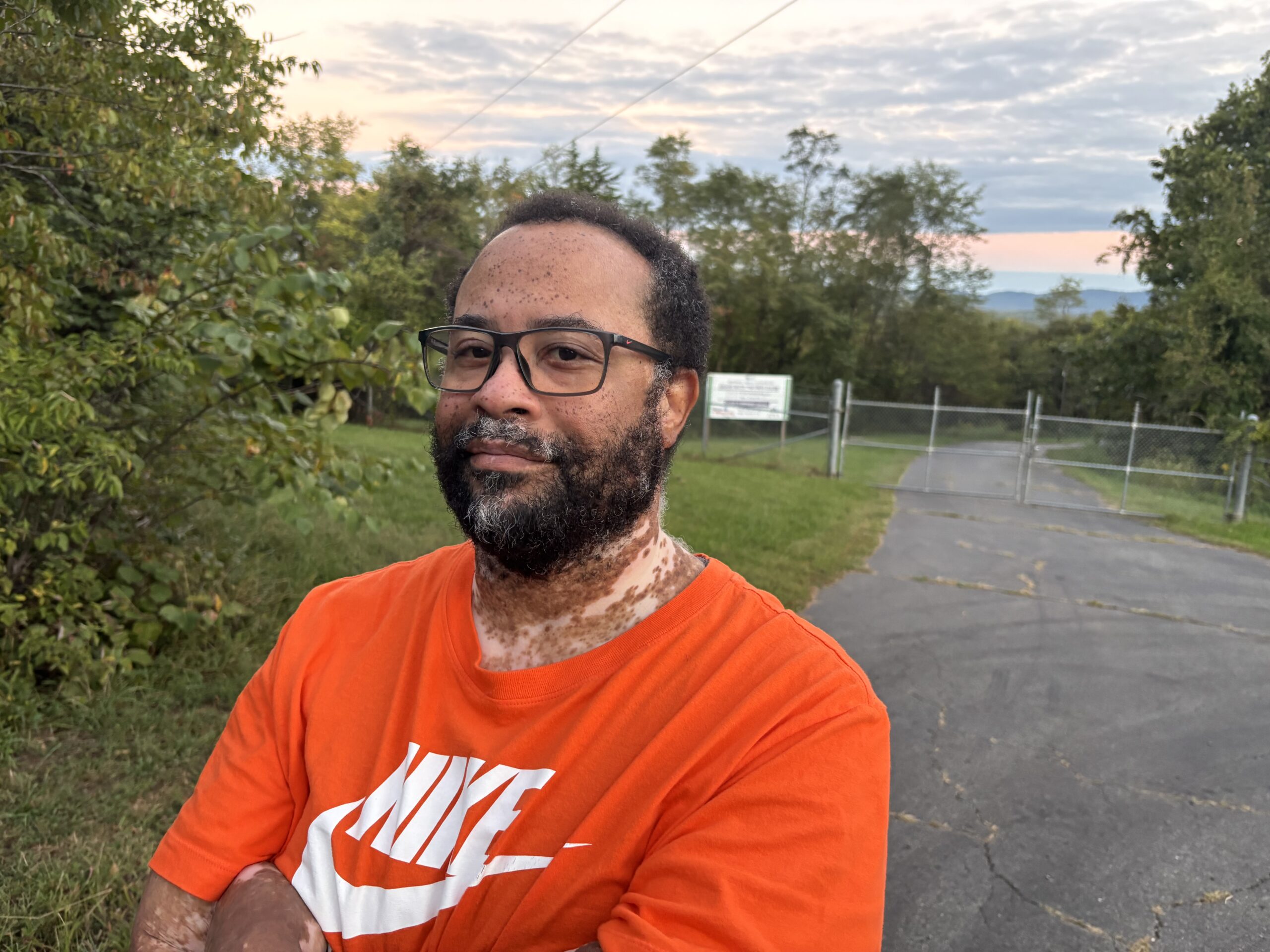
Antoine Sims, who grew up next door to Greenwood Chemical Company, remembers a waste lagoon near the plant. “It was a green that I could not describe,” he says.
If you’re cruising Interstate 64 on Afton Mountain near the lower scenic overlook, or traveling U.S. Route 250 west of Charlottesville, and you spot three carved wooden bears frolicking in a roadside field, you’re pretty close to what’s left of the Greenwood Chemical Company.
Now the Superfund site is expected to be auctioned off, more than 40 years after a chemical explosion killed four men, shuttered the plant, and traumatized the tiny community of Newtown, down the road from Greenwood.
Antoine Sims grew up on Summer Rest Lane, right next door. He remembers scouting for Christmas trees with his mom near the plant and seeing a waste lagoon there.
“It was a green that I could not describe,” says Sims, who lives in Ivy. “And it looked oily, and was thick. I remember seeing fish just kind of floating, and there being dead animals floating in there, too. Then the barrels. Maybe three or four that were just up out of it.
“That water color, I would never forget, just because, in my head, I’m thinking, ‘Oh, wow. I don’t know water was that color.’”
The plant’s history long predates Sims, now 47 and a father of two. Cockerville Chemicals opened its doors in Newtown in 1947. It was owned by DuPont chemist F.O. “Neil” Cockerville, who blew off a thumb and part of his leg doing experiments in the cottage he shared with his wife, Eloise, about a mile down the road.
Cockerville, sick with acute bronchitis he blamed on his work, sold the company for $10 to Clarence Hustrulid in the late 1960s, who renamed it Greenwood Chemical Company. Through the 1980s, the plant had seven to 12 employees who made sprays for fruit trees, chemicals for developing photos and metal plates, and pharmaceutical agents.
Accidents there were common.
According to Daily Progress accounts, a foreman died of burns sustained in a 1966 fire that erupted when toluene vapors ignited. Two more workers perished in explosions in the 1970s. A pair of plant workers were injured in 1981, and in 1983, a boiling container of ethyl acetate started a fire that leveled a building and caused $20,000 in damage.
Emergency responders dreaded getting calls from the plant. As a kid, Sims recalls explosions, “like a low rumble, like large ammunition,” he says, subsequent smoke, and, sometimes, stuff falling from the sky.
“When the wind would catch, it was silvery metallic-looking stuff that would fall from the sky into yards, on cars, on people’s houses,” says Sims. “There was talk of that, and kind of, just, like, ‘You kind of want to get that off of your car or whatever because you just don’t know what that is. It probably isn’t something we want on our cars or in our yards so don’t touch.’”
By 1984, Al Cereghino Jr. became Greenwood Chemical’s last president, a job he’d keep for seven months.
It was already humid on April 18, 1985, about 3:30pm, when an electrical spark ignited several gallons of hot liquid toluene, setting four men inside the plant alight. Three died within hours of the blast: John Harper and Maurrie Clark of Afton, and Keith Wood of Waynesboro. The fourth, Charles Ward, of Staunton, lingered 11 more days after being transferred to Norfolk General Hospital with burns across most of his body. He died of sepsis April 29.
That day, Sims and the other kids heard the bus driver’s radio crackle with news of the accident. They could see black smoke above the treeline as they trundled past the old Greenwood School. Sims spotted his late mom, Janet, tending victims whose skin had “melted” before he was whisked away by a neighbor. The school bus had to retrace its path because Newtown Road was blocked by emergency vehicles.
The dead men left behind four wives and nine children. One day after Ward died, Cereghino announced in little more than a whisper at a community meeting that the plant would close.
But the site had to be cleaned up, a job that fell to the EPA. By 1987, hundreds of chemical drums and gas cylinders had been carted away. Chemical lagoons were drained, filled with fresh dirt, and capped, and loads of rubble got trucked out. By 1990, EPA officials excavated 15,000 tons of toxic soil, and shipped it off in train cars to Utah to be disposed of.
It would be 14 more years before the last of the abandoned chemicals at the site—everything from benzene, arsenic, and cyanide to TCE, toluene, and naphthalene—were finally removed.
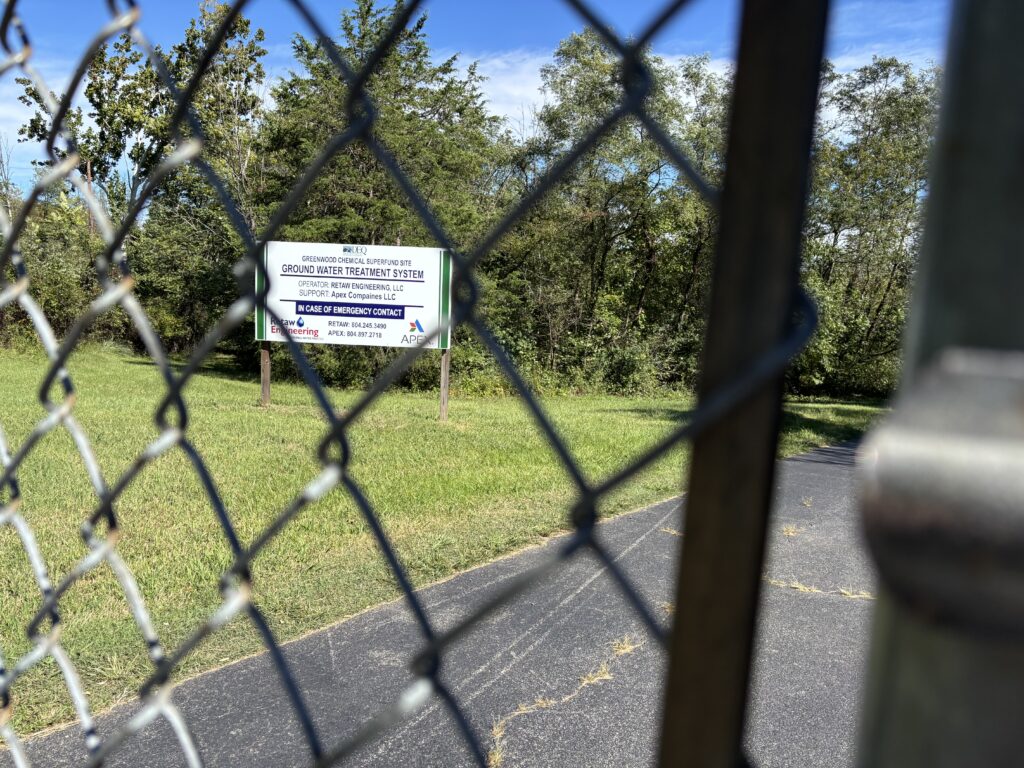
The EPA’s groundwater treatment system began filtering contaminated water from the property’s 11 wells in 2001. It’s still running today. Treated water gets discharged into nearby West Creek, which feeds the Mechums River, a Rivanna tributary and municipal water source. In 2012, the EPA passed the reins to the Virginia Department of Environmental Quality, which pays a Richmond firm more than $520,000 a year to oversee day-to-day operations.
Only after the EPA started its cleanup in the late 1980s, did Sims and his family start drinking bottled water.
“At that point, there was movement around the area again,” says Sims. “There was the tearing down of the old building, building a new building [the water treatment plant], then there was the communication with the church about the water, and there began to be talk about it, kind of like, ‘Hey, you might not want to drink the water, if you don’t have filters on your water tank.’”
In the early ’90s, Sims’ mom received notices tucked under the door from the EPA with water test results.
“At one point, I asked her, ‘Mom, what is this?’” recalls Sims. “And she was like, ‘This is the paper that lets us know what they’ve done over there, and water testing to let us know what the levels are.’ I still didn’t understand, until she said, ‘Contamination.’ Then it was like, ‘Oh, contamination levels.’ As in, if there is some.”
Sims left Summer Rest Lane in the early 2000s. His mom did, too, but not before sarcoidosis, an autoimmune disorder, claimed one of her lungs and put her on oxygen. She was in her 40s.
Sims was in his early 30s, and had just welcomed his second child, when he was diagnosed with sarcoidosis in his kidney. He’d need a transplant, which he got a few years later. Sims also has vitiligo, an autoimmune condition that affects his skin’s pigment. That’s gotten better with the new kidney, he says, but he’ll take prednisone for the rest of his life.
“I honestly do think that there’s something along with whatever chemicals they were using there that has had an effect on a lot of us,” says Sims, whose brother has developed sarcoidosis in his eye. “And those of us that were down from that chemical plant. Definitely.”
Nearby residents’ well water is still monitored by DEQ each year. So far, it’s clear. The site’s been waiting behind a chain-link fence for the last nearly half century for whatever’s next.
The parcel, assessed by Albemarle County for $100, hasn’t paid its tax bill in eons, according to Jennifer Matheny, the county’s chief of revenue administration. Whoever buys it at auction would have to cover that bill and some legal fees at a minimum. That means the 33 acres could sell for between $8,000 and $9,000.
“We mainly want to get an ownership of someone who pays the taxes and exists, instead of it being kind of in this limbo, which is really what it’s in right now,” says Matheny. “Someone may be able to do something with that property, even if it’s trails or something, but we want to bring it back into the community and get it back on the tax rolls.”
Whoever purchases the land at auction won’t be able to build a house or live there, as there’s no potable water. Any new structures that get built must work around the, still running, wastewater treatment facility. New buildings would also need special vapor barriers and below-slab piping to minimize soil disruptions.
Sims thinks the county or state should keep the tortured land.
“You’re not going to clean the chemicals out of that land,” says Sims. “There’s no way you got all of it. There’s people’s properties that probably got this stuff in the ground, and you [the EPA and DEQ] never went there to check for it. I think the government should be responsible for that property, until . . . forever.”
But there is evidence the pollution plume is shrinking. The chain-link at its perimeter is heavy with greenery, insects, and birds. Watch the fence long enough, and a deer will tiptoe by. Soon, it may be up to someone new to imagine a future for the parcel with stunning Blue Ridge and Rockfish Valley views and a terrible past.