At an April 16 work session, the Charlottesville City School Board opted to preserve its prior changes to the district’s school safety model, moving forward with the return of school resource officers at the start of the 2026-27 academic year.
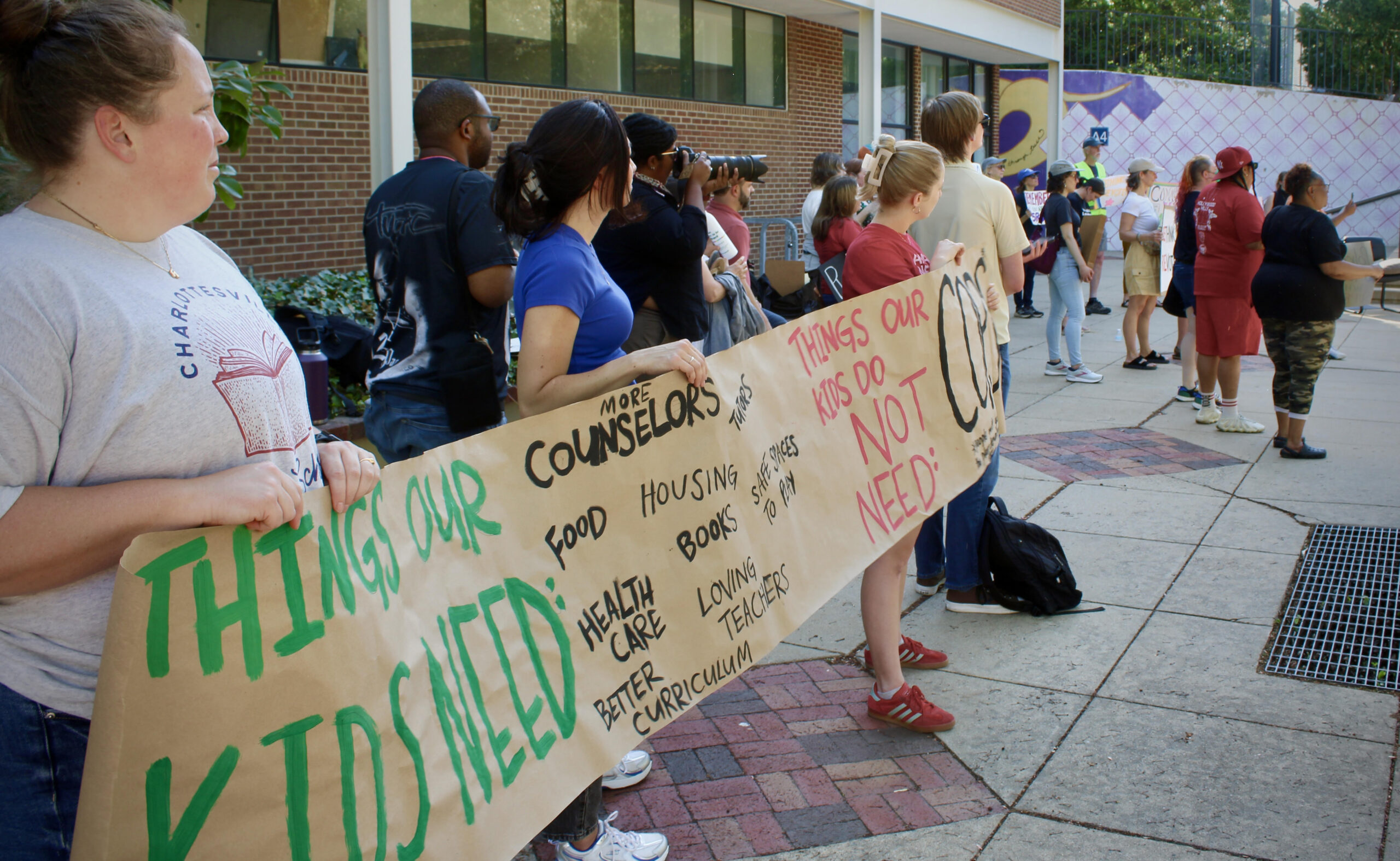
Dozens gathered outside Charlottesville High School ahead of the marathon five-hour-plus meeting, calling on the Board to “rethink” and “revote” the return of SROs. Demonstrators ranged from concerned parents and teachers to organizations including Indivisible Charlottesville, Community Justice Coalition, and The People’s Coalition.
Speakers at the “Rethink, Revote” rally voiced reservations about SROs, ranging from the disproportionately negative impact of policing on students of color and students with disabilities to the lack of community engagement prior to the vote.
“I do not want my child—I’m the parent of a child with a disability—to be exposed to the things that are statistically associated with policing in schools. I’m here tonight because I’m going to fight for my kid,” said Alix Heintzman, parent of two CCS students, as she walked into the work session.
“I sincerely want to see, from this point on, increased public engagement,” said organizer and CCS parent Terry Tyree ahead of the work session. “I need you to go for an entire month publicizing the next public meeting to pack that room and get more input.”
Charlottesville has debated SROs for more than five years. In 2020, the Board voted to remove officers in favor of creating a new school safety plan focused on restorative practices, including care and safety assistants. Renewed interest in SROs emerged in early 2024, culminating in the March 2025 4-2 vote approving the reintroduction of SROs.
“Ideally, we do not want police in our schools,” said student representative Harper Ullrich. “Even without SROs, there are police in our schools,” highlighting the more than 200 calls to CPD during the 2024-25 school year.
Ullrich presented a survey showing that the largest contingent of students was indifferent to SROs’ return, but noted the perspective of students on both sides of the issue.
“There are students who are not in support of SROs. The biggest concerns are about guns,” Ullrich added, but later noted that “the majority of students are not against SROs coming back into our building.”
After hearing from community members and district staff, the Board voted 3-3 to rescind its March 2025 decision, with Chair Lisa Larson-Torres abstaining. Five votes were needed to rescind the SRO model, since it was not an action item on the work session’s agenda.
While Larson-Torres voted against the SRO model last March, she cited work on the memorandum of understanding with the Charlottesville Police Department as the reason for her abstention.
“We talked about guardrails, … the data that we would want to collect, as far as the interactions, and the demographics,” said Larson-Torres. “If something’s going wrong, if there’s a poor interaction … the administrator can have that SRO pulled out of the building immediately.”
With a clear divide in Board members’ stances, it’s unclear where exactly the SRO issue stands moving forward. Debates over potential alternatives to the SRO program detailed in the MOU, including a proposal from Zyahna Bryant to station officers outside buildings while still providing the required office space inside, continued after the vote.
Members of the “Rethink, Revote” coalition are figuring out how to proceed as well, but expressed disappointment with both the Board and district more broadly.
“One instance … of an overreaction from an officer, one instance of criminalizing something that could have been dealt with in the schools is too many,” says Michael Salvatierra, CCS teacher and vice president of the Charlottesville Education Association. “You can say, ‘Oh, well then we can hold them accountable.’ But … that’s already wrecked a student’s life, a family’s life, when it didn’t need to, when it could have been dealt with in a different way that … did not involve law enforcement.”