With eyes closed and mouth open, I hear deer everywhere.
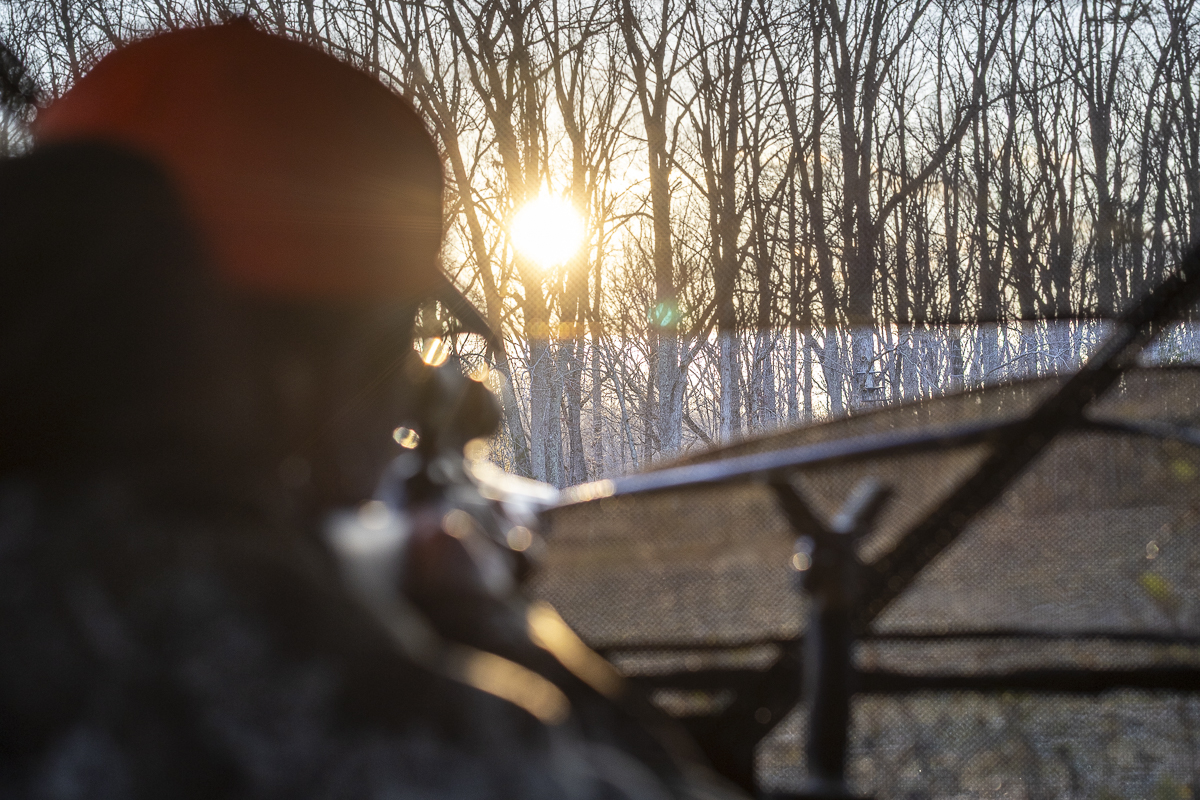
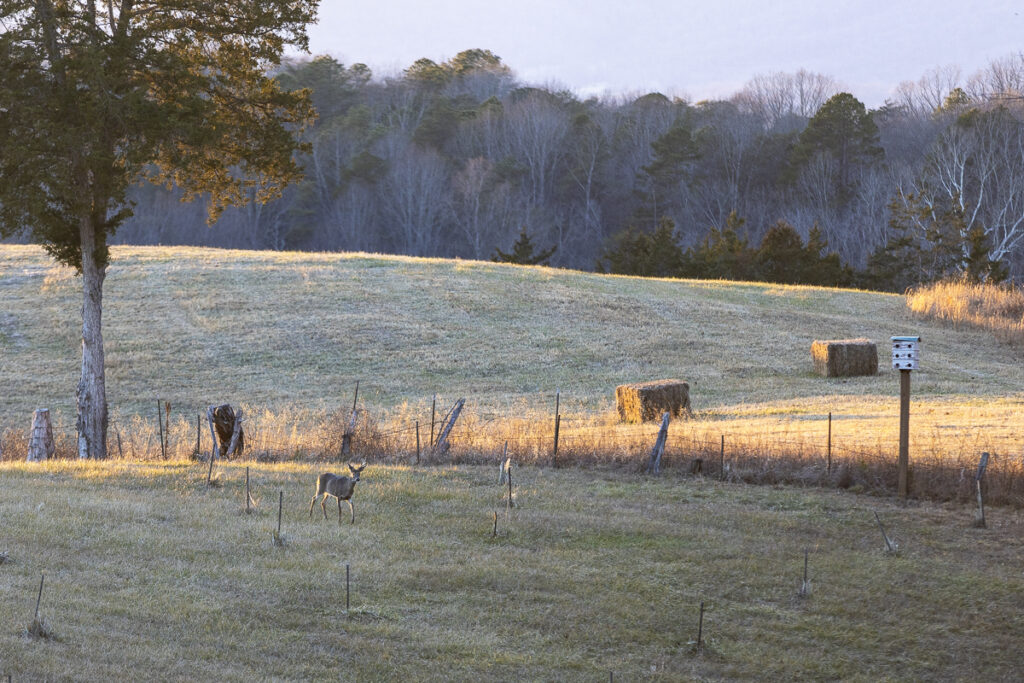
It’s just before sundown on the day after Christmas, and we’re clustered in a hunter’s blind beside an old privy in a field flanked by woods, waiting for a deer to tiptoe into view. The forest floor, littered with dry autumn leaves, is crackling.
The blind belongs to Emily Beasley, 47, of Scottsville, a hunter since age 8, who, with her husband, Allen, owns this field and 100 acres of land lined by the Hardware River, which feeds the James, to its north and west.
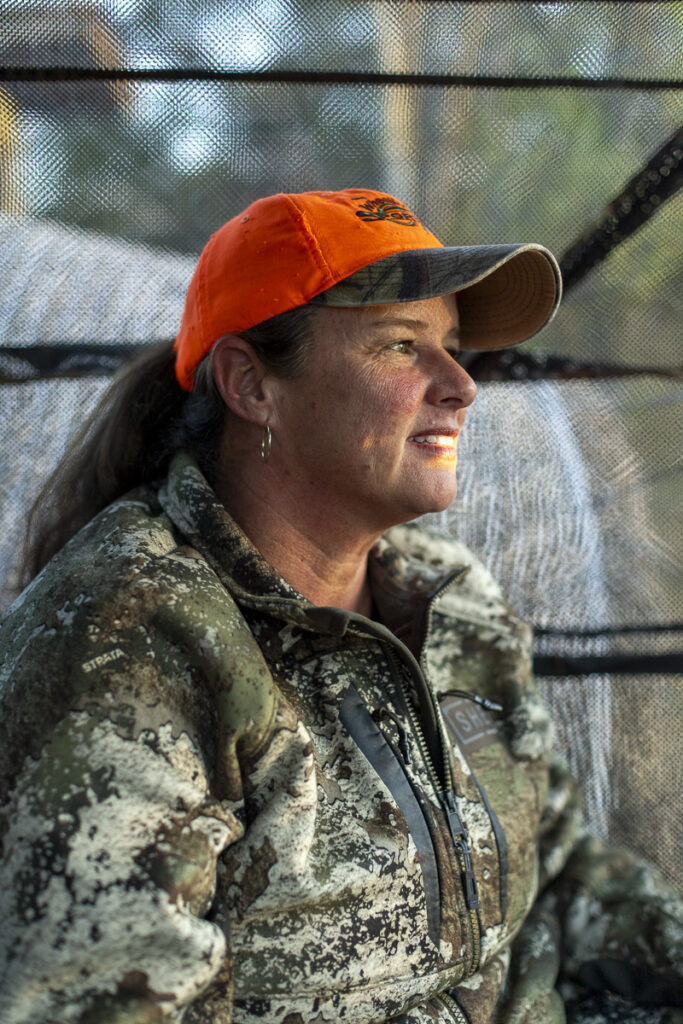
Beasley—a toss of long, dark hair and blue jean-colored eyes—is impossible not to immediately like. Trained as an educator, she learned to hunt as a child, when she’d tag along with the late Bill Haislip, a Fluvanna County neighbor and family friend. It was Haislip who taught Beasley, whose parents divorced when she was 3, about gun safety and animal tracking and encouraged her bloom from an animal lover to a student of nature, capable of the patience, skill, and strength needed to spot, track, kill, and process everything from turkeys to bear, pheasant, chucker, and deer. Lots of deer.
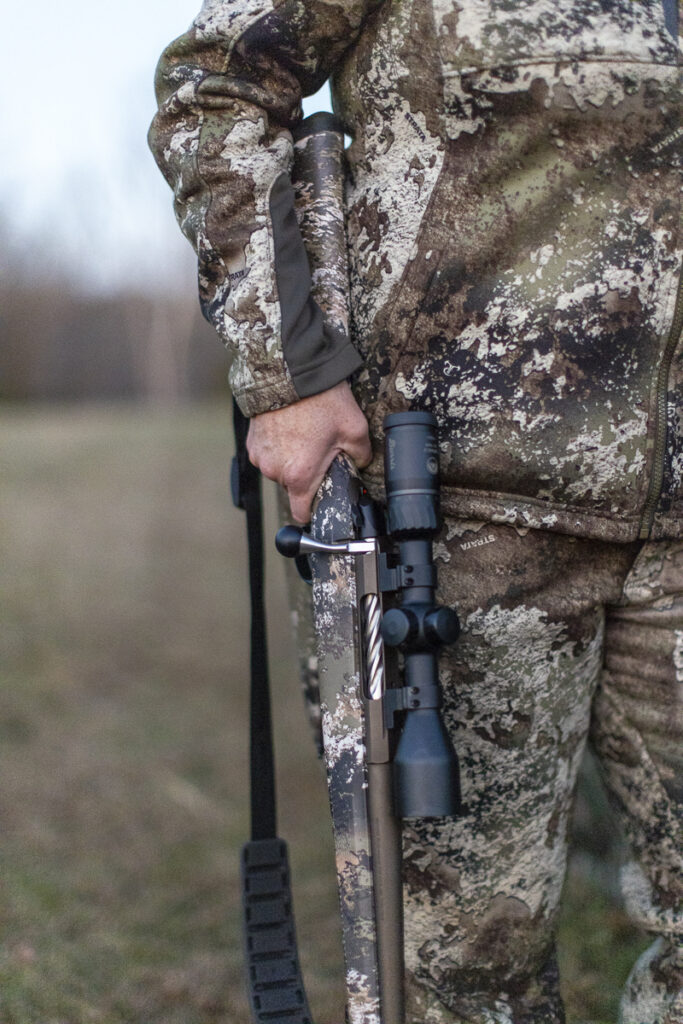
Lesson No. 1 for our first hunt? “Don’t slam the door,” Beasley says. We—that’s me and Jeff Morgan, a Charlottesville photographer—worm out of Beasley’s red pickup truck, which she cloaks between her barns, and gently nudge the doors closed. We wear mostly black; Beasley’s dressed head to toe in camouflage, and has given us each a hunter’s blaze orange hat. We slip across the gravel driveway and into the grass, and, one by one, fold our bodies into the blind to straddle three camping chairs, which, when we’re seated, give us a horizon-slatted, eye-level view into the field and wood’s edge. Beasley, her .308 caliber shotgun at her right, zips us in.
Lesson No. 2? Wait.
It’s twilight quiet, but, as the sun dips, our senses adjust. There’s life all around. We whisper to decode “deer, not deer” sounds as squirrels spasm over the leaves and throw warning scolds at who-knows-what. Deer, Beasley tells us, are quieter, slower, more paced in their steps. We squint as background noise becomes foreground.
You don’t realize how loud the world is until you don’t hear it anymore, Beasley says.
“Nuthatch,” Morgan, a birdwatcher, breathes to us minutes later in the blind.
A moment goes by. “Pileated woodpecker,” Beasley mouths.
The wind carries the sound of a train chugging along the James as the sun slants deeper. Gunshots and barking echo up from the damp hollow, and a miles-away four-wheeler churns uphill. The second hand on my watch pounds out seconds. I lick my lips because my mouth’s gone dry. I hadn’t realized it was hanging open.
A growing portion of a declining practice
In many ways, hunting in Virginia is on the decline. Between 2022 and 2025, there were about 10,000 fewer licensed hunters in the state overall, according to the Virginia Department of Wildlife Resources, reflecting national trends. In 2026 so far, the number of hunters in the Commonwealth has continued its slide, down by 36,000 compared to three years ago, to 297,000.
But there is a small sliver of heat. Women are making up a growing proportion of American hunters, both veteran and novice. Twenty-five years ago, there were 1.8 million women hunting in the U.S., but, by 2013, the number had risen by 85 percent, to 3.3 million. According to the U.S. Fish and Wildlife Service, women today comprise 17 percent of all active hunters but make up one-third of new hunters. They also account for a growing proportion of hunting-related spending on gear (as brands like SHE, Orvis, Under Armour, and KUIU can attest), travel, and taxidermy. Founded in 2017, Artemis, a group of sportswomen-conservationists affiliated with the National Wildlife Federation, already has 11,000 community members, according to Outside magazine, and most are between the ages of 25 and 45.
Since 2022, nearly 1,000 more Virginia women have taken up hunting, bringing the state’s total number of female hunters to just above 25,000. Last February, DWR launched new women’s programs offering hunting, fishing, and outdoor fluency, including mastery certifications, social events, and single-day skills events with a mentor.
Professional hunting associations and affiliate groups are making room for ladies, too. Central Virginia realtor and outdoorsman Jeff Phillips’ Star City Whitetails Facebook page, with nearly 130,000 followers, began its women-only “big buck” contest in 2020. Each summer, Phillips presents awards at Antlerstock, an annual event that draws thousands. The Virginia Peninsula Sportsmen’s Association also created a women’s division for its annual “big buck” contest in 2023. Beasley has taken home prizes from both.
“As a sportsman, I enjoy seeing that inclusiveness,” Phillips said. “The tremendous presence of women hunters on our page helps our tradition.”
Harvesting for the hungry
“Desperately.”
That’s how much hunter Gary Arrington wants to eat red meat again. Arrington, a longtime Bedford County game warden and now director of Hunters for the Hungry hasn’t eaten red meat since 2020—the year he contracted alpha gal syndrome from a tick bite—and says he’s eaten enough chicken, turkey, and fish to “grow fins and feathers.”
The allergy—which causes him terrible stomach pain if he eats red meat, anything from beef to pork to venison—hasn’t slowed his hunting, however. In 2025, Arrington killed eight deer, and gave all but two away to the organization he directs, a group that raises money to pay local processors to glean meat from donated kill to distribute at food pantries, churches, and food banks across the state. Last year, Hunters for the Hungry distributed more than 222,000 pounds of lean protein to hungry Virginians. Since its founding in 1991, the group has provided more than 32.6 million quarter-pound servings of lean meat to people in need.
Food banks, stretched thin by last year’s government shutdown and the freeze in Supplemental Nutrition Assistance Program benefits, are particularly grateful for this year’s donations, Arrington says, given that the typical cost of meat in a grocery store remains high.
“The average price of meat right now is about $8.25 a pound,” says Arrington, “and we’re doing venison for $1.63 a pound. Even when you figure in our expenses—our salaries, operating costs, budget—we’re doing venison for $3.05 a pound. We’re extremely proud of that.”
It’s been a busy feeding season. Since last September, Arrington has received requests for meat from 30 additional feeding programs, adding to his organization’s distribution roster of 65 major food banks across the state. These 90 entities, he explains, distribute hunters’ donations to nearly a thousand smaller entities, like the South Covington United Methodist Church, where Arrington recently dropped off part of a 2,500-pound donation of venison to be distributed to a line of cars queued up at its food pantry that “wrapped up all the way up the driveway and around the back of the church and then down again into the road.”
“We even came back an hour later,” Arrington says, “and the line was still just as long. It’s heartbreaking, but they’re all doing their best to take care of people.”
The thrill of the huntress
Finding credibility as a female hunter has occasionally been an uphill battle for Beasley.
“But you don’t look like a hunter!” people admonish.
“I never met a woman hunter who knew what she was talking about,” others say.
Last Halloween, as she was filling up her pickup with gas in full camouflage, someone asked if she was “going as a hunter.”
“No,” she replied. “I am a hunter.”
“I feel like I’ve had to earn credibility among hunters,” Beasley says. “I’m okay with that. That’s what’s driven me.”
Experiences in the field have also tested her mettle, including one in which she mortally wounded a 10-point buck only to have it ultimately claimed by a nearby hunter, a man. She keeps to the high road.
“‘No, you keep it,’” Beasley recalls telling him, before muttering, “‘I’m going to get way more than you anyway.’ And I do.”
As she runs into more women in the field, she compliments and chats with them. A veteran volunteer with Virginia Wheelin’ Sportsmen, she recently helped a woman without legs harvest her first deer. Beasley’s also taken her 17-year-old daughter, Ryllen, a Fluvanna County High School senior, hunting four or five times a year since she was 6. They share “hunting’s highs and lows,” Beasley says, as well as a reverence and respect for the animals they kill.
“She knows you don’t sit on them, you don’t take pictures with blood on them; you make it nice,” Beasley says. “You make it pretty.”
Now entering her fourth decade as a hunter, the thrill of a well-executed harvest hasn’t diminished, Beasley says. Her hunting spoils lie throughout the family’s home, including, recently, a snowy-white European mount skull of a 5-point buck Ryllen recently killed that sports two tiny vestigial fangs. The Beasley’s freezer is full of meat they’ve harvested and processed themselves—mostly venison, but also goose turkey, duck, and a little bit of bear. They eat meat most days.
While she admits there’s a dissonance in being both an animal lover and a hunter, Beasley maintains she’s tapping into something “everyone has.”
“It’s weird to explain,” she says. “Most hunters do love animals. It starts with the desire to be in nature. All the ones I know would help a wounded animal. I feel like I want to help something that’s hurt, but maybe outsmart something that’s not.”
And the kill itself? Well, Beasley says, it’s magical.
“If you could bottle that feeling up, you’d be a millionaire,” she says. “Ask someone who’s harvested something they’re really proud of, or put a lot of time into, and it’s just amazing. That’s the feeling. That’s what hooks people. It’s release. And afterwards, ‘Oh, God, that just happened.’ It’s very emotional, if you care. And I do.”
Female hunters are no monolith. But as hunting demographics shift, and women play a growing role in its evolution, organizations like Hunters for the Hungry may ultimately benefit, in terms of donated kill, volunteerism, and philanthropic support.
“Women are the future of hunting—women and youth,” says Beasley. “Eight to 10 years ago, that wasn’t the case. It’s almost become the norm. It’s good!”
Hunter and gatherer
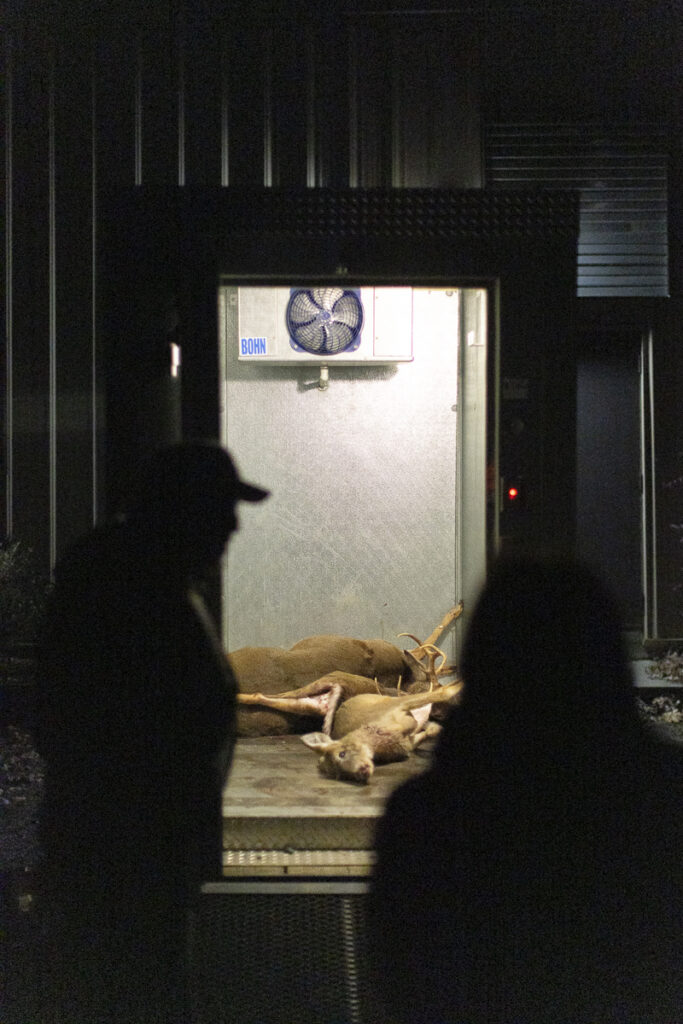
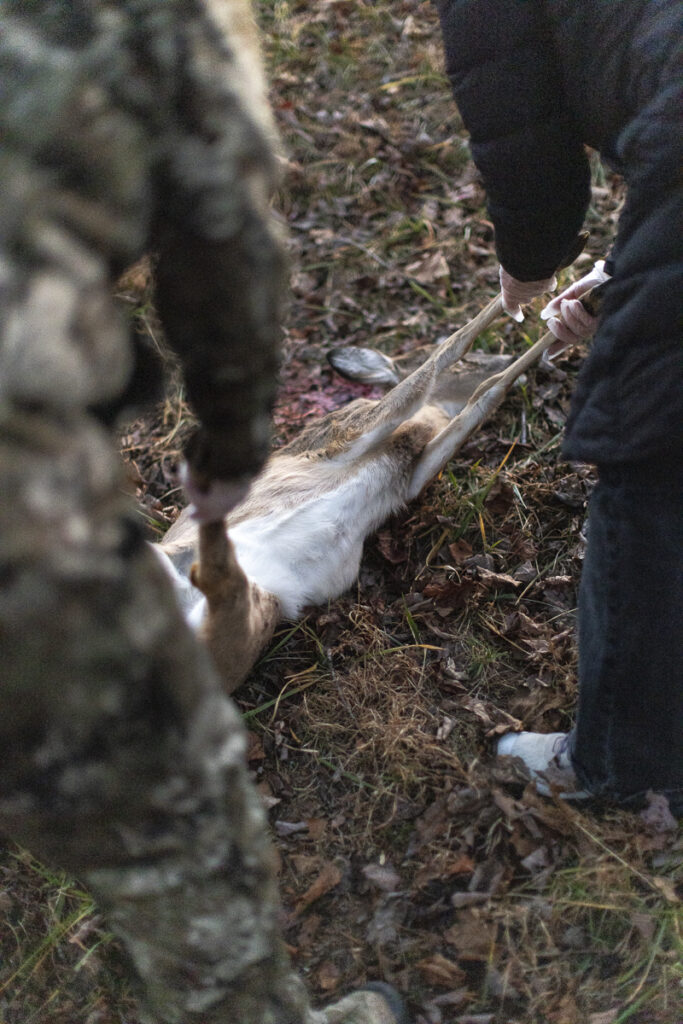
The button buck—a lean, maybe 60-pound creature with antler nubbins atop its head and a tiny gunshot wound in its left flank—was harvested in the morning. But it’s dark by the time Beasley slits the stretch of delicate skin on the buck’s rear legs and hoists it onto a hook inside a walk-in cooler at Appleberry Mountain in Schuyler. The young buck will hang there with several others until the morning when processor Adam Johnson returns to do his work, skinning the creatures and cutting the lean muscle into the requested cuts and grinds: some for local hunters who pay for the service, and some, like Beasley’s, with processing’s cost covered by Hunters for the Hungry, which will become coveted offerings at food banks across the state.
Several nights later, Beasley drops off another donation, this time a 75-pound doe that she figures will yield maybe 25 pounds of meat. After quickly field-dressing it in the Keswick backyard where she killed it (“Never call it ‘catch,’” Beasley says), she drops the doe at the Hunters for the Hungry cooler at the Louisa County Fire Station where it awaits transformation.
“Field to table,” Beasley says plainly. “No waste.”
There are coolers like these all over rural Virginia—including 24-hour drop-off locations at the Louisa County Resource Council, Eppard’s Processing in Barboursville, and Hidden Pines Meat Processing in Madison. Hunters can donate their kill by giving away the entire animal, marking their legally harvested, field-dressed deer for Hunters for the Hungry, which pays the $70-80 processing fee; by sharing a portion of their processed harvest with Hunters for the Hungry; or by donating both the animal and the processing costs.
While most meat donations are frozen until they’re ready to be consumed, a new effort led by Hunters for the Hungry is producing shelf-stable canned venison chili, which, for food-insecure community members who lack a refrigerator or freezer, is a game-changer.
Evolving needs, Arrington says, require new kinds of thinking. And female hunters will be key no matter what.
Between 2021 and 2024, the number of female hunters who donated at least one deer to Hunters for the Hungry increased by 44 percent, Arrington says, adding, “We look forward to these numbers continuing to increase.”
While Virginia’s official hunting season ended January 3, in some urban municipalities, antler-less deer may be hunted by bow between January 4 and March 29, 2026. In its semi-final tally for 2025, Hunters for the Hungry expects to distribute more than 200,000 pounds of venison in a moment when grocery costs remain high, economic confidence is shaky, and new changes to federal feeding programs are set to take effect. Arrington expects his organization, and the dwindling number of processors across the state, to continue to lean in.
Beasley will, too. She first donated to Hunters for the Hungry when hired to thin Farmington Country Club’s deer herd as a bow hunter. Her latest donations marked the end of the 2025 hunting season.
And next season, she’ll be back: for the chase, the craft, even the uncertainty.
“That’s why it’s called hunting,” Beasley says. “Because you never know what’s coming.”
Cornbread Venison Chili Pie
A recipe from Emily Beasley
Ingredients
Chili
2 T. olive oil
1 medium onion, chopped
2 cloves garlic, minced
2 lbs. ground venison
2 14-oz. cans diced tomatoes
2 T. tomato paste
2 cups chicken broth
Cornbread
2 8.5 oz. Boxes Jiffy Corn Muffin Mix
2 eggs
2/3 cup milk
1 cup frozen corn, divided
1 cup shredded cheddar cheese
1 16-oz. can kidney beans, drained and rinsed
Directions
Preheat oven to 375 degrees. In a 9- or 10-inch cast iron skillet or sauté pan, heat olive oil over medium high heat until it shimmers. Add onion and garlic, sauté for one minute. Add ground venison and brown it, breaking up the meat. Drain excess fat and stir in chili seasoning, diced tomatoes, and paste. Mix over medium heat for one minute, then pour in broth. Reduce to low and simmer five minutes, stirring. As meat simmers, combine Jiffy mixes, eggs, and milk. Do not over mix. Stir in 1/2 cup corn and cheese into the cornbread batter and set aside. Stir in remaining 1/2 cup corn and kidney beans into meat mixture. If not using a cast iron skillet, transfer meat mixture into a baking or casserole dish, pouring cornbread batter over it. Bake for 35 to 40 minutes, or until the top is golden brown. Remove and allow to sit 10 minutes before optionally garnishing with salsa, green onions, sour cream, and shredded cheese.