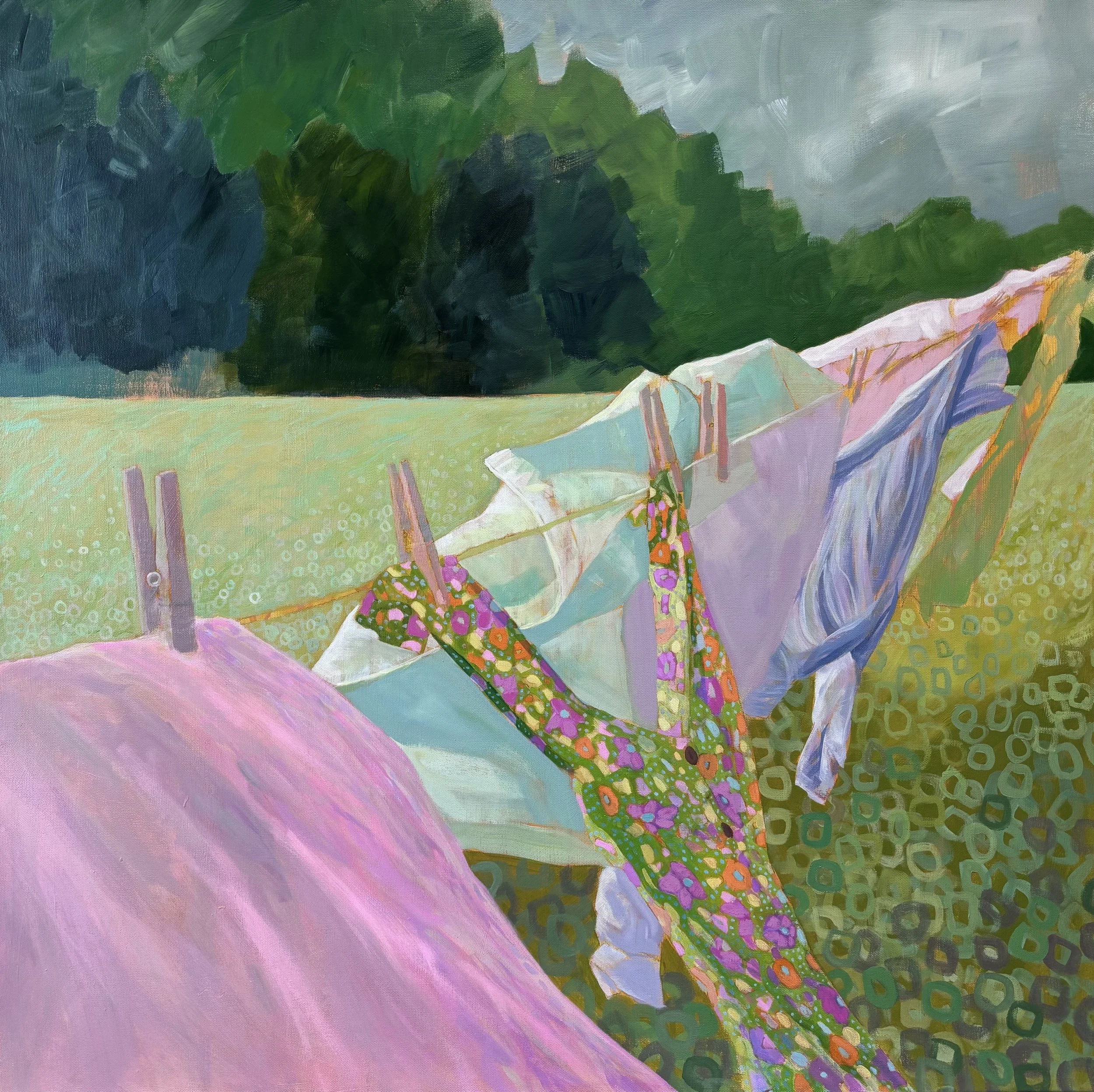
In culmination of an ambitious project that began at the end of January 2025 when a group of artists convened at Phaeton Gallery to work on creating a clothesline, “Weathering: The Endurance of the Ordinary” features the work of 10 women examining “the quiet resilience embedded in daily life and the subtle ways time and environment shape both objects and human experience.”
The quotidian object was intended to provide inspiration and, when placed outside for an extended period of time, a case study in weathering. “We didn’t want the clothesline to become tied to complicated ideas about who does the laundry,” says gallery director Lisa Hogan. “What emerged instead were people’s personal memories of it. Almost everyone had an evocative story about fresh laundry, many from childhood—how it smelled in the sun, how the fabric felt, the ritual of hanging it out. The clothesline became less about chores and more about memory, comfort, and ordinary life.”
Over the course of several Sundays in February 2025, the artists met to discuss the project while sewing meaningful garments—there’s even a wedding dress worn by participating artist Mary Lamb—onto the 175-foot line, which snaked around the gallery space while they worked.
Once the clothesline was done, they took it to Hogan’s property in southern Albemarle and hung it across a pond and into woods, where it stayed for three months, buffeted by the elements, an embodiment of weathering. The artists visited the clothesline to observe or paint, viewing it as “both muse and metaphor.”
“We went through ice storms and windstorms,” says Hogan. “There were some dramatic clothesline incidents—branches twisting into it, pieces breaking off. When we finally took the clothesline down, it was loaded with caddisfly larvae tucked between the clothespins. We carefully relocated the larvae before moving the line to the gallery for the show.” The artists saw this as another connection with nature, the outdoors, and the elements and a response to the installation.
Suzanne Keith Loechl, who came up with the clothesline idea, uses it quite literally. Her paintings of laundry snapping in the breeze evoke memories of smell and touch and nostalgia for simpler times. She uses a highly keyed palette with lots of pink, which imbues the work with a roseate aura, enlivening the garments and the scene with a sense of joy. In “The Grass is Always Greener,” the imposing woods and brooding sky offer a visual and emotional foil to the laundry gaily fluttering on the line.
Sarah Trundle chose a more oblique approach. She fractures the clothesline into abstract shapes, layering scraps of paper and paint to create striking investigations of form, gesture, and color.
Laura Wooten’s “Windowsill Elegy” and Jennifer Esser’s “Dreams of My Father” are the artists’ response to the death of each of their fathers. Deeply rooted in the landscape, Esser’s lush paintings are explorations of color and form, and this one, with its explosion of hue, is a joyful response to her father’s life. Wooten’s painting is more somber in mood, featuring objects associated with her father, including a string of Buddhist prayer flags resembling clothes hanging on a line.
Donna Ernest’s collage, “Dust, Thread and Becoming,” is a crazy-quilt arrangement of her late husband’s ties, which continue to hold vestiges of the man who wore them. For Ernest, who has lived a life of spiritual investigation, weathering endows beauty. It is not diminishment, but rather, proof of presence.
Krista Townsend saw in the tenacious dandelion “the endurance of the ordinary.” Her radiant paintings of dandelion flowers and puffballs in fields remind us of the much-maligned plant’s beauty. A series of paintings depicting the stages of a dandelion’s life cycle show us the miraculous workings of nature.
Peg Shaw’s ethereal photographs offer tantalizing glimpses of other lives lived. The images have a worn and weathered look, which adds a sense of age and distance to them. Shaw sets them in squares of rust-colored wood embellished with bits of hardware, adding an edgy punch to the poetic images.
Mary Lamb uses old photographs and paper ephemera in collaged arrangements to create imagined queer narratives. For her, weathering relates to her materials and also, endurance.
Somé Louis likes the slow pace of embroidery, which allows her to appreciate the passage of time. Here she embroidered her father’s poetry about the loss of their home in Jamaica through erosion onto garment-shaped fabric.
Phaeton artist-in-residence Lindsey Luna Tucker looked to the landscape for examples of weathering. Tucker is inspired by nature, but her work, in the romantic tradition, is more concerned with conveying an emotional response than a realist take. Her fluency with her medium is evident in her loose, expressive brushwork and the expansive washes of color that bloom across her surfaces.
Plans are afoot to take the clothesline back outside for more weathering, with the idea of revisiting the project in a year. Phaeton Gallery will host a conversation and tea with the artists on May 31.