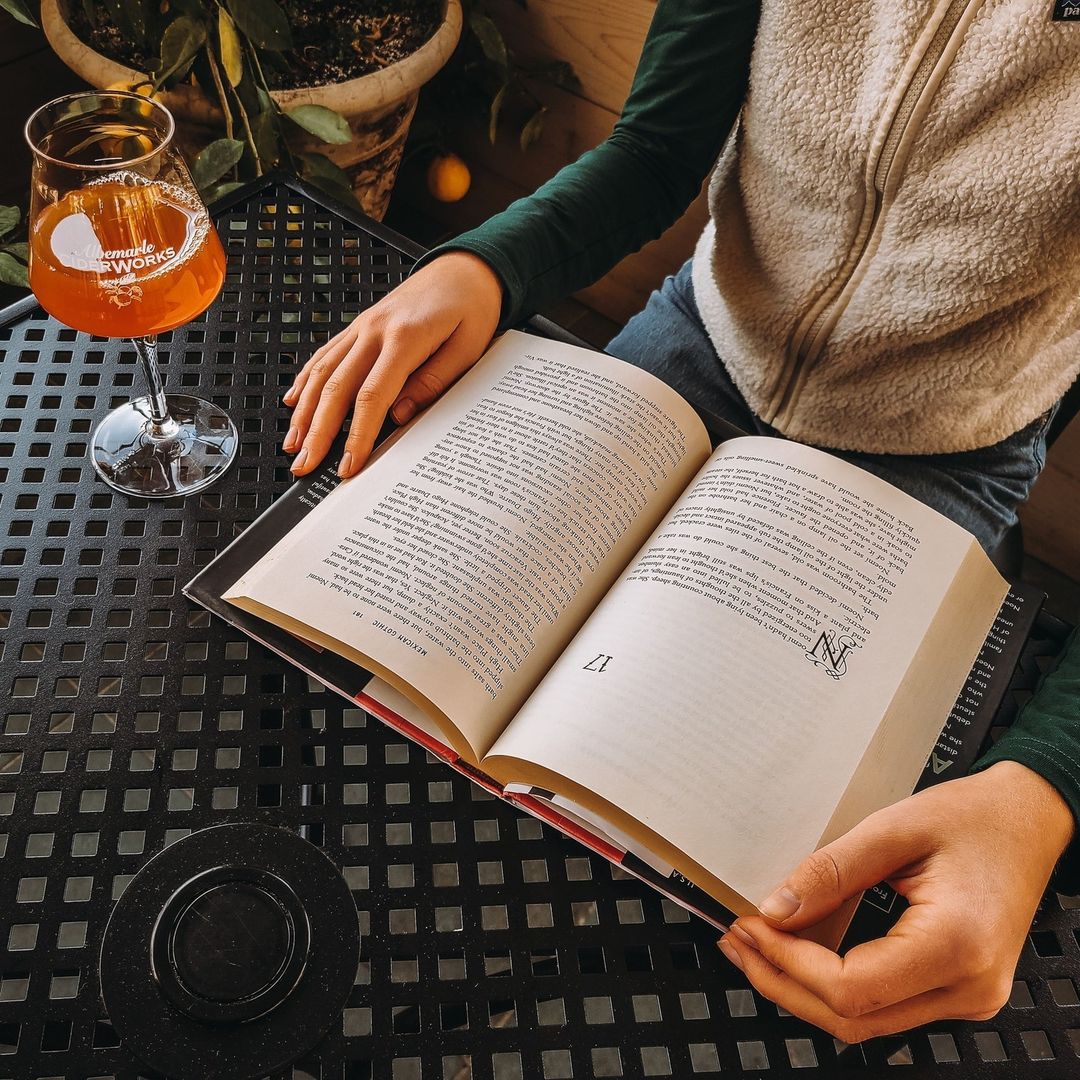
Every great story starts somewhere. This spring, WriterHouse and C-VILLE Weekly challenged local writers to prove that sometimes one page is all you need. As part of WriterHouse’s WriteNow! campaign, the First Page contest invited authors to submit only the opening page of an original work, leaving bestselling novelist and UVA professor Bruce Holsinger to decide which beginnings demanded a second page.
Winner
Accumulation
By John M. Faust
Daddy, like the pharaohs, had a materialistic understanding of the afterlife. He’d say the moment we die, we wake up in a big room reunited with everything we ever used up, lost, threw away, outgrew, or otherwise came to part with during our time on Earth. The for-instance he liked best, the one that really brought out the poet in him, involved a certain orange three-speed with a black-and-white banana seat and squeeze brakes on the handlebars. With a faraway look in his eye, Daddy would tell us it was there waiting for him by the foot of the bed on his ninth birthday, “in that chalky blue time just before the dawn.” He said he didn’t even know the bike was orange till the sun came up and colored everything in for him, this being a thing he waited for like it was part of the gift, not leaving his bed, not switching on the light, not so much as poking a toe out to touch the spokes. He adored that thing until it really wouldn’t do, him getting to the age where people expected him to drive a car, among other milestones of adulthood. “I’ll ride her again, Teddy,” he’d say to me. “You mark my words.” I did have questions. I didn’t ask them directly because when Daddy said “mark my words,” it meant “I have spoken” and “end of discussion.” After that, only Mama could talk, and it was not often she tested the privilege.
John M. Faust is a retired litigator who lives and writes in Charlottesville. He is the October 1984 Kinderhook (New York) Elks Lodge “Teenager of the Month.”
Says Holsinger: “A beautifully rendered first page, with a killer opening sentence and paragraph that create a character whose life story I want to read in full.”
Runner-up
Lake Superior
By Marian Bayker
I pin the little plastic wings to my chest, as if I were the one who took the airplane down the tarmac, angled into the sky, rode turbulent airstreams up through the clouds, brought it back down again to this place that is not my home. The pouch around my neck, the one that says UNACCOMPANIED MINOR, hangs like a medal against my chest. A flight attendant crouches in front of me. She smiles red lipstick and white teeth and I can see the shape of her breasts under her blouse and it is a good shape and she takes my hand and suddenly I am somebody. Somebody important. Like President George W. Bush, or Macaulay Culkin. “Welcome to the Twin Cities,” my flight attendant says, and I start to say “I bet you say that to all the boys,” or “Which twin is the better city?,” but in the end I don’t say anything because sometimes silence carries the weight of maturity more forcefully than words. Hand in hand, we exit the plane. “Alex!” someone calls, and there they are, my mom’s friend Helga and her daughter Helene. Identical white blond hair in short, fashionable curls. Identical noses, perfect and peaked. Helga takes me into her arms and I tolerate this as best I can. Helene stands back but I see her eyes flit briefly across my face. Her eyes are blue, like mine. Deep blue, like the clearest lake water.
Marian Thomas Bayker is a trans writer, baker, and mother living in Central Virginia. In the fall, she will begin an MFA in creative writing at Hollins University. Her work has appeared in new words {press}, Mala Leche, and Husk Zine. Bayker is a longtime fan of WriterHouse classes.
Says Holsinger: “Creates an intriguing and believable scene through the eyes of an observant boy I’m already rooting for by the end of the first page.”
The judge Best-selling author Bruce Holsinger knows what it takes to produce rock-solid fiction. The writer, professor, and Guggenheim fellow penned Culpability, the 116th selection of Oprah’s Book Club. His novel The Gifted School earned a Book of the Month Club selection and won the Colorado Book Award, and The Displacements was named the inaugural title in the United Nations Read for Action Book Club. Holsinger’s essays and reviews have appeared in The New York Times and Vanity Fair, and he’s been profiled on NPR’s “Weekend Edition,” “Here & Now,” and “Marketplace.”