At a March 25 special meeting, regional service providers and project leaders presented Charlottesville City Council with plans to renovate and operate a low-barrier shelter at 2000 Holiday Dr.
“I know from the outside it’s difficult to understand why this kind of process seems to take a long time. And to be clear, in the best of times, this work is H-A-R-D—hard,” said Piedmont Housing Alliance Executive Director Sunshine Mathon at the onset of the presentation. “But we are not in the best of times. This work has blossomed during the most hostile federal environment that this work has ever seen, particularly to the unhoused services sector.”
Members of the working group, led by regional continuum-of-care coordinator Blue Ridge Area Coalition for the Homeless, include The Haven, People and Congregations Engaged in Ministry, The Salvation Army, and several other area nonprofits.
Under the proposed operational plan, the city would remain owner of the Holiday Drive property, while The Haven and PACEM would run the day and overnight shelter, respectively. BRACH would also have a presence at the site, bringing three Charlottesville-area homelessness service providers under the same roof.
Even after the city’s $6.2 million purchase of the Holiday Drive site in October, there’s still a lot more work to be done—and money to be spent.
At least one memorandum of understanding agreement would be needed to make the organizations’ collaboration official. Before any programs can launch, the building needs major renovation work, according to project leaders.
Projected capital costs for the project were scaled down from $9.7 to $8.6 million in the fall, reducing the number of beds feasible at the site from 113 to approximately 80. Beds would be divided between a men’s section (48 beds and two isolation rooms) and a women’s section (24 beds and two isolation rooms), with four additional gender-neutral beds.
Original plans for 10 to 15 medical respite beds have been temporarily shelved, though organizers hope for future collaboration with the University of Virginia or Sentara health systems.
The shrinking scope of construction means the site needs more extensive renovations to make the best use of the space, according to Erin Hannegan, project manager and principal for design firm Mitchell Matthews Architects & Planners. Floorspace would be divided as follows: 37 percent for the overnight shelter, 20 percent for dining space, 10 percent for the day shelter, 18 percent for resident support, 12 percent for shared support, and 3 percent left unfinished for a future health clinic.
Planners still haven’t nailed down where they’ll get the estimated $8.6 million the project will require, since it’s only just been presented to City Council. Hannegan estimated that it would take at least two years to open the low-barrier shelter.
Capital costs are only the beginning, with projections for annual operational budgets coming in the range of hundreds of thousands of dollars for each organization. Major expenses include staffing, programming, and transportation—especially with the relocation of the central resource hub.
“We really wanted to focus on transformational impact at 2000 Holiday Dr. We want to increase our safety net and improve it,” said BRACH Executive Director Shayla Washington.
Beyond the day and overnight shelters, on-site programming will include “coordinated entry, case management, housing navigation and connections to health care and workforce supports,” according to Washington.
Owen Brennan, executive director of The Haven, underlined the importance of accessibility to the site, especially with the nonprofit’s plan to move its core operations to Holiday Drive.
“A move to Holiday Drive is not going to eliminate the visible presence of unhoused community members downtown,” said Brennan. “No stakeholder group expressed confidence that this project could succeed without a dedicated, reliable, and frequent shuttle service.”
A JAUNT estimate for a dedicated line connecting the Holiday Drive site to downtown and other key locations like the DMV came in at $411,000 annually.
“This is not easy. It was never going to be easy, and anyone who thought that it would be a simple solution was sadly mistaken,” said Charlottesville City Manager Sam Sanders.
“Buying the building was the easiest thing that I could do. … The hard part is working beyond what we have seen today and turning that into a reality. I’m sure there’ll be some hiccups,” said Sanders. “The direction that I got from Council was to make sure that we were making a big, bold step forward.”
“We know that [the city has] to help support in the operating [costs]. I have engaged our regional peers. Our county leaders, my counterparts, have all heard about this project. They were all very curious about the opportunity, and surprisingly, I heard nothing but positive comments about it,” he added. “I hope that turns into checks on an annual basis.”
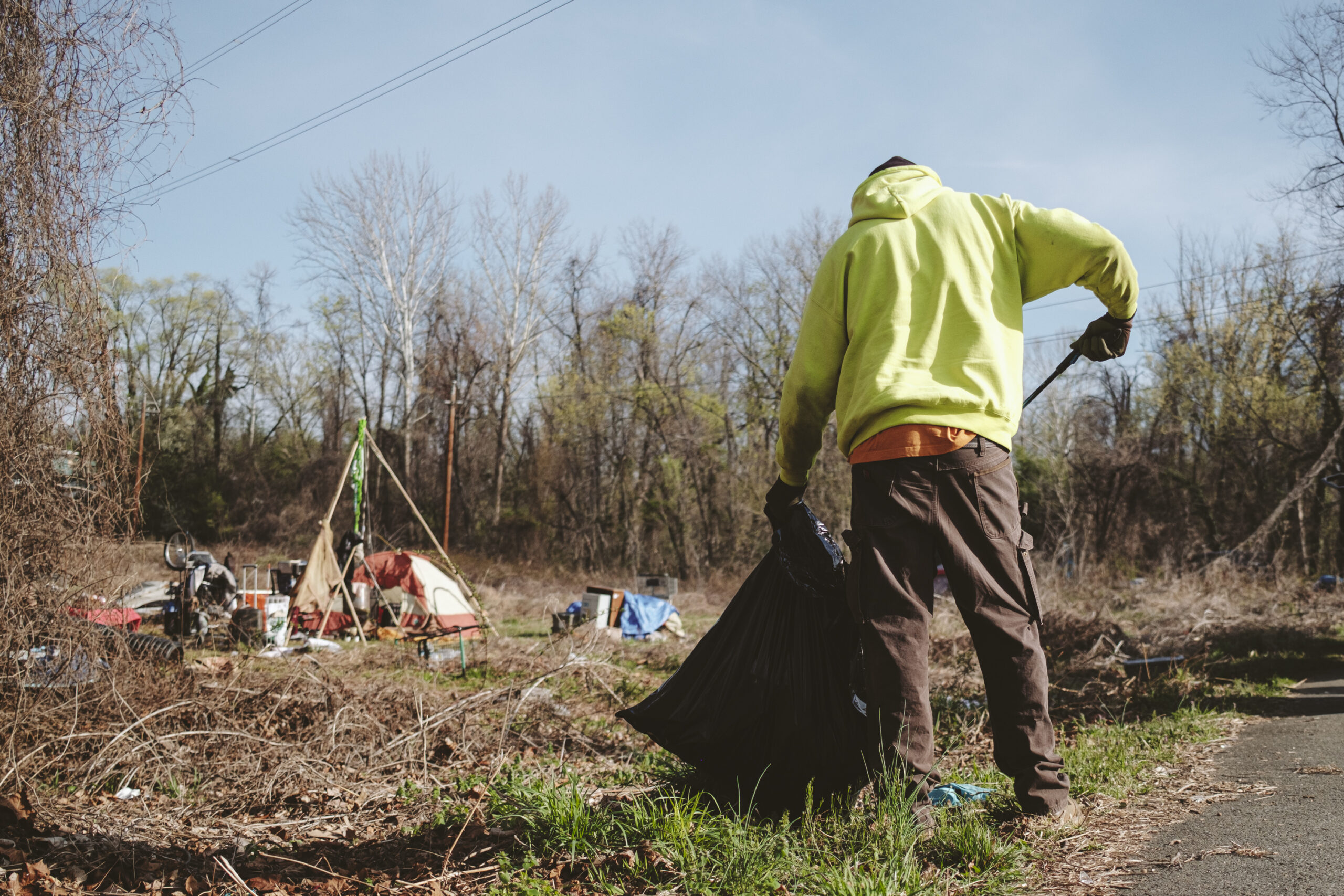
Cleaning up and providing safety resources to an encampment along the Rivanna Trail near Free Bridge are among the city’s efforts to support the local unhoused population.