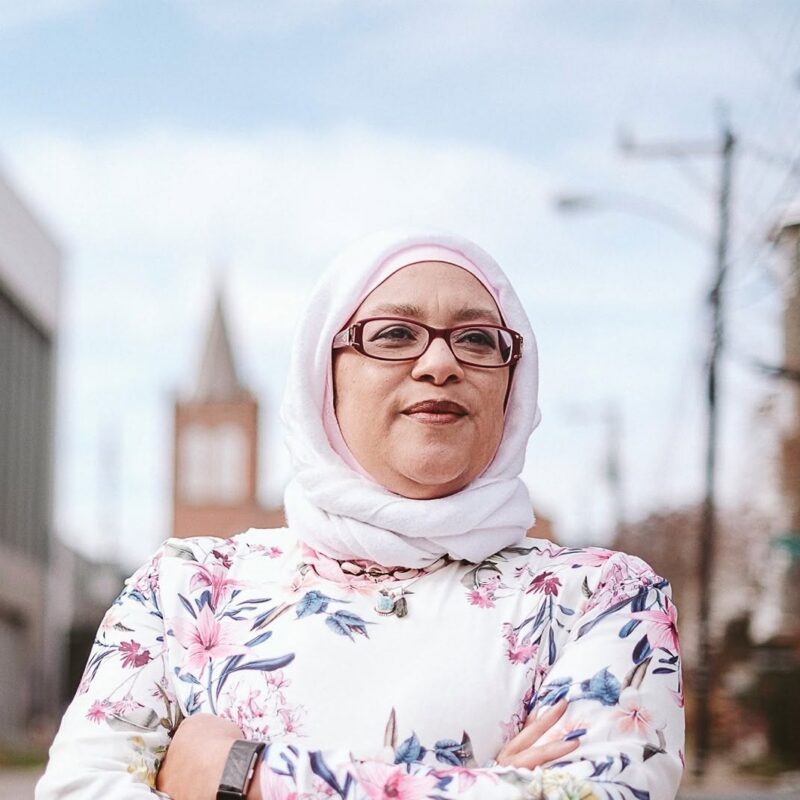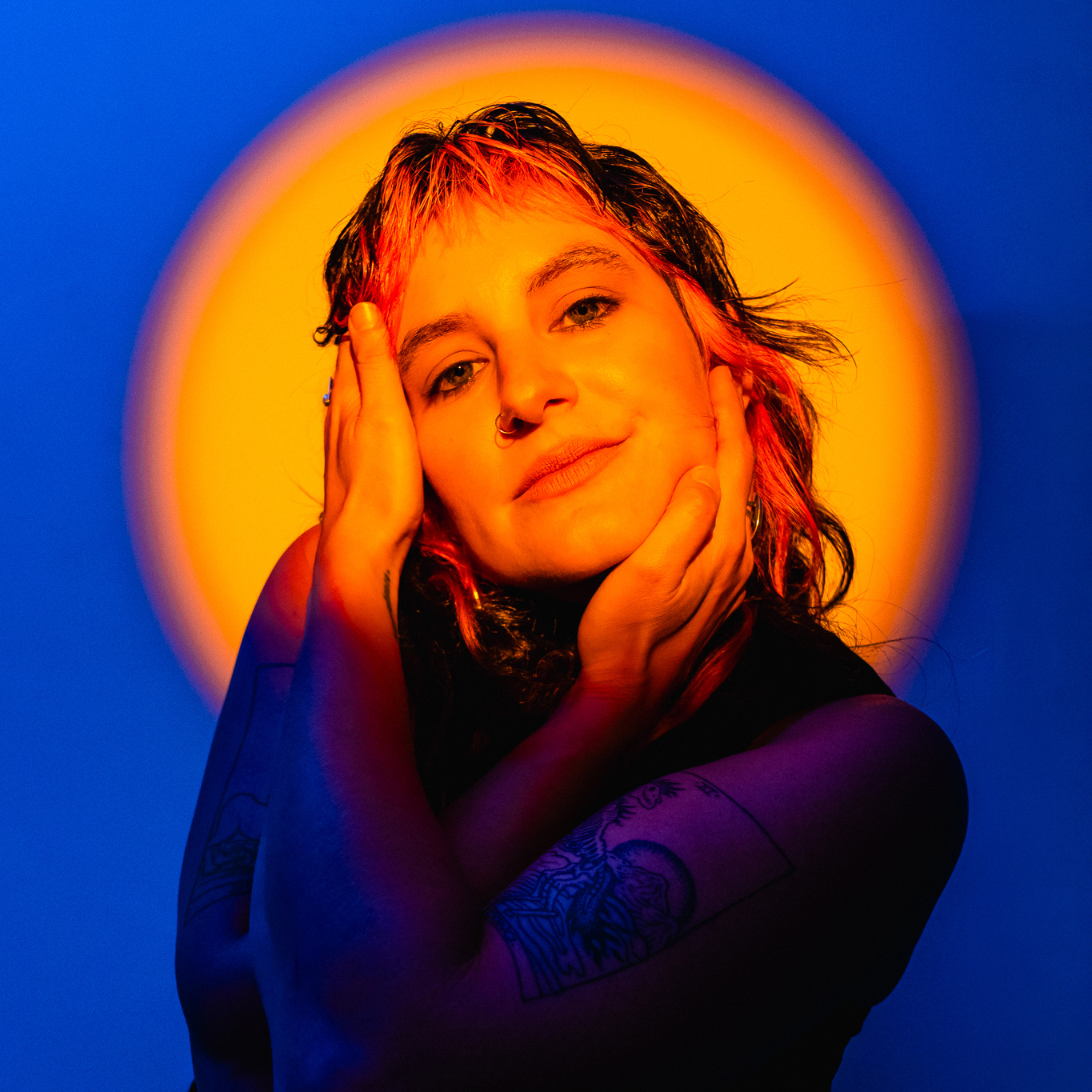
Though highly adaptable, Sally Rose’s natural habitat is Nelson County. The nonbinary Oh Do Kwan black belt Shagwüf bassist sits here now at a picnic table, a few miles from their cabin in the Blue Ridge wild, where they roam, split wood, and pioneer.
Midday has emerged, all glory, across the mountains beyond the Rockfish Valley Community Center, and Sally Rose—their name may be two words, but spiritually it’s a mononym—has a new album.
It’s their first in five years and sixth overall. The previous efforts were Americana, singer-songwriter records, with the last one, Tread Light, maturely full of heartache and plangent twang. The new album, Feral, released November 6, is not that. Feral is a pop record, though with acoustic ghosts deep down and righteous (but empathetic) fury everywhere else.
“This is going to sound really weird,” says Sally Rose, or SR for short, “but I have to be honest.” Okay, we’re ready. “I feel like this is the first time I’ve made a record that was not a Shagwüf record that I would actually listen to, if it wasn’t my music.”
Inspired by, among others, Bjork, St. Vincent, Alex G, and the Kim Gordon record The Collective, Sally Rose conceived of Feral three years ago while recording Shagwüf’s 2024 album, Tres Animales, by a lake in Louisa County. Illiterate Light drummer Jake Cochran, who goes way back with SR and Shagwüf, produced the album vibe-ily, and the experience got into Sally Rose’s heart.
While recording “El Borde,” a song about Shagwüf’s founding drummer Pablo Olivieri’s immigrant experience, Cochran had the dirty disco glam band speak only Spanish. On “Dysphoria,” an SR tune that, in hindsight, presages Feral, Cochran gave Sally Rose the floor for hours to talk about the nuance of gender expression and the world as felt by Queer people. Sally Rose came out as nonbinary, adopting they/them pronouns, first to family and friends starting in 2020, and then publicly in 2021.
“I just knew that I trusted him and felt safe with him,” Sally Rose says of Cochran, whom they’ve known for a decade. “We both had these rock projects that we love and pour our heart and soul into, but we both expressed to each other the feeling that we have more weirdness in us that we don’t really get to flex in our other projects because the other bands are more democratic—there are two or three other people involved who are very much part of the songwriting.
“He knew that I really, really, really wanted to break away from my sad boy country songs, and I was like, ‘I want to make a weird record. I want to write about shit other than heartache. I want to step outside myself a little bit. I want to speak about my gender experience as, essentially, an elder Queer in the punk scene.’”
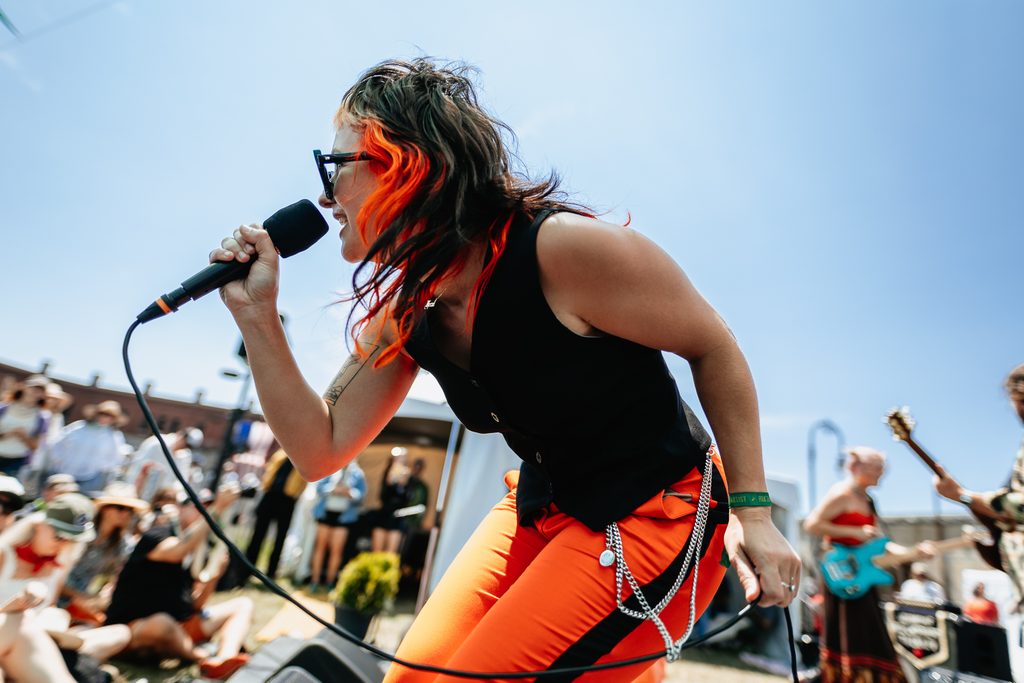
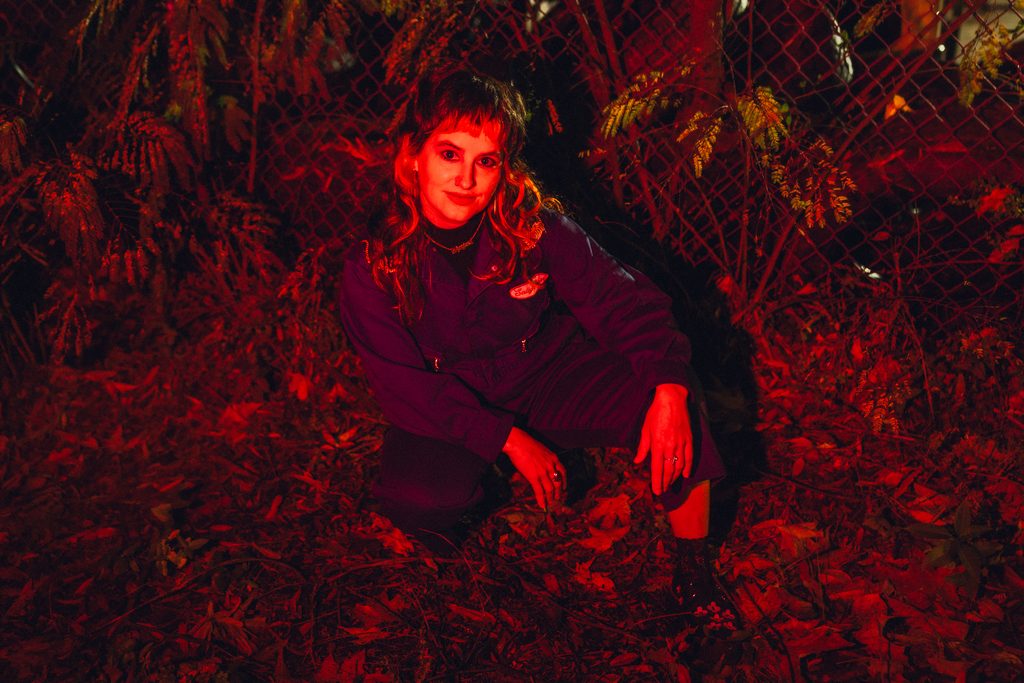
Sally Rose took a band drafted from Virginia-grown acts to Rhode Island’s Newport Folk Festival, where Feral’s songs got their concert debut in July. Photo by Joey Wharton.
Sally Rose is 35 now, hair partially dyed a formidable orange and tarot cards tattooed on their biceps. SR released their first solo record when they were 16, and their lyrics remained flowery through subsequent offerings, but Feral was not going to be like those records. As producer, co-writer and chief purveyor of vibes, Cochran demanded lyrical concision, nontraditional guitar tunings, and laughter as needed. He also kept two mics, one for business and one for art.
“My mind is much more expanded and I’m writing in a totally different way,” Sally Rose says. “I’m challenging myself to do lyrics in a completely different way, performance in a different way. … It’s like the old martial arts [question]—form, no form, form, no form. I feel like I spent two decades proving to myself that I had form, proving to other people that I had form, and then all of a sudden I just cracked that egg wide open—back to no form, literally to the point where we’re learning these songs for the album release because they’ve changed a lot in the studio. Jake and I changed them all up. I would bring him a basic structure and then we would take a hatchet to it.”
*
There were also pebbles used, but only for percussion. The little rocks predominated among the found objects reimagined at Cochran’s detached garage of a studio. Crooked Smile Production, about 16 x 20 and vinyl-sided, occupies the backyard of Cochran’s Richmond home, and it’s where he and Sally Rose co-wrote and recorded Feral’s 11 songs. They began simply, with SR and Cochran sitting face to face, acoustic guitar to acoustic guitar.
“Then we’d see how we could record it without that,” Cochran says. “We would get the acoustic recording done with some vocals and be listening to it and then we would just try things. … How far can we get away from where we originally started before we start to tie them back together? And I think that’s particularly what happened on the title track, ‘Feral.’”
The brew on “Feral” features foreboding beats, light guitar strums, and the pebbles, their musical properties unleashed after being dropped on Cochran’s driveway. In “Year of the Fire Horse,” almost titled “We the People,” they blend military drums, guitar pedal distortion, and a blues riff that turns gruesome.
“We wanted the songs and the song structure to be firmly rooted in the folk-American music tradition,” Cochran says, “played on an acoustic, sung with your neighbors, and that’s the core of it. That was something that Sally Rose grew up with, that sort of music, so starting there and then getting weird created the feeling of this album. You can also write a song with an extremely weird synthesizer part as the basis, but then it’s very hard to translate backwards. We just wanted it to have that song structure—that root in folk music that we could then destroy.”
Illiterate Light and Shagwüf formed in the Shenandoah Valley in the mid-2010s, and the bands’ members got to be buddies while sharing bills at Harrisonburg’s Golden Pony, which shuttered in June. When Shagwüf found itself shopping for a new studio and producer after Adrian Olsen moved Montrose Recording from Richmond to Los Angeles, the band chose Cochran and his all-in-one services. Tres Animales would be the first full record he produced.
“I think together when we started working on the Shagwüf album,” Cochran says, “that was mostly just me being hired because I was a good friend and they knew I knew their music and could do a good enough job. Within that, I introduced a lot of off-the-wall ideas, really just to get the band in a different headspace.”
And so Sally Rose invited Cochran to produce and co-write Feral. It took SR a few years to raise the money, which they very conservatively ballparked at $10,000, to cover tracking, mixing, post production, mastering, cassette tapes, CDs, vinyl records, and vagaries. Production commenced in spring 2024 and ended in summer 2026.
Sally Rose and Cochran worked on Feral in days-long bursts that they scheduled around Illiterate Light’s tour dates, and on the road, Cochran kept Sally Rose’s musical spirit alive inside him with a centering playlist. Stacked with artists such as Beck, The Breeders, and Minutemen, the playlist matches Feral, Cochran says, either “sonically or energetically.”
“The process of recording should be exciting and enjoyable and fun,” Cochran says. “When that’s the case, you typically hear that afterwards. You can hear the joy, even if it’s a dark or angry song. Something that is the spirit of the person can come through.”
*
If there’s a song on Feral to jam out like it found peanut butter and white bread, it’s “Dirtbike Dirtbag.” From the community center picnic table, Sally Rose agrees verily and vows to go “full balls to the wall LCD Soundsystem on that one” when they play it live, though SR’s still working out how.
“We started doing production and that opened up another wide realm of weird opportunities,” says Sally Rose, while a Bobcat loader smears mud loudly across a soccer field in the background. “Now as we’re learning how to play these to perform them live, people are like, ‘What chords are you playing?’ And I’m like, ‘I have no fucking idea. I have no idea. I don’t know what I’m playing. I couldn’t tell you. I might know the key-ish. I can tell you what tuning it’s in.’
“People think I’m being modest or humble. No, I don’t know what the fuck I’m playing. Like no, I did one year of community college. I’m not a scholar. Music is very much a feeling, sensory, emotional thing for me.”
Feral’s songs got their concert debut in July at the Newport Folk Festival in Rhode Island, where Sally Rose took a band drafted from Virginia-grown acts. Named the Feral Folk after their festival smartphone group chat, SR’s band brandishes acoustic guitar; Illiterate Light’s Cochran on electric guitar; Kayla Wilson, formerly of Ten Pound Snail and False Nectar, on lead guitar; Palmyra’s Sasha Landon on electric bass; and Shagwüf’s Brittany Horkan on drums.
“Jake called me,” Landon says, “and said, ‘Hey, we’re putting together a band to pitch SR for Newport,’ partially as a selling point to the Newport folks because Palmyra’s played there three times.”
It was an easy yes for Landon, who speaks of Sally Rose as a kind of tutelary force and says that on the road to Newport, SR helped her walk into a public women’s restroom for the first time.
“They said, ‘Hey, you belong in this space, too,’” Landon says. “As a trans person on tour, that is a scary space that I do not go into very willingly, but knowing that I had them with me, it was less scary.”
“Transness,” Landon continues, “is so heavily baked into [Sally Rose’s] writing and queerness.” On Feral, particularly the song “Your Fear.” “As a fellow Queer, non-binary transperson, just so much of my writing has that steeped into it, too, and I think that we live in a time where it is increasingly a little bit scarier to be loudly and proudly Queer because that can other you.”
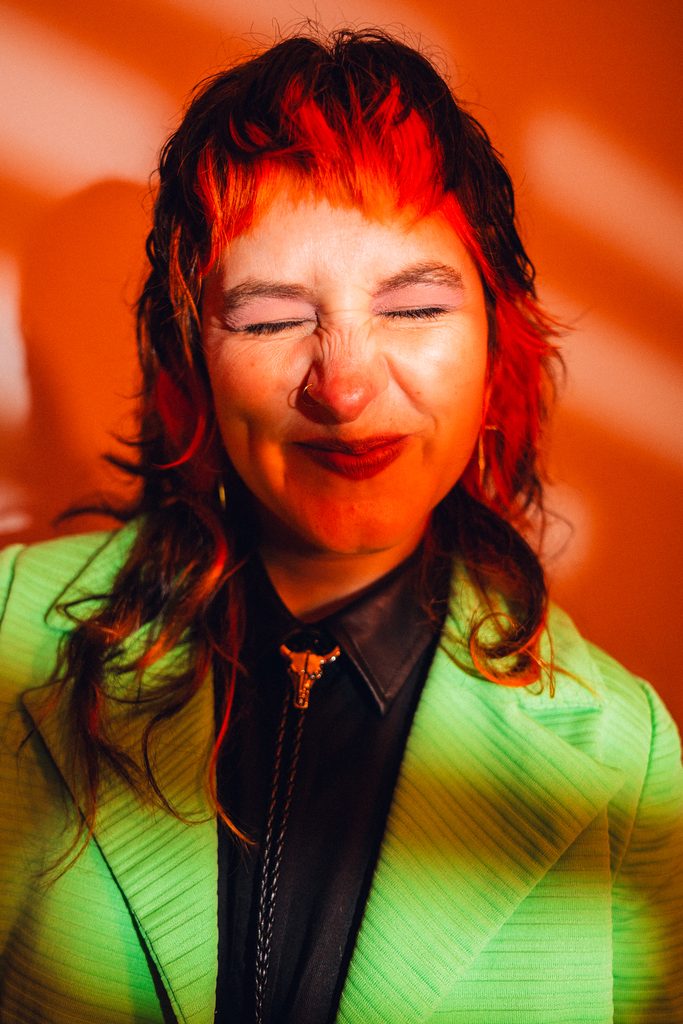
Current events, political activism, and self-evolution supplant country longing and heartbreak as the raw material for Feral’s songs. SR’s longtime visual collaborator Rich Tarbell complemented the bolder, wilder musical style with a bolder, wilder—and concerted—presentation.
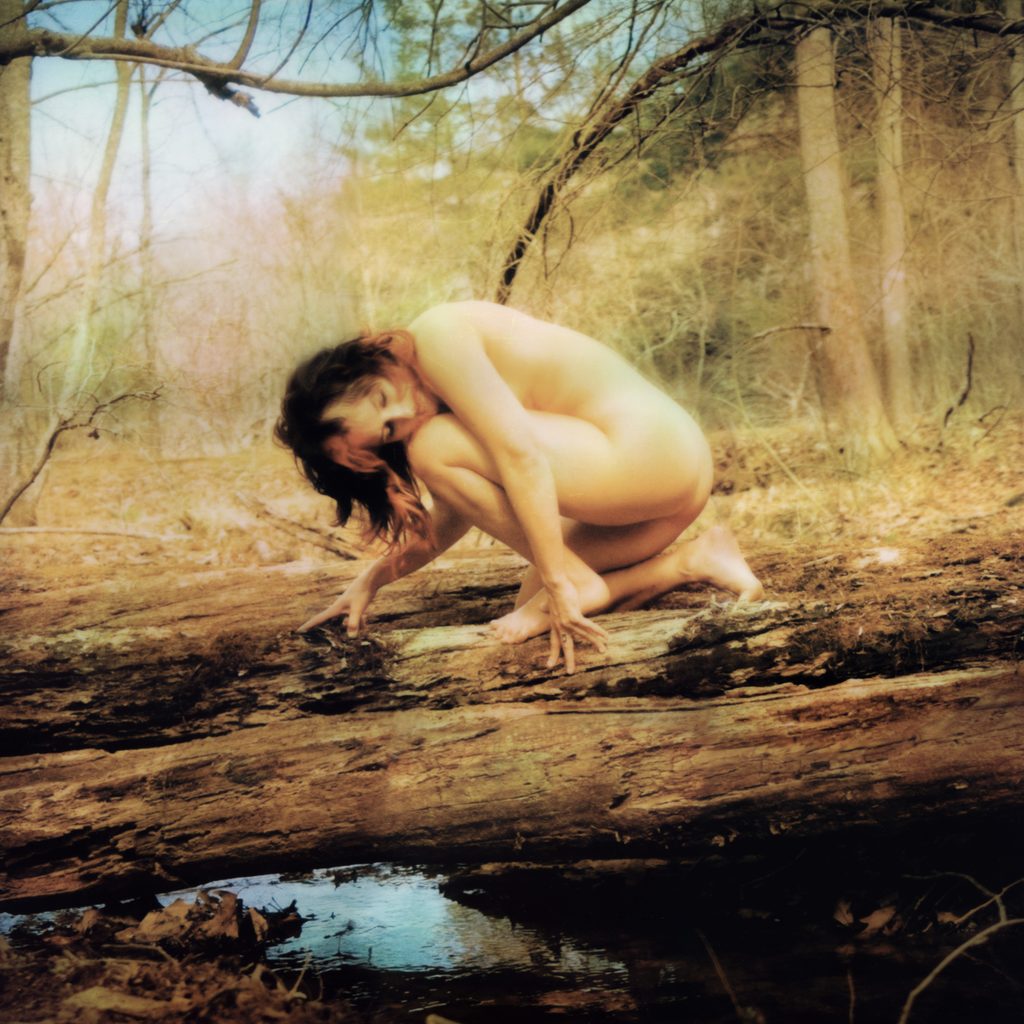
“I want to be able to show it to somebody in, say, New York City,” Tarbell says, “and have them go, ‘Oh shit, that’s amazing. Whatever it is, I want to listen to that.’ I didn’t shoot the album cover”—it shows Sally Rose primordially nude in the woods—“but I was a part of the ideas developing it and the balance back and forth of things. As the recording was taking place, [we thought about] what can we do to make this all make sense together?”
The Wildfang blazer-pant combo, also formidably orange, that’s been a mainstay of Feral’s promotion was Tarbell’s idea. The duo procured it off Poshmark, and Sally Rose took it out for a spin at Newport, part of their pitch to the big time as a solo artist.
It was SR’s first appearance at the venerable festival, where Illiterate Light has hosted a stage the past six years and recommended numerous Virginia artists to the festival bookers, including Sally Rose and their wilder, oranger self.
“Americana’s great, but everybody’s doing it,” says Tim Barry, the Avail frontman-turned-folk artist and SR collaborator. “Zig when they zag. The video shorts that Sally Rose was dropping right before the Newport Folk Festival were nothing short of just shockingly great. Just so cool, so good, so prepared, so visual, so audio, so catchy, so Sally Rose.”
At Newport, 550 miles from Nelson County, Sally Rose closed their 22-minute set by making a crowd-surfing, amp-hopping spectacle of Feral’s first single, the self-possessing “Gas It Up.”
“I think the best way that I can describe this record is it feels like a love letter to myself,” Sally Rose says. “It’s as tender as it is tough. It’s as playful as it is serious. It kind of touches on all the things that are important for me in music that I’ve listened to.”