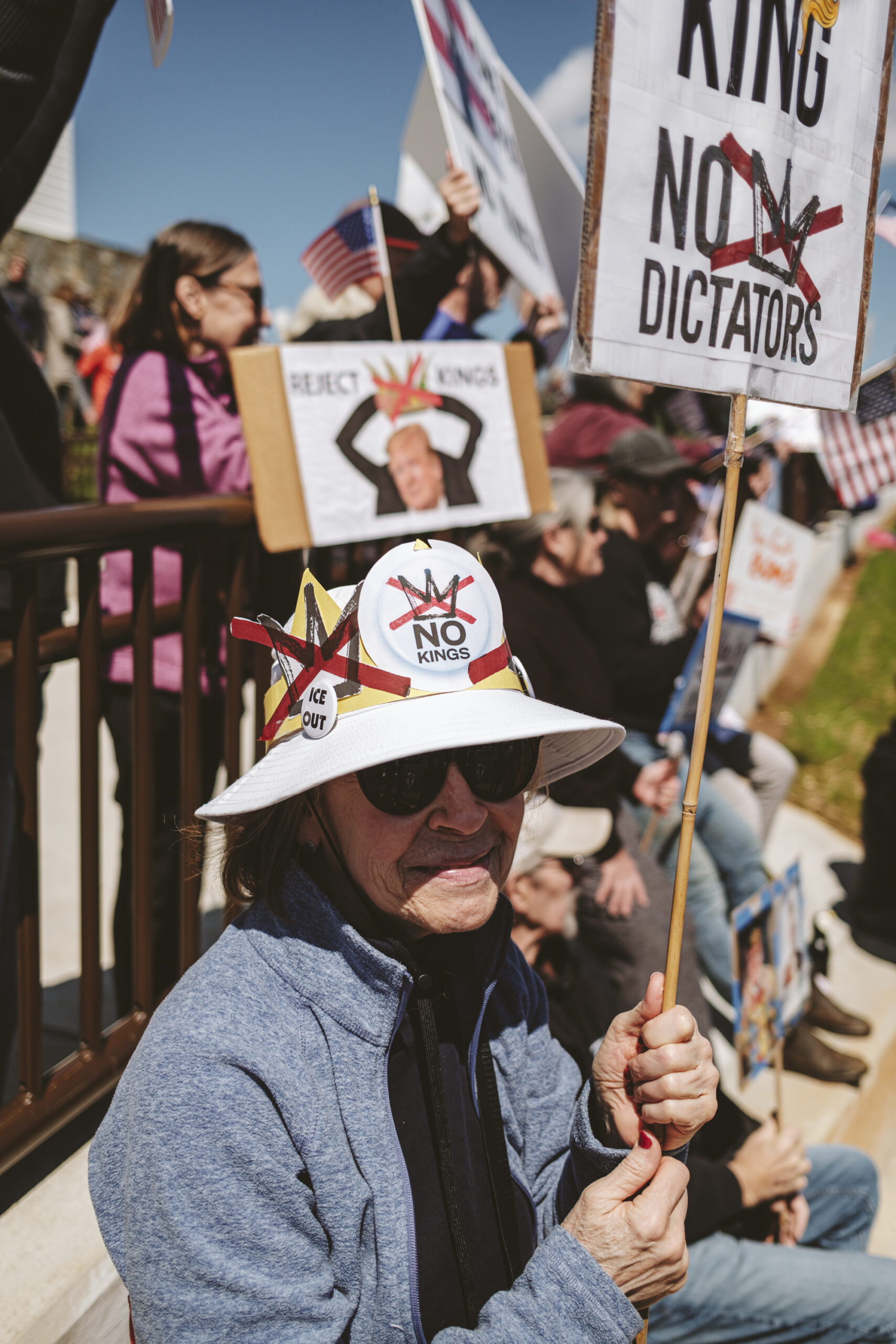
Organizers used March 28th’s No Kings 3 protest to launch efforts for a one-day nationwide general strike on May 1. Photo: Eze Amos
An estimated 12,000 people lined US 29 North around The Shops at Stonefield on March 28 to say, “No Kings.” On May 1, organizers hope attendees will agree to a few other nos, if only for the day: No work. No school. No shopping.
May Day Strong, a nationwide initiative to celebrate workers, decry billionaires, and protest the Trump regime, was publicly announced at the third No Kings protest at the end of last month. In Charlottesville, volunteers with Indivisible and the Democratic Socialists of America circulated May Day Strong flyers among the throngs of attendees.
“I was in the No Kings crowd going around talking about May Day, and was absolutely blown away by how enthusiastic the response was,” says Kathryn Laughon, a board member for Indivisible Charlottesville. “It was overwhelmingly positive. People had practical questions, but I did not get … the thing where you go through a crowd, you talk to people, and people are polite but not interested, or wave you off.”
The May 1 effort is modeled after the January 23 general strike in Minneapolis, where an estimated 50,000 citizens marched in subzero temperatures to protest federal immigration enforcement officials’ militarized occupation of the city.
Organizers are urging interested citizens to take as many actions as they reasonably can on May 1: Call in sick or take a vacation day from work, skip school yourself or allow your kids to have the day off, and avoid buying anything. Rather than stay at home, Charlottesville May Day celebrants are encouraged to join organizers at noon that day at the Free Speech Wall on the Downtown Mall. Protesters will march from there to a big public party—featuring free food, music, and kids’ activities—at Booker T. Washington Park, a little more than a mile away.
Terry Rephann, a regional economist at the University of Virginia’s Weldon Cooper Center for Public Service, says a one-day event won’t make much of an economic dent. “It would have to be pretty large and pretty long, maintained over a long period of time, to have any real disruptive impact,” he says.
But organizers describe the May Day protest as an opportunity to build the kind of community and organizing muscle that a sustained general strike might require.
“One day is not the end of what we’re doing,” Laughon says. “One day is an opportunity to show our power. It is an opportunity to find out what we need to do better if we need to do this again in the future.”
“We understand that some people may not necessarily be able to take part in the protest part of it and the celebration part of it,” says co-organizer Sandrina Da Cruz of Indivisible Charlottesville, “but we know that they’re going to be able to do things that are within their means, such as no shopping.”
During the Minneapolis single-day strike, numerous Twin Cities businesses voluntarily closed their doors—something Charlottesville organizers hope to recreate on May Day.
“Local businesses are an integral part of our strike coalition,” says family nurse practitioner Catherine Muller, part of the four-person local team handling business outreach. “We are striking to disrupt the billionaire class that is making it hard to survive as a small business. … From our business partners, we gain a commitment to close on May 1, or to give workers the day off, or to donate a percentage of profits. Businesses are also publicly supporting us with storefront flyers in a meaningful display of solidarity.” In return, Muller says, the group plans to encourage citizens to support those shops and restaurants the day before and after May 1.
Planning has been under way since mid-February, with dozens of area citizens taking part in decentralized preparations. “Every time we create a team, we bring more people into our organizing,” Laughon says. “All of those are wins along the way, and I think on May 1, our win will be that we get people involved and learn our lessons from it.”
Events like No Kings and the organizing around them do seem to be building the muscle that the movement’s hoping for, drawing in people who hadn’t previously been involved with activism.
“I had joined No Kings protests in 2025 with my family, and during that time I learned about Indivisible Charlottesville[‘s] People’s Activist series,” says Da Cruz, a longtime humanitarian worker. “That’s how I got to understand how to take concrete action and get meaningfully involved.”
Organizing team member Ted Mills and his husband joined up with the organizing movement around May Day through the local DSA chapter. “[We] got to know a lot of people who are really committed politically to making some real positive change,” he says. “And getting to know those people inspired us to get involved.”
Organizers say they’re in this for more than one day. “Any place in the United States or in the world that has effectively used general strikes,” Laughon says, “has required long-term planning, long-term organizing, and a series of targeted actions like this.”
“We can take this one day of action,” Da Cruz says, “and we can prepare for a more sustained strike-ready force as needed, depending on what this government decides to do.”