Think of this as Charlottesville’s field guide to the new year. We rounded up the city’s most dialed-in experts in politics, food, art, weather, and beyond, and asked them to predict what’s coming up for 2026. Their collective wisdom charts the trends, shifts, and stories that will shape the year.—C-VILLE writers
VIRGINIA POLITICS
Fast times in the Old Dominion
If you’re someone who doesn’t enjoy politics, 2026 won’t be your year because Virginia will be hard to ignore—and likely in ways that feel both personal and highly local.
A state that once prided itself on deliberation is now rewriting political history at warp speed—and, for the first time, a state named for a woman will be governed by a woman. Abigail Spanberger’s election as Virginia’s first female governor broke a 400-year pattern and it also ushered in a Democratic supermajority in the state legislature. Together, these events accelerated nearly every policy debate, not just at the state Capitol but in local governments across the Commonwealth.
Just weeks before her inauguration, the General Assembly approved a constitutional amendment reopening Virginia’s redistricting process—an extraordinary move in a state that rarely rushes constitutional change. That late-October vote, paired with the November House of Delegates election that followed, satisfied the state’s constitutional requirement (at least according to Democrats) for a second passage in the 2026 session. If that happens, the measure then goes before the voters, presumably early this year, with enough time—assuming voters agree—for the General Assembly to redraw congressional boundaries ahead of the November midterms.
And brace yourself for another constitutional flashpoint. The abortion-rights amendment—passed by the General Assembly in 2025—would establish a fundamental right to reproductive freedom. The measure is now poised for a second legislative vote this winter that would place the highly controversial issue of abortion on the November ballot alongside the midterm Congressional candidates.
Beyond the state legislature, issues shaping local governments are no less intense. From fights over affordable housing to local taxing authority, governing boards at every level are operating in fast-forward. Northern Virginia’s data-center boom continues to divide communities over land use, noise, and energy demand, while school boards remain flashpoints where curriculum and library debates collide with calls for transparency and calm.
Meanwhile, Charlottesville remains a focal point. After Spanberger urged the University of Virginia’s Board of Visitors not to select a new president until she takes office—a story first reported by The New York Times—the university again finds itself at the intersection of federal, state, and local authority.
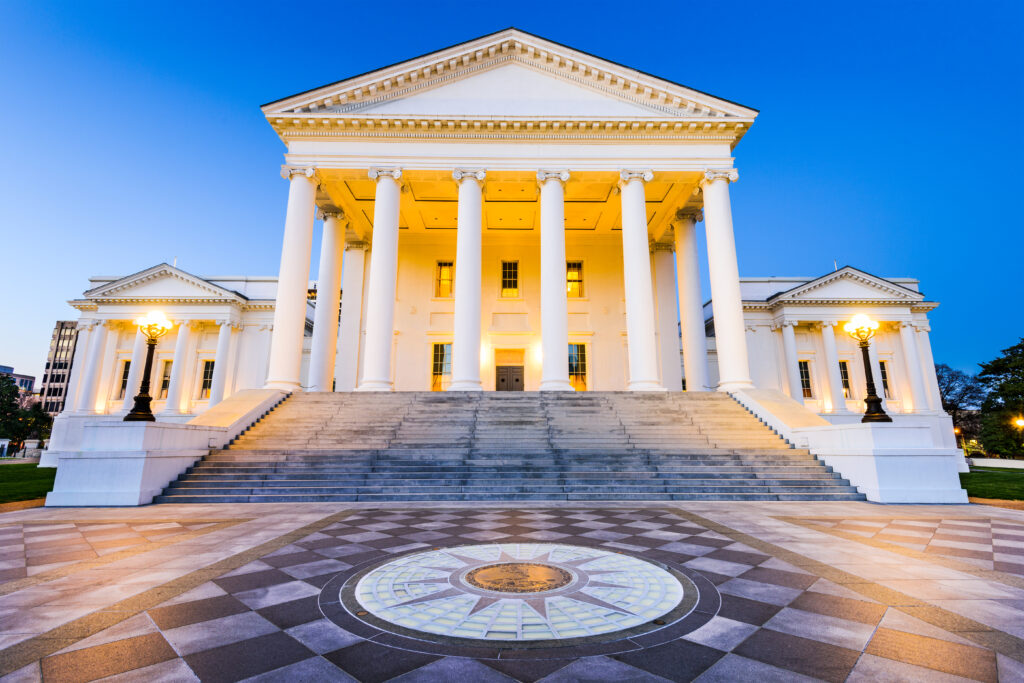
Add in surging housing costs and sea-level threats in Hampton Roads, and the Commonwealth’s trademark caution looks increasingly like a relic. From classroom to courthouse to Mr. Jefferson’s Capitol, local and state issues facing Virginia in 2026 portend an Old Dominion that’s anything but old.
Ken Stroupe, Associate Director
UVA Center for Politics
Unclear lines, but blue expectations
Democrats in the Charlottesville area are entering the 2026 election cycle riding high. Earlier this month, Governor-elect Abigail Spanberger was pushing 90 percent of the vote in Charlottesville and cleared 70 percent in Albemarle County—both metrics made her the strongest performing statewide Democrat that this area has seen in years. Looking to 2026, U.S. Senator Mark Warner is a strong favorite for a fourth term. While the Charlottesville/Albemarle area will again be part of his coalition, could he actually surpass the numbers that Spanberger posted last November? Though Democrats should take nothing for granted, this seems like a possibility, especially if Donald Trump’s numbers continue to slide.
Our area may very well elect a new member to the U.S. House this year, although the circumstances could be somewhat unusual. Democratic legislators in Richmond have made concrete moves toward mid-decade redistricting. While a national redistricting craze started earlier this summer in Texas, several other states have followed suit. One of them was California, which Democrats hope will provide a template for Virginia. In November, Golden State voters approved Proposition 50, a measure aimed at overriding the state’s independent line-drawing commission so that Democrats could enact their own map, by a larger percentage margin than the 20 points Kamala Harris carried the state by in 2024. Though Virginia is not as solidly blue as California, our legislators are set to attempt something similar next year—Prop 50’s smashing margin probably bodes well for Democrats in the Commonwealth.
Under the current configuration of the 5th District, deep blue Charlottesville consistently loses out to the ever-reddening Southside region. But if Democrats have a free hand at re-drawing the state’s House map this year, that pairing will almost certainly change (see story on page 10). Charlottesville would likely be put in a Democratic-leaning district, though the exact lines are uncertain. We may end up in a “I-64 district,” which would reach into the Richmond area. Another option might be to put Charlottesville into a “college town district,” which could follow I-81 down to the Blacksburg/Radford area. Either way, Democrats, who currently hold six of Virginia’s 11 seats in the House, are looking to add several more seats to their column via redistricting—where Charlottesville is placed could be key to their efforts.
So, for this year’s elections, voters can probably look forward to a redistricting referendum sometime in the spring, a summer primary, and a fall general election. Never a dull moment in Virginia politics!
J. Miles Coleman, Associate Editor of Sabato’s Crystal Ball
University of Virginia Center for Politics
LAND CONSERVATION
Onward and upward
Thanks to decades of effort, the greater Charlottesville area has long been a leader in land conservation. Our local environmental protections didn’t happen by accident, but rather through hard work and strong policies built over time. That strong policy framework, combined with steadily increasing the permanent protection of forests and farmland in our area, has kept the rural landscape largely intact, despite many challenges to the contrary. We hope to honor and continue that work in the new year.
There are so many public benefits that come from keeping rural land intact, from improving climate resiliency through carbon sequestration and flood mitigation to ensuring the quality and quantity of water resources for drinking, recreation, and habitat. Land conservation also protects biodiversity and public health, and strengthens our local economy through production of local farm and forest products, and through tourism that relies on the scenic beauty of the natural landscape around us.
Looking forward to 2026, I hope the community will continue to advance key policies and programs related to land conservation. One of the most important is Albemarle’s Growth Management Policy, which protects the rural area and its resources by directing new growth and development to the designated growth areas. I am also hoping to see implementation of the county’s Stream Health Initiative, a series of 14 proposals to improve stream health locally through policies, voluntary programs, and education. Local conservation programs, like the county purchase of development rights program, which includes an equitable framework to support landowners of modest means with farmland protection, should be renewed and strengthened.
Going forward, implementing the actions of the Climate Action Plan and Biodiversity Action Plan is also critically important for our community. The CAP includes actions like protecting and maintaining our tree canopy, which will help build resiliency locally by moderating temperatures, sequestering carbon, and mitigating the impacts of major storm events. The BAP will help improve habitat connectivity by establishing and maintaining wildlife corridors, and much more. Land conservation is a major throughline of all of these programs and policies, and is key to their success.
Despite constant pressures and challenges to our rural landscape, I remain hopeful that we can do more land conservation and do it better, in 2026 and beyond.
Kim Biasiolli, Conservation Program Manager
Piedmont Environmental Council
TRAILS AND PUBLIC ACCESS
Every day is a winding road
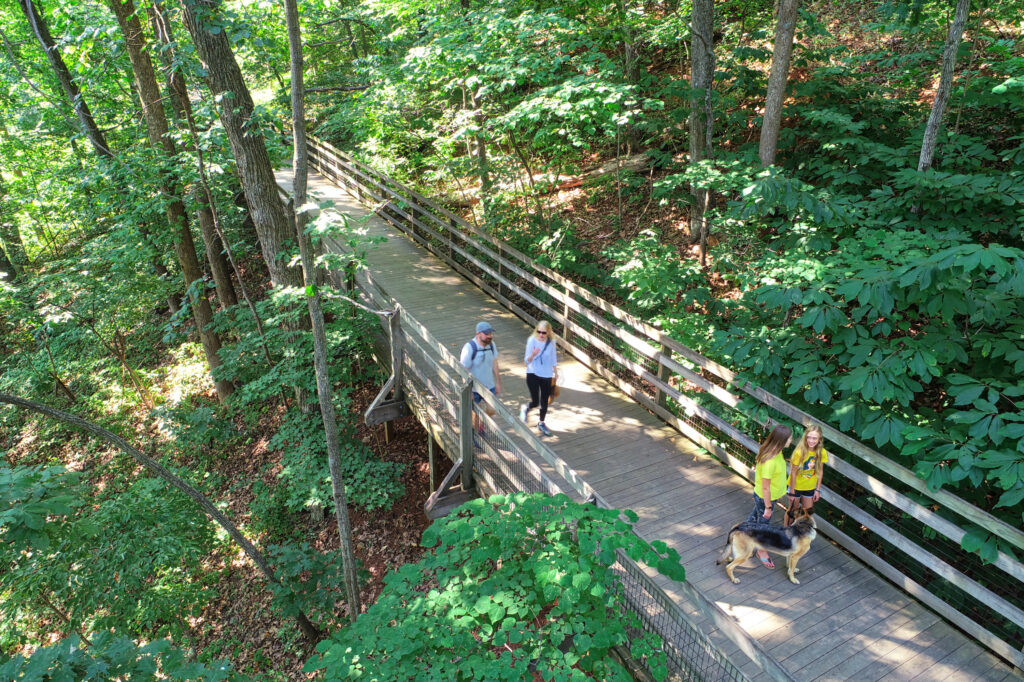
Although Charlottesville was recently named top midsize adventure town by Blue Ridge Outdoors, not all local parks and trails are easily accessible. A coalition of area groups, businesses, and agencies is working to correct that. Here are some projects we hope to see started or completed in 2026.
Albemarle County will invite residents to help select a route for the Three Notched Trail, which will eventually stretch from Charlottesville to Crozet, the Afton Tunnel, Waynesboro, and beyond. This generational project will also seek opportunities to address key barriers along the way that could bring progress in the near term.
Construction will begin on a new bridge and trailhead at Hickory Street to connect Southwood residents to Biscuit Run Park across a newly restored stream valley. A downhill bike skills park just opened and several additional miles of trail and boardwalks will open in 2026. We hope to see progress on the trail connecting the surrounding neighborhoods to the park and to Wegmans.
A new greenway along Meadow Creek will connect Greenbrier neighborhood to Hydraulic and the 29 corridor. We would like to see the final piece (a tunnel under the railroad tracks at the John Warner Parkway) get underway.
The Rivanna Conservation Alliance will break ground on a major project to conserve the banks and improve access to the river at Riverview Park.
Albemarle recently made Free Bridge Lane (in Pantops) permanently car-free, and there will be more upgrades in the coming year. The coalition is working to extend the Old Mills Trail (which currently ends near Interstate 64) four miles further, to connect to Milton landing and Glenmore, netting a 10-mile riverside greenway. We hope to begin the first mile segment in 2026.
As part of America’s semiquincentennial celebration (250 years since the signing of the Declaration of Independence), Thomas Jefferson’s Monticello is looking to extend the popular Saunders-Monticello Trail to connect to the City of Charlottesville, Piedmont Virginia Community College, and other nearby sites.
Area volunteers will be building new bridges and upgrading maintenance along the Rivanna Trail and in nearby parks like Mint Springs (Crozet), Pleasant Grove (Palmyra), and Sunset (Waynesboro).
People who would like to learn more and get involved are invited to attend the free annual Active Mobility Summit March 5-6 at The Wool Factory and the annual Loop de Ville Trailfest in the fall.
Peter Krebs, Community Advocacy Manager
Piedmont Environmental Council
REAL ESTATE
A market in motion
As 2026 approaches, Central Virginia’s real estate market stands on the threshold of another dynamic chapter—one defined by shifting interest rates, evolving consumer confidence, and the steady pulse of life changes that always drive housing decisions.
If interest rates continue their descent into the upper 5 percent range—as predicted by various economists—the impact will be both immediate and significant. More buyers, many of whom have been waiting for rates to improve, are expected to re-enter the market. At the same time, sellers who have been holding onto historically low interest rates may finally feel motivated to list their homes.
The dual effect of new buyer demand and an increase in listings could bring much-needed energy to what has been a restrained market. However, the pace of that recovery will depend heavily on the broader economy—particularly inflation trends and consumer confidence levels.
Even as rates improve, lingering inflation may temper optimism. Home price growth is likely to continue softening. Instead of a sharp decline, the market may experience what we saw at the close of 2025—a leveling effect. This plateau creates space for buyers and sellers to reach a more natural equilibrium after several years of market fluctuation.
That balance, while slower-paced, is not necessarily a bad thing. The move toward a more balanced market between seller’s market and buyer’s market gives participants the breathing room to make more thoughtful, educated real estate decisions rather than the reactionary offers and bidding wars that characterized the post-pandemic boom.
Beyond the numbers, Central Virginia remains one of the most desirable regions in the Mid-Atlantic. The area’s unique blend of lifestyle and opportunity continues to attract both local movers and out-of-state buyers. From proximity to outdoor activities like hiking in the Shenandoah National Park or spending weekend afternoons at a thriving array of wineries or breweries to the proximity of cultural centers of the capitals Richmond and Washington, D.C., the appeal is undeniable.
The job market also remains robust. With major employers like AstraZeneca’s recent expansion announcement, Central Virginia continues to show economic resilience—a factor that supports long-term housing demand.
Looking ahead, the spring 2026 real estate market is expected to be lively. Increased inventory, motivated buyers, and gradually easing rates could generate a healthy flow of transactions. Yet, if rates don’t dip too dramatically and days on market remain slightly elevated, conditions may favor a more balanced and deliberate market tempo.
Buyers will have more breathing room to evaluate options, while sellers with move-in ready, well-priced, well-located homes—particularly single-family detached properties near key commuting routes and amenities—should still find strong demand.
The bottom line: Central Virginia’s 2026 housing landscape will likely be one of motion rather than mania—dynamic, but not frenzied; active, but increasingly balanced. With the pandemic’s distortions receding and life’s natural rhythms reasserting themselves, the region is poised for a year of steady growth built on lifestyle appeal, economic strength, and the enduring human need to find home.
Ali DiGuardo, Chief Operating Officer
Charlottesville Area Association of REALTORS® (CAAR)
Buyers’ market?
Inventory is up. We saw moderating prices and increasing inventory in 2025, and I suspect we will see more of this in 2026. Broadly, I think the Charlottes-ville/Albemarle/Central Virginia real estate prices will be anywhere from flat to up or down 1 to 3 percent. There will be pockets and segments that appreciate more or less than others.
Predicting interest rates is always a gamble. Two thoughts: 1. If a quarter of a point is what is helping or preventing you from buying a home, maybe do a hard look at how much you can actually afford. 2. In the words of a client, “I’m glad I didn’t wait for rates or prices to drop to buy.”
If you’re selling, 2026 is not the 2020-2022 real estate market. Price, prepare, present, and market your home as the product that it is.
We have a lot of uncertainty in our market as we are so heavily influenced by government—federal and local—and we have a lot of positivity on the horizon with the biotech center, NGIC/DIA, and AstraZeneca, as well as Merck in Harrisonburg and Northrop Grumman in Waynesboro/Augusta.
Jim Duncan, Co-founder
Nest Realty
WEATHER
When it rains, it … doesn’t rain all that much?
Long-term weather predictions remain largely dependent on what we meteorologists call teleconnections. Teleconnections are a relationship between something happening in one part of the world and seeing how it affects areas far away from the source. One of the most common teleconnections is ENSO, or El Niño-Southern Oscillation, which includes both El Niño, the warming of the central and eastern Pacific Ocean, and its counterpart La Niña, which correlates to the cooling of the same region. Both of these look to have some kind of impact on our local weather in 2026.
Impacts of ENSO are most noticeable in the cold season. Current signals show a swing toward a La Niña pattern for winter, meaning a cold start but a return to milder temperatures for late January, February, and March. Traditionally this pattern promotes normal precipitation in Central Virginia, but above-average precipitation in the Appalachian Mountains and Ohio Valley. Will this translate to a snowy winter? Only if enough cold air is present to change the rain to snow. At the moment I’m not confident the cold air and moisture will connect very often, therefore I think this winter will see below-average snowfall across Central Virginia. For reference, seasonal snowfall averages are 16 to 20 inches for Charlottesville and 20 to 40 inches for the Blue Ridge Mountains.
Trends show an El Niño pattern developing for the spring and summer of 2026. The Mid-Atlantic is an area not as affected by teleconnections in the summer, but I believe this time period will see a continuation of above-average temperatures and below-normal precipitation. Rainfall trends will follow those usually seen in Central Virginia this time of year with most of our summer moisture coming by way of hit-and-miss, convective-type thunderstorms instead of low-pressure systems bringing widespread rainfall.
An El Niño pattern through the summer and fall would have an impact on the hurricane season. During El Niño patterns there are fewer hurricanes in the Atlantic basin due to windier conditions and a more stable, calm atmosphere. That lack of activity would trickle downstream into less available remnant tropical moisture to potentially fall on Central Virginia.
Travis Koshko,
Chief Meteorologist, CBS19
VISUAL ARTS
So much to see
Nationally, the art world is bracing for a cautious but creatively rich year. Market reports suggest collectors and institutions are leaning toward authenticity, sustainability, and storytelling rather than speculation or hype. That wider trend bodes well for Charlottesville.
Second Street Gallery stands as a clear barometer for this moment. Long known for championing both emerging and established artists, the gallery continues to innovate. In 2026, expect exhibitions that merge contemporary experimentation with community dialogue; projects that not only hang on the wall but also spark conversation about equity, ecology, and belonging.
To the northeast, Les Yeux du Monde enters the new year with renewed vigor. Its roster of painters and sculptors, many with national profiles, offers a refined counterpoint to the city’s more experimental corners. Les Yeux du Monde’s commitment to quality, connoisseurship, and regional identity continues to make it one of Virginia’s cultural touchstones.
Meanwhile, The Fralin Museum of Art at the University of Virginia is poised for an especially dynamic season under the leadership of director Karen Milbourne. Milbourne’s global curatorial perspective and focus on cross-cultural dialogue are already shaping the museum’s direction. Expect exhibitions that connect Charlottesville to wider international narratives, along with a revitalized emphasis on public scholarship, student engagement, and community access.
Across town, the McGuffey Art Center remains a dependable creative engine; its resident studios and workshops will keep fueling the next generation of working artists.
Also watch for continued recognition of painters Lou Haney and Sharon Shapiro, both of whom bring bold color, feminist narratives, and personal storytelling into the local and regional spotlight. Among the younger generation, Paul Norton stands out as one to watch, as his fresh approach to abstraction and material process reflects the kind of inventive energy defining Charlottesville’s next wave.
And a new seed has just been planted: the Charlottesville Area Arts Coalition, freshly launched in 2025, facilitated by independent consultant Ruby Lopez Harper and administratively housed within New City Arts Initiative as part of a seven-month Arts Council Feasibility Study. It’s too soon to forecast its full harvest, but early signs suggest fertile soil for collaboration among organizations, artists, and community partners. A long-awaited gathering of creative forces under one shared umbrella.
Together, these institutions forecast a vibrant, layered 2026—one defined less by spectacle and more by substance. The climate for the arts in Charlottesville looks bright.
Kristen Chiacchia, Executive Director and Chief Curator
Second Street Gallery
Coming attractions
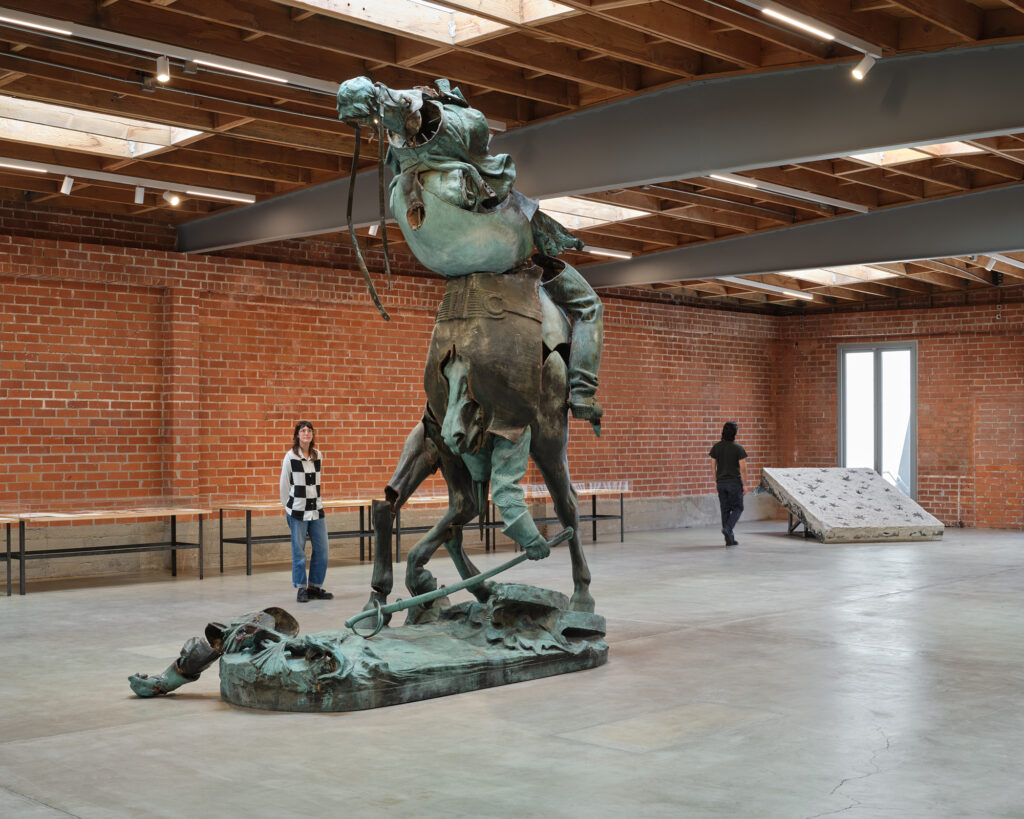
Projects to watch in 2026: Swords into Plowshares. When Charlottesville’s Lost Cause monuments to Robert E. Lee and Stonewall Jackson were finally taken down in 2021, the Lee statue’s path was followed closely by community members. Awarded to the Jefferson School African American Heritage Center, it was melted into bronze ingots in 2023. Less public was the fate of Jackson, given to The Brick in Los Angeles, which invited artist Kara Walker to transform it with no restrictions on its final form. Walker’s “Unmanned Drone” was unveiled at the end of October, accompanied by an expansive timeline in the L.A.-based museum detailing the work of Charlottesville organizers, activists, and community leaders advocating for its removal.
This unveiling previews what to expect in 2026—not another bronze statue necessarily but a powerful piece of contemporary, public art created from the raw material of the decommissioned Lee statue once intended to uphold white supremacy. Here in Charlottesville, Swords into Plowshares’ community-engaged, democratic process is set to culminate in concept designs by three semi-finalists selected from a competitive, national open call. The proposals from each of the semi-finalists to transform the bronze ingots will take into account over 500 individual responses to JSAAHC’s request for input from Charlottesville community members on the location and form of the new public work. In 2026, the Charlottesville community will have another chance to participate when invited to review the three semi-finalists’ designs on view at JSAAHC and online from March to May.
Coalitions to join in 2026: Charlottesville, Albemarle, and the surrounding counties have a robust arts and culture sector but lack a centralized, coordinated structure to support their creative communities. A collaborative, community-led effort is underway to explore the creation of a future arts council for the Charlottesville area—one that is equitable, accessible, and focused on making it possible for artists to live, work, and thrive here. This planning process will culminate in a proposal for new, centralized arts coordination in 2026.
Maureen Brondyke, Executive Director
New City Arts Initiative
LOCAL FOOD
South of the border
The broader global and big-city trend of Mexican, Latin, and South American food is gaining more traction here in Charlottesville, especially as a lot of the world’s best restaurants this year and the previous years have some sort of Hispanic or Hispanic American touch.
I am personally keeping my eye on a local popup called CAÑA (aka @sugarcanechronicles on Instagram) by my cousin Harvey Mayorga (one the three Guajiros brothers). From what I’ve seen, it’s tasting-menu style and, like Arepas, the restaurant, and now Noble Steakhouse, these eateries are further following Bebedero, Conmole, and Zocalo in the higher-check-average range and broadening the horizon of diners who are seeking higher-end Mexican/Central/and South American food. For a long time, a lot of the more casual offerings of Mexican and Latin food have been widely Americanized and undervalued in Charlottesville, and it’s amazing to see old and new restaurants working on new dishes and items that Charlottesville diners are excited for and see the value of. Taqueria El Comalito does an amazing job offering menu staples that folks know and love, while also doing more traditional shapes of masa that go beyond tacos. Chef Will at Zocalo has been taking more creative freedom with his menus, highlighting his roots from Mexico City that brings modernity, authenticity, and freshness.
Christina Martin, Owner
bakernobakery
UVA
Up and coming
The tension between University of Virginia faculty, staff, and students and the Trump administration, Board of Visitors, and the new UVA president will shape the university in 2026. The mess that was created by the Trump-Youngkin-Sheridan BOV led to a showdown between the governor-elect and the BOV around the issue of UVA’s presidential selection. The board decided to move ahead with a presidential selection prior to Governor-elect Abigail Spanberger’s reformulation of the out-of-compliance BOV, which may lead to instability and a lack of legitimacy for the university. The Trump administration could continue to come at UVA with its ideological agenda and extortion tactics. Unless challenged, the current agreement, which was signed with the DOJ by interim President Paul Mahoney, will continue to cast a pall of fear and undermining of academic freedom at UVA.
They will notice that we have a General Assembly that will make significant changes in the way the university is democratically run, such as an elected staff, student, and faculty representative to the BOV, and maybe those will be voting members; a general counsel that is independent of MAGA politics and appointed by the university not the attorney general; a BOV and administration that understand the true meaning of shared governance and faculty, staff, and student involvement in decision making.
Collective bargaining will advance through the legislature, and we will be a step closer to a university that is less elitist and in which faculty and staff have power to participate in governance.
Walt Heinecke, Associate Professor
School of Education and Human Development at the University of Virginia
HOMELESSNESS
Homes sweet homes
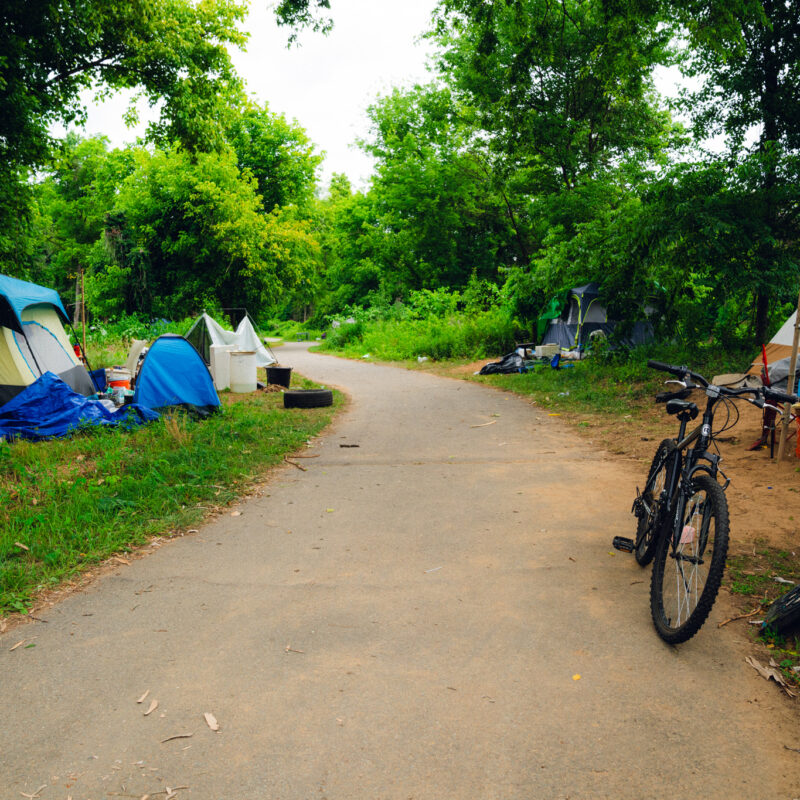
At the end of 2026, the Charlottesville area will have made some important gains toward addressing its housing affordability crisis, but will still be thousands of homes short of what is needed to be a community where housing is widely accessible.
The City of Charlottesville will move forward with its pro-housing priorities. Now that the city’s new zoning code can be fully activated, we should start seeing new housing (and housing types) envisioned by the Cville Plans Together Process being built. The city is also looking to update the zoning code, study the intersection of environmental regulations and housing development, and take a look at how homestay regulations fit with the city’s housing priorities. The continued revision of the zoning code and related policies reflects city leadership’s desire to ensure that its approach to housing is not just symbolic, but also substantially improving people’s lives.
In the area of homelessness, significant movement is finally underway. A timeline has not been established for the Holiday Drive homeless shelter, but in the coming months we should see progress toward its opening. Shelters are like the emergency room for people who are homeless—critical, short-term infrastructure for dealing with urgent challenges—not a permanent solution to a long-term problem. Housing is the ultimate solution to homelessness.
Premier Circle will provide some of that housing. It is set to open in late 2026 and will provide supportive housing to many community members experiencing homelessness. Premier Circle is a major step forward for the area, but will still not fully meet the need. The city and county need to begin collaborating on building additional supportive housing ASAP.
We will also see the next phases of the resident-led redevelopment of Kindlewood, South First Street, and Sixth Street, all of which will provide more badly needed income-restricted housing, an essential part of addressing the housing affordability crisis. Projects like 501 Cherry, MACAA, the Westhaven redevelopment, and Park Street Christian senior housing will continue to move forward.
Many are asking if 2026 is the year Albemarle County leadership finally gets serious about addressing their affordable housing crisis.
The county has started trending toward allowing more housing in the development area and completed the AC44 Comprehensive Plan rewrite in late 2025. But county leadership has accomplished very little in terms of reshaping its core housing and land-use policies to fit the community’s needs, instead relying on outlying counties to absorb housing demand, creating a de facto external development area. We are hopeful that the additions of Sally Duncan and Fred Missel to the Board of Supervisors will help move the county in the right direction.
Charlottesville is fortunate to have State Representatives Creigh Deeds and Katrina Callsen, who have supported good housing policies over the last few sessions. Abigail Spanberger focused her campaign on affordability issues and we hope to finally get substantive state-level policies to encourage the building and funding of a wide range of housing types throughout Virginia.
Matthew Gillikin, Co-chair
Livable Cville
DEVELOPMENT
In 2025, Charlottesville settled a lawsuit against a new zoning code intended to make it easier for developers to build new housing without getting permission from City Council. The city has hired the civil engineering and planning firm Line and Grade to conduct a transportation study the plaintiffs argued should have been done beforehand.
Only a handful of residential projects have been approved by staff in the city’s Department of Neighborhood Development Services, but one of the biggest development stories in 2026 will be whether Council decides to amend the rules to give it more power in some situations.
The Public Housing Association of Residents is leading a charge for Council to amend the rules again to curtail an 11-story building on West Main Street adjacent to Westhaven. The call is echoed by many in Fifeville who want to block or at least shrink a new apartment building on Seventh Street SW. If constructed, both projects would be marketed to students.
NDS is currently undertaking a minor update of the development code to fix small errors and provide technical clarity, but staff currently don’t anticipate major changes until 2027 or beyond.
At least one city councilor, Michael Payne, has expressed interest in making changes to address student housing, but the elected body opted to wait on a direction to staff until new Councilor Jen Fleisher was sworn in on January 1.
At the same time, the University of Virginia is moving forward with construction of a student housing complex on Ivy Road that will have 780 units. A second project is planned for Emmet Street at the site of the former University Gardens. Will that move forward in 2026? Hundreds of new units are under construction at places like the Verve and the Blume, while student enrollment at UVA is expected to remain steady.
In the past two years, NDS has approved two major development plans for large apartment complexes and both were for projects that sought to subsidize rental prices through low-income tax credits. One was for the third phase of Piedmont Housing Alliance’s redevelopment of Friendship Court into Kindlewood and that project was awarded credits.
The other approved plan is for a six-story building on 1000 Wertland St., one of three properties that UVA is willing to donate to build affordable units. While Council is providing funds for Kindlewood and other PHA projects, it declined to do so for a project being shepherded by an out-of-town developer. A state entity called Virginia Housing failed to award credits and a big question in 2026 is whether this project will proceed.
Sean Tubbs, Publisher
Town Crier Productions