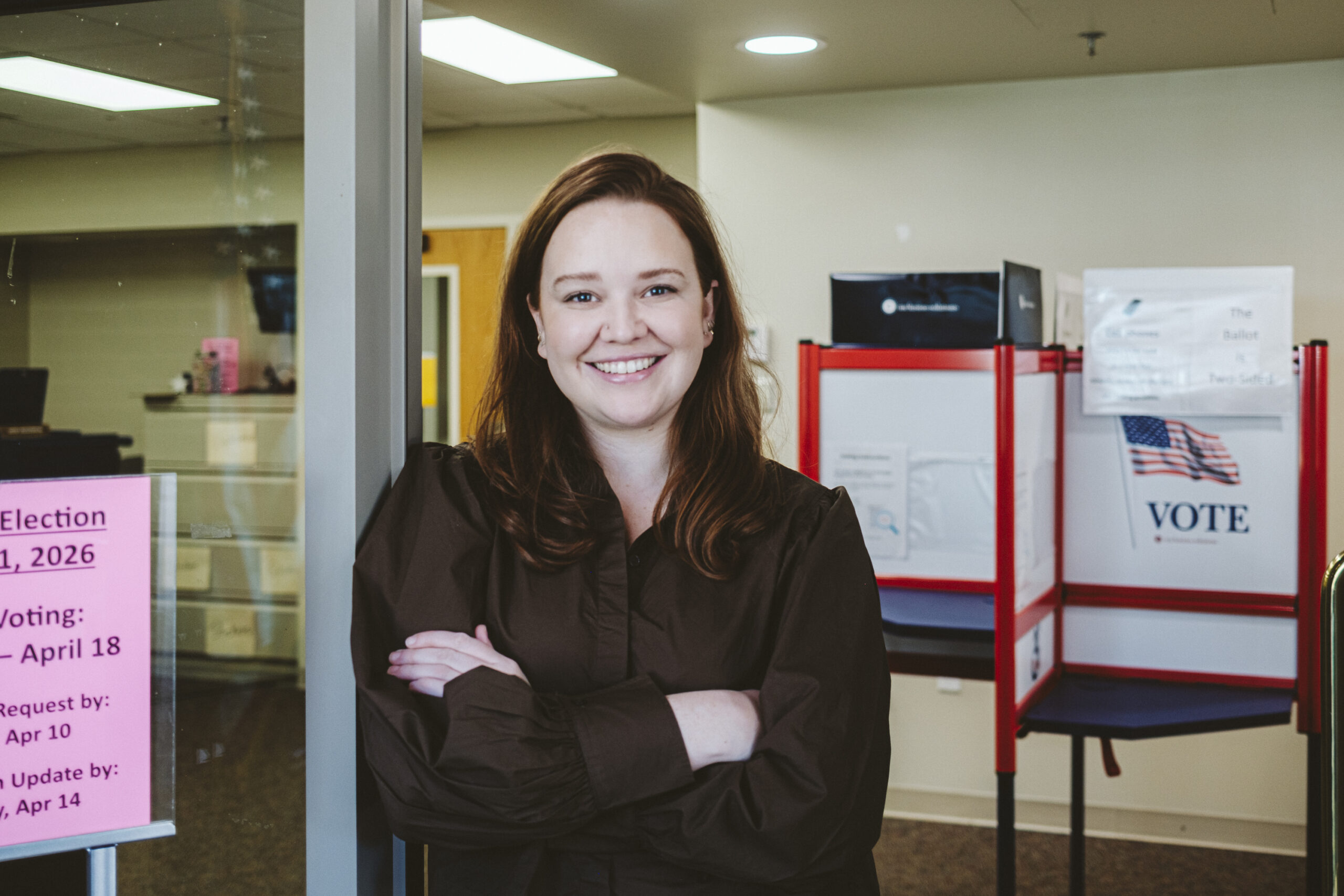
Election season has come early to Virginia, with voting now open for the April 21 referendum on the state’s proposed plan for mid-decade redistricting. Nationally, President Donald Trump and Republican leaders are pushing for what they call stricter election security measures as this fall’s midterm elections approach. Amid all the ballot-box buzz, how safe is voting here in Virginia? For all its complex details, the answer boils down to: Election officials aren’t stupid.
Charlottesville Registrar Taylor Yowell and Albemarle County Electoral Board Chair Bucky Walsh both described a gauntlet of redundant, common-sense safety measures designed to block any attempts at fraud long before they reach the final vote tallies.
Election security starts with registration. Either you’ve already presented documents providing your identity to the DMV, whose data election officials double-check when processing online applications, or you provide that proof yourself upon registering in person at your election office. That data includes sensitive details, like your Social Security number. “We’re going to make sure that that is not a Social Security number associated with any other person,” Yowell says. Election officials’ system flags any potential duplicates for further investigation.
When you register to vote in person, you’re mailed a registration letter at your home address, rather than receiving it immediately at the office. The address has to be a real, physical place; no P.O. boxes allowed. This further layer of security helps to prove that you live where you say you do. Absentee ballots can only be mailed to the address on your registration.
If you move, the Virginia Department of Elections checks with the post office for change-of-address and mail-forwarding forms. The Department of Health’s Office of Vital Records also updates death records weekly with election officials to make sure there’s no ballots cast by the deceased.
Once voting begins, officials track every voter and their status using secure tablets called “poll pads.” Their system knows, for instance, if you’ve requested an absentee ballot, but shown up to vote in person. If you do cast a ballot in person, it’ll make sure your absentee ballot isn’t tallied. In Albemarle and Charlottesville, secure drop boxes for completed absentee ballots are bolted to the ground, locked tight, emptied daily, and monitored on video 24/7. On Election Day, poll workers keep constant custody of any dropped-off absentee ballots.
At the end of each day of voting, Walsh says information gathered on poll pads is “harvested over a private network that is not connected to the internet. It’s taken back to a central machine, and then that machine is uploaded into the state’s voter registration system so that we have a record that this voter has already voted in this election.” Officials’ poll books are updated each morning with fresh information from the central database.
Virginia’s Election Day voting machines never connect to the internet, and officials keep paper ballots to check against electronic tallies. Before each election, officials and observers from both parties test every machine together, scanning sample ballots with different combinations of markings—correct or incorrect—to ensure the system records results correctly.
The machines are then wiped clean. Both the plug-in drives on which ballot data is stored, and the machines themselves, are physically marked with tamper-evident seals. Machines are securely stored in undisclosed locations under lock, key, and round-the-clock video surveillance.
Evidence of voter fraud in Virginia is scant at best. An online database from the right-wing Heritage Foundation lists only 36 documented incidents between 2007 and now, only two of which involved actual, failed attempts to cast a single fraudulent vote. Between 2007 and 2024, Department of Elections data recorded 50,775,323 votes cast in Virginia elections.
“I’ve been here since 2020,” says Yowell. “If I remember correctly, I think we’ve had one experience of someone that was attempting to [vote twice], but we, of course, caught them when they came on Election Day.” Yowell says the voter was elderly, possibly confused, and appeared to have made an honest mistake.
“There’s a real risk of you getting caught, and even if you get away with it, what have you succeeded in?” says Michael Gilbert, director of UVA’s Karsh Center for Law and Democracy, and an expert on election security and fraud. “You’ve gotten one, two, maybe three more votes for your favorite candidate, and that’s just extremely unlikely to make any difference in any election. So the costs and benefits don’t add up.”
“Although it’s always possible to improve some regulations and procedures here and there, I’m not aware of any proposed changes to our voting structures that would make our elections meaningfully safer than they already are,” Gilbert says. “And if we’re not very worried about fraud, which I think we should not be, anti-fraud measures that are going to layer on more requirements are very hard to justify.”
“I think we’re spot on,” says Walsh, asked whether officials could do even more to make elections safe. “I believe Virginia does this as well as, if not better than any other state in the country.”