
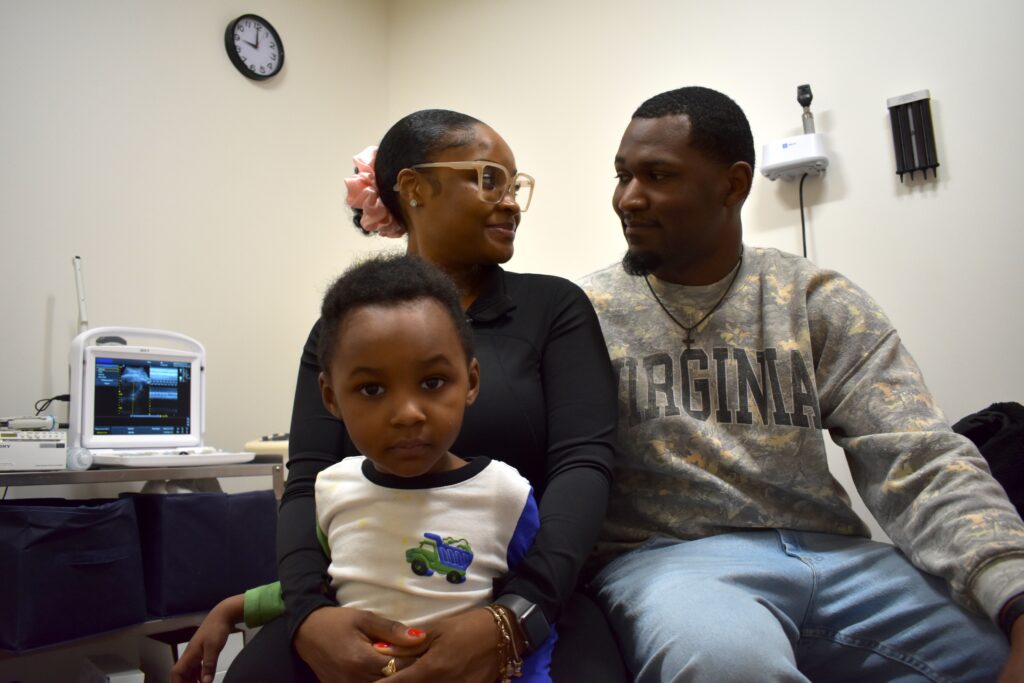
Chardae Johnson might have a little third-trimester brain fog, but she knows one thing for sure: She’s not taking Tylenol for her aches and pains like she did while pregnant with her firstborn.
“I’ve been steering clear of it just because I really don’t know what to believe,” says Johnson, 28. “Honestly, there’s a lot of information and a lot of it’s misinformation. So I haven’t taken it. That’s my stand. I don’t want to risk anything.”
She’s less resolute on what vaccines the new baby, due this month, will get.
“I can’t lie,” says Johnson, who lives in Louisa with her husband, Brennan, and their 3-year-old son, Bryson. “As an adult I’m okay getting vaccines, but I’m not sure about how I feel about babies getting vaccines. I know they’re saying that vaccines give children autism, so that’s what makes me a little scared . . . I do think that when they do the bulk vaccines at once, that’s a little bit too much for babies. I’m more interested in doing them a bit more spread out, especially if they think the vaccine is highly recommended.
“But, I don’t know,” Johnson sighs, rubbing the round of her belly. “It’s like a field of lostness. It’s too much information.”
‘Things we thought were a given’
It’s a brave new world for new and expectant parents who, amid shifting health guidelines on everything from Tylenol use during pregnancy to childhood vaccine schedules, are navigating a widening sea of options and opinions coming in from every direction.
Many are conflicted. While nearly two-thirds of Americans say they are “highly confident” that childhood vaccines effectively prevent serious illness, just over half think they’ve been adequately safety- and schedule-tested. Many follow their providers’ advice on what vaccination schedule to follow, but some, like Johnson, are mulling over a decision to space the full complement of shots out—or even eschew them altogether.
It’s why Denise Young, an obstetrician and gynecologist for more than 30 years, spends a lot more time explaining and defending well-established standards of care, such as the shot of vitamin K that newborns get that helps the blood clot, RhoGAM, administered to moms with Rh-negative blood, and the hepatitis B vaccine, which Young recommends in the first 24 hours but which growing numbers of parents are choosing to delay, after Trump officials said, without evidence, that the shots were linked to autism.
“Everybody’s got more questions about things we thought were a given, until recently,” says Young, who offers pre- and post-natal care each Thursday at the Central Virginia Health Services clinic in Louisa. “The misinformation that’s being spread leaves moms very unsure about what their options are, and what the real data is behind what we’re recommending.”
Hepatitis B’s a case in point. According to the Mayo Clinic, which “strongly recommends the vaccine for newborns,” the virus can spur dangerous liver infections that start when they’re passed from infected parents to their children during birth. In the U.S. alone, more than 1,800 people die of hepatitis B infections each year, a mortality rate that scientists say may be grossly undercounted.
Before 1991, when newborns were routinely inoculated against it, roughly 20,000 babies got hepatitis B infections each year. About half contracted the virus from their mother during birth while the other half got it through contact with household objects, like toothbrushes, razors, or combs used by an infected person. After the hepatitis B vaccine was integrated into the childhood vaccine schedule in the 1990s, the number of infected newborns declined by more than two-thirds in the first decade alone.
But today? Parents are suspicious, Young says, as they wade through a cacophony of health advice that has lately pitted established government agencies against professional health care associations.
That was the case in January when the Centers for Disease Control announced changes to its recommended vaccine schedule for infants and children, reducing the number of vaccines from 17 to 11. Three weeks later, the American Academy of Pediatrics released its own vaccine schedule, which calls for kids to be vaccinated against 18 diseases, including several that the CDC recommends be administered only to certain high-risk populations, including RSV, hepatitis A and B, rotavirus, and meningococcal disease.
The groups are also at odds about whether kids should receive flu and COVID-19 vaccines. Currently, the AAP recommends the shots for babies six months and older, while the CDC has maintained since January 2026 that the shots should be given only when physicians and parents decide together.
The changing federal guidelines give Young pause.
“It’s a kind of vilification of the systems, and the professionals within that system,” she says. “It’s really frustrating to work really hard to do the best care you can provide and have random comments by people undermine everything you do. And put moms’ health, and babies’ health, in jeopardy a lot.”
‘Hard-core quarantine’
Last December, Cass Girvin, 38, bookmarked Arizona’s measles tracker.
He and his wife, Carter, 36, were headed to Arizona for a marathon—she’s trying to qualify for the Olympic trials—and opted to bring their 4-month-old baby, Margot, along, leaving their 2-year-old twin sons behind with grandparents. They wanted to be careful, though, given that Margot was still too young to be inoculated against measles, which, in 2026, has been reported in 20 states, including Virginia.
After reassurances from their pediatrician, the Girvins strategized to minimize the risks. They got direct flights from Dulles International Airport, instead of from Charlottesville. They masked on the plane and Carter nursed Margot throughout the nearly five-hour flight with the hope that, “being confined against mom’s body would somewhat limit the deluge of random air particles.” Once in Phoenix, they hunkered down in their hotel room as much as possible, rather than venturing out to shops and restaurants as they normally might.
And they monitored a measles outbreak just 100 miles away.

“I was literally checking the measles page daily on the Arizona Department of Public Health, including on the day of our flight and on our flight back out,” says Girvin, a Western Albemarle High School teacher and coach. “It was in a really, really small town, and the numbers peaked, and then they went back down. It was unnerving: this horrible, horrible disease we’ve eradicated, and now we’ve un-eradicated it.”
Others, like Andrew Burgdorf, his wife, Megan McVey, and 3-week-old daughter, Josephine, aren’t leaving home and won’t yet accept visitors, a self-imposed isolation that’s bred some hurt and confusion among relatives.
“I have some more conservative extended family,” says Burgdorf, 39, a cybersecurity business analyst, “and I think some of them have been a little confused as to why we’re not having more people meet the baby, or taking her out more. Everyone’s been respectful of our perspectives, but, for me, I’m almost kind of avoiding the discussions.”
McVey’s more blunt.
“I’m very happy to say that we’re hard-core trying to keep her quarantined until she’s able to get more vaccines,” says McVey, 42, a user experience designer. “I don’t feel bad doing that. You have to do what makes you feel comfortable, both as a parent and as a couple. But it’s hard when you have other people saying, ‘What’s wrong with you?’”
In another month, once Josephine has had more of her shots (the family is following the American Academy of Pediatrics’ schedule, as recommended by their UVA Health doctors and nurses), the couple will introduce the baby, but only to visitors with updated COVID, flu, and Tdap (that’s the three-in-one tetanus, diphtheria, and pertussis, also known as whooping cough) vaccines.
“To each their own,” McVey says, “but, for us, it’s like, ‘What does science say? What do our health care professionals say? What does the peer-reviewed research say?’
“It’s confusing as hell,” McVey adds. “I don’t think we realized what it was like until you’re in it, so to also have layered in the confusion around the health piece, and the political environment right now, it’s really challenging. I have a lot of empathy, regardless of where you are on the spectrum, trying to keep your family safe, keep your own sanity, and make it through the fourth trimester. It’s a lot.”
‘Slowly, gently, work it into the agenda’
Getting “crunchy topics” like childhood shots out in the open, says special education teacher Jenny Ward, 34—in the third trimester of her third pregnancy—is key.
When Ward’s first pregnancy resulted in a miscarriage, the difficulty was magnified because she hadn’t told anyone she was pregnant, an experience that made her “a much bigger advocate for myself and other moms.”
It also sharpened her appetite for broaching difficult topics, especially with other moms.
“I like talking about these things that are uncomfortable, potentially, to friends who I know think differently than me,” says Ward, 34, whose 2 1/2-year-old son has gotten the full course of vaccines now endorsed by the American Academy of Pediatrics.
Her strategy? Start with common ground.
“I remember my husband’s skepticism, his saying, ‘Why did it push through so quickly?’” says Ward. “All of us are COVID-vaccinated now, but my husband initially had that pause. So, when we think about other vaccinations, I bring that up to be like an olive branch to be like, ‘I get it. I’ve been there. This was my husband’s pause, too.’”
Chatting about vaccine hesitancy is second nature to Child Health Partnership nurses like Teri Lamb, who’s part of a team that fans out across Albemarle, Fluvanna, and Louisa counties to do home visits with income-eligible families.
“In the past, the CDC recommendations always aligned with the American Academy of Pediatrics’ recommendations, and it was always something I could just fall back on,” says Lamb, a public health nurse for nearly 30 years. “Now, it’s like, ‘whoa. It’s changed our practice.’”
While she’s not getting a lot of questions, Lamb isn’t waiting for families to ask about vaccinations to talk them up. She brings pictures of people suffering from vaccine-preventable diseases to home visits, offers reassurance about vaccines’ efficacy and safety, and praises parents who tote kids to their well-child visits and vaccinate—but when they’re ready.
They’re in it, says Lamb, for the long haul, sticking with families through pregnancy and birth and up to kids’ 7th birthdays.
“Even if we have a strong opinion as providers—we know vaccines are awesome and we want our families to have them—we’re working with families long-term,” explains Becka Richman, the organization’s nursing supervisor. “We can come from a place of curiosity. ‘Tell me a little more about why you’re deciding not to vaccinate? What have you heard? What did your parents do with vaccines? What did your sister, who just had a baby, do about vaccines?’”
“I think it’s a time of a lot of confusion,” she adds. “When we have these moments in public health where there’s a lot of conflicting evidence, what it trickles down to is just people not knowing who they can trust.”
Compounding parental decision-making is the fact that some federal guidelines make sense to some, like Burgdorf: limiting sugar intake and removing dyes and additives from foods, for example, which was part of U.S. Health and Human Services Secretary Robert F. Kennedy Jr. and U.S. Department of Agriculture Secretary Brooke Rollins’ new dietary guidelines.
“There are these tidbits of crumbs of scientific data sprinkled into the new guidelines, but it just creates more confusion,” Burgdorf says. “‘Do I actually listen to that advice, or is that even less important because everything else is so politically motivated?’”
It’s hard to sort out. Jenna Warshall, 33—a middle school English teacher turned stay-at-home mom who delivered her second son earlier this month—calls it a battle of head versus heart.
“So even though I 100 percent trust doctors and science, I don’t necessarily trust things that seem to be politically motivated; it still just puts that nagging feeling in the back of your head,” says Warshall, who gets nightly migraines but won’t take Tylenol, even though she’s confident science says it’s safe. “We’re human. We can’t ignore that.”
“What makes me nervous is certain things being taken off the market or being delayed, like hepatitis B, which is being changed … We were very, very fortunate because our baby was born in August, which meant she got the previous recommendations. But some people will be in a different boat, and that’s unnerving.” Cass Girvin
“[With my first son], every recommendation they had, I was like, ‘Let’s just do it. Let’s just do it.’ But I’ve seen how the vaccines make the babies just a little sluggish, not like themselves, and thought that was a little strange … I definitely had to go back to the provider and ask, ‘Are they supposed to be this sluggish for three days?’” Chardae Johnson, of Louisa, due in April with her second child
“I think [federal officials] should have to be personally responsible for every child’s injury or death that occurs due to these things that they’re saying. I’m certainly responsible for things that I would be doing that would be ‘malpractice’; why shouldn’t they be?” Denise Young, MD, OBGYN at UVA Health and Central Virginia Health Services
“The Tylenol talk has died down, but other things have replaced it … It’s good to talk about these things in real life, to make sure the sources that you’re getting your information from aren’t from one side or the other, and you can see the whole picture.” Jenny Ward, of Charlottesville, a special education preschool teacher, due in April with her second son
“When I met families that weren’t vaccinated, I slowly, gently, tried to work it into my agenda … I’m telling my families, praising them, ‘You are doing the right thing by vaccinating your child, getting them to that well-child visit’ … even before they’ve mentioned anything. With vaccinations, it’s ’I know it’s so hard to see them cry, but you’re absolutely doing the right thing.’” Teri Lamb, a Child Health Partnership home visiting nurse in Louisa and Fluvanna counties
“It’s really disappointing that there’s so much out there that can put doubt into our minds, especially when we’re at our most vulnerable, and at our most hormonal.” Jenna Warshall, of Charlottesville, a middle school teacher and stay-at-home mom, who delivered her second son in early April
“We have all of these healthcare workers that were heroes during the COVID pandemic, and now the political lens has changed, they’re going against federal guidelines, and the stakes are being drawn in a different way. My heart goes out to them. … The pandemic, the health insurance complications, and rising costs, and then, now, this new political battleground that’s not science-based. They’re really getting thrashed around … and it’s made it an even tougher profession again, after everything they’ve been through.” Andrew Burgdorf, of Charlottesville, a cybersecurity analyst and father to 8-week-old Josephine, born in mid-January
“A couple of times I’ve had families ask me, ‘Oh, I heard on the news that Tylenol causes autism,’ so I’ve done teaching around that a couple of times. … I explained from my training what I know to be valid, and I’m pretty straightforward. ‘Actually, this is what we know about Tylenol. And it’s safe.’” Emily Koester, of Charlottesville, a Child Health Partnership home visiting nurse